

Iran’s stockpile of enriched uranium has once again seized global attention after former U.S. President Donald Trump asserted that Tehran had agreed to surrender it as part of a deal to end the war.
However, on Monday (20/04), Iranian Deputy Foreign Minister Saeed Khatibzadeh swiftly refuted this claim. Speaking to the AP news agency, he emphatically stated that such a notion was “unacceptable from the outset.”
As both parties continue to negotiate a path towards further peace talks, the future of this critical material is poised to be a central topic of discussion.
But what exactly is enriched uranium—and why does it hold such profound importance on the world stage?
What is Enriched Uranium?
Uranium is a naturally occurring element found within the Earth’s crust. It is predominantly composed of two primary isotopes: U-238 and U-235.
Over 99% of natural uranium consists of U-238, an isotope that does not readily sustain a nuclear chain reaction. In stark contrast, only about 0.7% is U-235, the crucial isotope that can be easily split to release immense energy through a process known as nuclear fission.
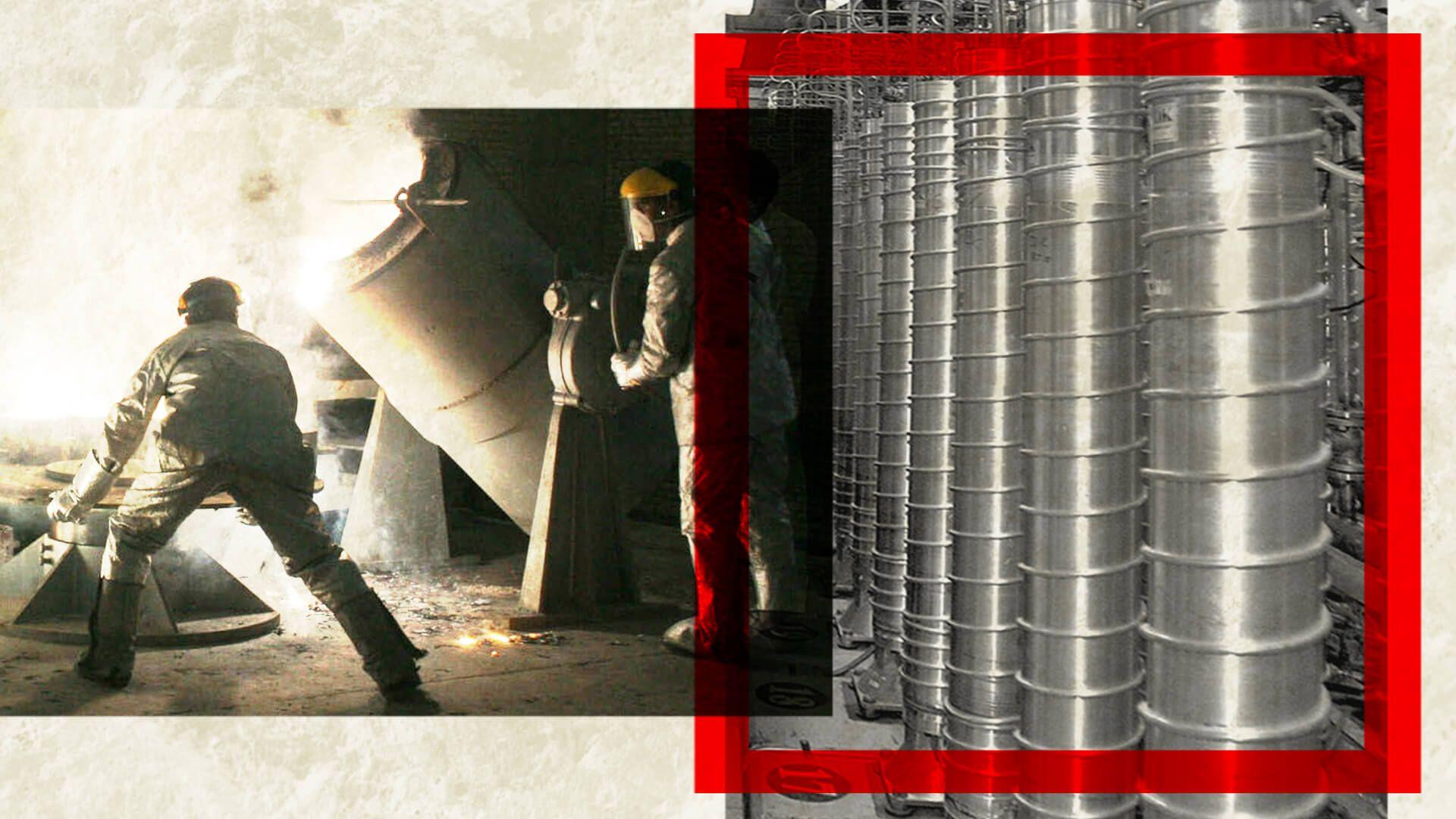
For uranium to be useful in applications ranging from power generation to potential weaponry, the proportion of U-235 must be significantly increased through a sophisticated process called uranium enrichment. This begins by converting uranium into a gaseous form, which is then fed into centrifuges—advanced devices that spin at incredibly high speeds.

As these centrifuges spin, the heavier U-238 isotopes are flung slightly outward, while the lighter, more desirable U-235 isotopes remain closer to the center. This differential movement allows for the gradual separation of the rarer and highly useful U-235 from the more common U-238.
The increasingly concentrated, or enriched uranium, is then meticulously siphoned out from one end of the centrifuge, ready for further processing or use.
What Differentiates Uranium for Nuclear Reactors from Nuclear Weapons?
The varying degrees of uranium enrichment dictate its suitability for diverse applications. Low-enriched uranium, typically containing 3%–5% U-235, serves as fuel for commercial nuclear power plants. This concentration is sufficient to sustain a controlled chain reaction for energy generation, yet it remains significantly below the threshold required for nuclear weapons.
Higher enrichment levels, specifically 20% or more, are utilized in research reactors. However, weapons-grade uranium is typically enriched to approximately 90% U-235. At such extreme concentrations, conditions are ripe for a virtually instantaneous, uncontrolled nuclear reaction, forming the destructive core of an atomic bomb.
- How does Iran’s nuclear program stand, and what threats might it pose?
- The U.S. attacked three Iranian nuclear facilities, what were the impacts and how will Iran retaliate?
- Where are Iran’s nuclear facilities located and which ones were attacked by Israel?
When a critical mass of this highly enriched material is brought together, atoms begin to split exponentially fast, unleashing an enormous amount of energy in mere fractions of a second. This fundamental distinction marks the divide between the civilian and military applications of uranium.
In a nuclear reactor, the fuel is only lightly enriched, and the chain reaction is deliberately slowed and meticulously controlled. This allows energy to be released gradually over months or even years for electricity generation. Conversely, the explicit purpose of uranium for a bomb is precisely the opposite: to allow the reaction to proceed instantaneously and unleash all its energy in a single, devastating burst.

Under the landmark 2015 agreement with six world powers—China, France, Germany, Russia, the United States, and the United Kingdom—Iran was restricted to enriching uranium only up to 3.67% U-235. The deal also imposed a maximum stockpile limit of 300 kilograms, capped the number of centrifuges it could operate, and explicitly prohibited enrichment activities at its underground Fordo facility.
However, in May 2018, during Donald Trump’s first term, the United States controversially withdrew from this pivotal agreement, significantly altering the trajectory of Iran’s nuclear program.
Why is the Enrichment Level So Critical?
The higher the level of uranium enrichment, the closer the material is to being usable in nuclear weapons. Reaching a purity of 20% U-235 is considered a critical milestone because a substantial portion of the technical effort required to produce weapons-grade material has already been accomplished by that point.
Transforming natural uranium into 20% enriched material necessitates thousands of repetitive separation steps, consuming immense amounts of time and energy. Conversely, further enriching uranium from 20% to approximately 90% requires significantly fewer additional steps and comparatively less effort.
This means that uranium already enriched to higher levels can be further refined into weapons-grade material relatively quickly, significantly reducing the breakout time for potential proliferation.
How Much Enriched Uranium Does Iran Possess?
At the core of the ongoing negotiations lies the crucial question of what to do with Iran’s existing stockpiles of enriched uranium. According to senior U.S. officials, at the onset of the conflict, Iran held approximately 440 kilograms of 60%-enriched uranium. This quantity of material could be further enriched to the 90% threshold required for weapons-grade uranium relatively swiftly.
Beyond this, Iran also possesses around 1,000 kilograms of 20%-enriched uranium, alongside a larger reserve of 8,500 kilograms enriched to approximately 3.6%—levels typically employed for civilian applications such as power generation or medical research.
Much of the high-enriched uranium, with its potential for conversion into nuclear weapons material, is believed to be stored at Isfahan. This facility was notably one of three underground nuclear sites in Iran targeted by a joint US-Israeli airstrike last year.

However, the exact amount of high-enriched uranium stored at other undisclosed locations remains unclear, adding a layer of complexity to the ongoing diplomatic efforts.
Sources indicate that Tehran has rejected demands for a 20-year moratorium on nuclear enrichment, instead proposing a five-year pause—a similar offer previously tabled before the conflict escalated. Furthermore, Iran has firmly refused demands to relinquish its 440-kilogram stockpile of high-enriched uranium, adhering instead to its initial concession to dilute the 60%-enriched material.
Is Iran Actively Building a Nuclear Weapon?
Iran steadfastly maintains that its nuclear facilities are exclusively for peaceful purposes, a claim supported by the International Atomic Energy Agency (IAEA), which has stated it has not found evidence of an active nuclear weapons program. However, producing weapons-grade uranium is merely one critical step in constructing a functional nuclear weapon. A fully operational bomb also demands intricate additional work, including the sophisticated design and assembly of a warhead, alongside the development of a reliable delivery system.
Patricia Lewis, an independent arms control expert, notes, “Iran did develop capabilities in warhead design up until 2003, when that program appears to have been halted.” She cautions, however, that “following the collapse of the 2015 nuclear deal and the continued failure of talks towards a new agreement, there is a possibility that Iran could decide to resume developing warhead capabilities.”
A May 2025 assessment by the U.S. Defense Intelligence Agency indicated that Iran could produce enough weapons-grade uranium for one device in “possibly less than one week.” Yet, the report also affirmed that Iran is “almost certainly not actively producing nuclear weapons,” even though it has taken steps that could position it to do so should it choose.
Adding to the international concern, Israel asserts it possesses intelligence suggesting Iran has made “real progress” in developing crucial components for nuclear weapons.
Additional reporting by Nadia Suleman and edited by Mark Shea
- How does Iran’s nuclear program stand, and what threats might it pose?
- Who is Mordechai Vanunu, who exposed Israel’s nuclear program?
- The ‘secret operation’ of 20 years to eliminate Iran’s top nuclear scientists
Summary
Iran’s enriched uranium stockpile has become a central point in global discussions, especially after a refuted claim by former U.S. President Donald Trump regarding its surrender, which Iran denied. Enriched uranium is a critical material where the fissionable U-235 isotope is concentrated, making it suitable for nuclear energy or potentially weapons. This concentration process, involving sophisticated centrifuges, separates the rarer U-235 from the more common U-238.
The degree of enrichment dictates its application; low levels (3-5%) are typically for power reactors, while weapons-grade material requires approximately 90% U-235. Iran currently possesses significant quantities of 60%- and 20%-enriched uranium, which could be further refined to weapons-grade relatively quickly, especially since the U.S. withdrew from the 2015 nuclear deal. Although Iran maintains its program is peaceful, and the IAEA hasn’t found evidence of an active weapons program, these high enrichment levels significantly reduce the time required for potential weaponization.
