
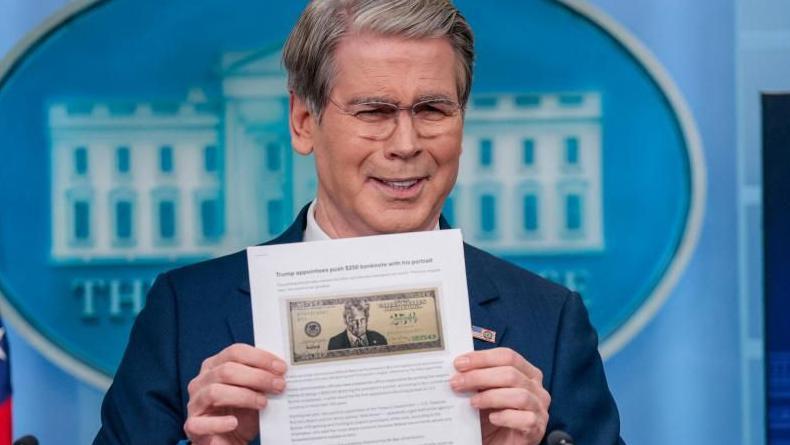

The United States government is reportedly preparing to print a US$250 banknote featuring a portrait of President Donald Trump, should lawmakers greenlight the controversial move.
Current federal law strictly prohibits the printing of US currency with the likeness of any living person. However, key allies of President Trump in Congress have introduced new legislation, aiming to bypass this longstanding regulation and pave the way for the unique denomination.
A spokesperson for the Treasury Department informed the BBC that the agency is “undertaking appropriate planning and due diligence” in anticipation of the proposed bill. This proactive stance signals a serious consideration of the legislative initiative, despite the conventional barriers.
Proponents of the bill in Congress argue that the US$250 denomination would serve as a fitting symbol to commemorate the nation’s 250th anniversary, which falls this year. If enacted, this measure would mark the latest instance of President Trump and his allies working to emblazon his face, name, and image upon national institutions and cherished symbols, continuing a pattern of personalizing governmental facets. Previously, Trump’s signature was slated to appear on US currency as part of the country’s quarter-millennium celebration.
What will the US$250 banknote look like?
While no artistic concept for the proposed US$250 banknote has been unveiled to the public, the Bureau of Engraving and Printing (BEP), a sub-agency of the Treasury Department responsible for developing and producing US currency, has already commenced requests for design work. The Washington Post was the first to break the news about these preliminary Treasury plans.
A Treasury Department spokesperson confirmed, “If this legislative mandate is signed into law, the BEP is moving proactively to produce a commemorative $250 note that will appropriately acknowledge our great nation’s 250th anniversary.” This statement underscores the department’s readiness to act swiftly if the legal framework changes.
The legislation specifically mandating the creation of a US$250 banknote was initially introduced last year by US Representative Joe Wilson, a Republican representing South Carolina. For this bill to become law, it requires approval from both the US House of Representatives and the Senate, facing a significant legislative hurdle.
When questioned about the potential new banknote, Treasury Secretary Scott Bessent stated that the matter was “entirely in the hands” of Congress. He affirmed that the Treasury Department would adhere to the law should the legislation be passed. Bessent further added that he did not “see anything inappropriate” about featuring the image of a sitting official on a commemorative note marking the nation’s 250th anniversary, indicating a degree of openness to the concept.
Beyond the primary federal law prohibiting living individuals on currency, the move to create a US$250 banknote could also conflict with other existing federal laws that specifically define the denominations authorized for production. These laws currently do not include a US$250 denomination, posing an additional legal obstacle.
Currently, the US$100 bill, featuring Benjamin Franklin, one of America’s Founding Fathers, represents the largest denomination actively printed. Historically, the United States has issued banknotes of even greater value, including US$500, US$1,000, and US$10,000 bills, though their production was discontinued in 1969. While these larger denominations remain legal tender, they are no longer in circulation and are predominantly held by currency collectors.
The development of new currency typically spans several years, involving a complex collaborative process among various agencies, including the Federal Reserve Board and the US Secret Service. Crucially, the designs for new banknotes are kept under wraps throughout much of this process.
“Banknote designs are typically published six to eight months in advance for global public education and cash handler education purposes,” according to the BEP. “Releasing designs earlier would assist counterfeiters and cause confusion in the marketplace, thereby decreasing confidence in US currency.” Given these intricate procedures and the need for secrecy, it remains unclear whether a US$250 banknote could realistically be printed and issued in time for the nation’s 250th anniversary on July 4th.
How did US politicians react?
The proposal to release a US$250 bill has already drawn sharp criticism from political figures, including US Senator Mark Warner, a prominent member of the Senate Banking Committee. Senator Warner, a Democrat from Virginia, voiced his strong disapproval in a statement, highlighting the economic struggles faced by American citizens.
“When Americans are struggling to afford rising gas, groceries, housing, and healthcare costs, President Trump’s priorities for taxpayer funds are completely out of touch with the challenges families face every day,” Warner asserted. He added, “If this White House put at least half the energy into lowering costs as it does fueling the president’s ego, American families wouldn’t need a new $250 bill just to fill up their gas tanks,” casting the proposal as a misallocation of resources and a reflection of the president’s self-interest.
This initiative aligns with a broader trend observed since President Trump took office last year, wherein he has actively sought to associate his likeness, name, and image with public buildings and national symbols across the United States. Notable examples include the renaming of the Kennedy Center to incorporate Trump’s name, the planned inclusion of his portrait on US passports, and the ongoing repainting of the presidential aircraft, Air Force One, in colors personally selected by Trump.
Summary
The United States government is reportedly considering printing a US$250 banknote featuring President Donald Trump, pending congressional approval. This move would require new legislation to bypass federal law that prohibits living persons on currency and to authorize the new denomination. Proponents argue it would commemorate the nation’s 250th anniversary, reflecting a broader trend of Trump personalizing national institutions.
The Treasury Department is undertaking planning for the potential bill, though no design concept has been unveiled, and new currency development typically takes several years. The proposal has drawn criticism from politicians like Senator Mark Warner, who deemed it out of touch with economic struggles and an ego-driven initiative. Treasury Secretary Scott Bessent, however, stated that the department would adhere to law if passed and saw nothing inappropriate about a commemorative note.
