
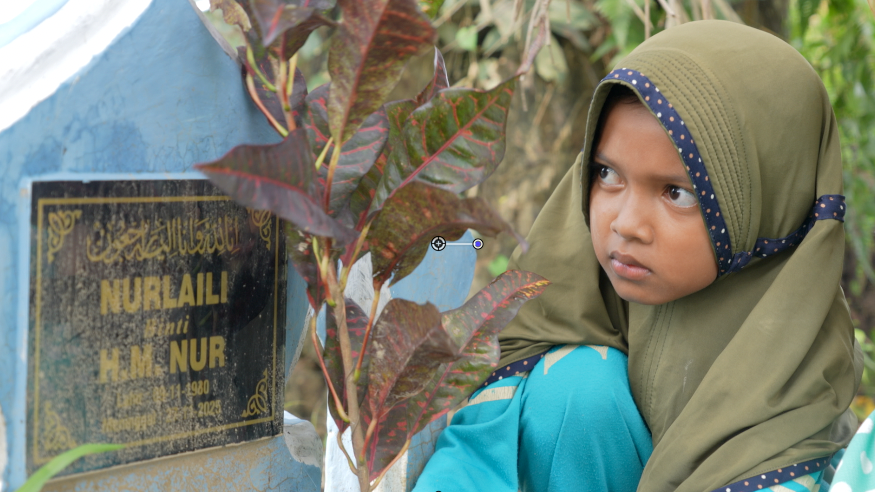

In the heart of North Aceh, a young girl steadfastly refuses to succumb to the crushing weight of trauma and profound loss, six months after devastating floods and landslides claimed her mother, elder brother, and grandmother.
Sausan Sania, a tenacious fourth-grade elementary student, navigates each day with unwavering resolve. Her journey of healing and resilience manifests in various ways: visiting the graves of her loved ones, selling toys for pocket money, sharing laughter with friends, and diligently pursuing her dream of becoming a policewoman.
This article marks the second installment in a special report series by BBC News Indonesia, chronicling the valiant struggles of vulnerable groups, particularly female survivors, half a year after the Sumatra disaster.
Note: BBC News Indonesia has obtained permission from Sausan Sania’s father and school to conduct interviews and document her activities.
“You [my friend] are so lucky to have a mother, to be accompanied by her, to have her cook for you, to be held by her, to walk with her, to be hugged by her.”
“I don’t have a mother anymore,” expressed 10-year-old Sausan Sania, her words echoing the deep void left by her loss. This poignant observation was shared with a peer whom Sausan saw spending time with her mother, a stark reminder of what she no longer possessed.
Sausan’s mother, Nurlaila; her eldest brother, Muhammad Zunnur; and her grandmother, Aman Husna, tragically perished in the Sumatra floods that swept through the region in late November last year. Today, Sausan lives with her father, T. Zaman Huri, her other brother, and her younger sister. Beyond Sausan’s immediate family, the catastrophe claimed over 1,200 lives across Aceh, North Sumatra, and West Sumatra, leaving an indelible scar on the region.

Around 10:00 AM on Friday, May 8th, the lively cacophony of children’s voices resonated from State Elementary School (SDN) 6 Tanah Jambo Aye in North Aceh. Just six months prior, this vibrant schoolyard had been eerily silent, submerged and half-buried by the floodwaters. A vehicle was parked outside, delivering hundreds of free nutritious meal packages (MBG), a signature program championed by President Prabowo Subianto. Amidst the cheerful throng of students, Sausan could be seen engrossed in play with her friends in the schoolyard, a testament to enduring childhood spirit even as parts of the ground remained waterlogged and caked in flood mud.

A radiant smile and genuine laughter graced Sausan’s face, momentarily obscuring any visible trace of the trauma and profound loss she carries. Sausan and dozens of her fellow pupils wore new school uniforms, generously provided by the government just two weeks prior. For footwear, however, some students still made do with sandals. As the bell signaled the start of class, Sausan and her friends entered their fourth-grade classroom. The room, devoid of chairs and desks, presented an immediate challenge to traditional learning.

Undeterred, Sausan and her classmates settled on the floor, attentively listening as their teacher explained a mathematics lesson. Moments later, a shy smile touched Sausan’s lips when the teacher invited her to the front. With remarkable courage, she walked to the blackboard and confidently wrote down the answer to the math problem. This budding confidence stood in stark contrast to her demeanor immediately after the disaster.
You might be interested in:
- Six months after the Sumatra disaster: The plight of a mother raising her baby in temporary shelter in Aceh – ‘No breast milk, ruined farm, only empty promises of aid’
- The stories of children orphaned by the Sumatra calamity: What is the state’s responsibility?
- Toddlers and children in Aceh Tamiang subsist on instant noodles for weeks, what are the health impacts?
Before her present smiles and resilience emerged, Sausan often displayed a quiet sorrow, as recounted by Lili Andasna, the head of SDN 6 Tanah Jambo Aye. “Sausan was frequently lost in thought and sad when she first returned to school after the disaster,” Lili shared, highlighting the initial struggles of the young survivor.

Sausan’s sadness was not an isolated incident; the majority of the 400 students at the school grappled with similar emotions, Lili added. “Over 90% of our students were affected by the floods. We made every effort to comfort Sausan and the other children. I told them, ‘No, dear, we must be ready, we must be strong. This is a trial from Allah’,” Lili explained, detailing their approach to emotional support. Slowly, Lili observed, the profound sadness that had gripped Sausan and her classmates began to fade. The children gradually rediscovered their joy, laughing, playing together, and re-engaging effectively with their lessons. “They were especially happy when the government provided new uniforms,” Lili noted, acknowledging the positive impact of such support. “I always tell the teachers that we must not despair; we must rise quickly and reorganize our school so that the children can regain their enthusiasm for learning.”

After the school day concluded, Sausan made her way home, a journey of approximately one kilometer from her school. Upon her arrival, she proudly presented a Yasin and Tahlil book, containing cherished photographs. “This is Mama and my brother. Isn’t my mama beautiful?” she said, her voice filled with longing and pride. Overwhelmed by a sense of yearning, Sausan quickly changed her clothes and then invited her father, Zaman Huri, to visit the graves of her mother, brother, and grandmother. The family gravesite was located just about 400 meters from their home. Accompanied by her father and siblings, Sausan held hands with them as they walked towards the sacred ground.

Upon reaching the graves, Sausan diligently pulled out weeds, gently caressed the headstones, and offered her prayers. Over the past six months, Sausan has frequently urged her father and siblings to visit the graves, finding a unique way to confront her trauma, grief, and loss. “When I remember and miss Mama, my brother, and Nenek, I ask Bapak to go on a pilgrimage. At the grave, I tell them stories and pray for them, hoping they are peaceful and happy in heaven,” Sausan shared during the interview, with her father, Zaman Huri, by her side.
Back home, Sausan then meticulously arranged a variety of children’s toys she had purchased online. These toys, however, were not for her own amusement but for resale to friends in her neighborhood. “I buy them for Rp1,000 and sell them for Rp2,000. It’s enough money for snacks,” Sausan admitted with a bashful smile, revealing her entrepreneurial spirit.

Still with a touch of shyness, Sausan revealed that her ultimate aspiration was not to be a businesswoman, but a policewoman (polwan). Dressed in a security uniform, Sausan dreams of bringing immense pride and happiness to her parents. “Especially for Mama, so she can be proud of me from heaven,” she articulated with conviction. Sausan recounted one final moment of pure joy she shared with her mother, brother, and grandmother, a memory that stands out among a million other beautiful recollections they shared. This precious moment unfolded just two days before the catastrophic disaster.
“My whole family, Mama, Nenek, and my brother, had dinner together. We ate grilled fish. That was the last time we went out and laughed together,” she recalled, her voice tinged with nostalgia.

Moreover, she vividly remembered her mother’s last words before the relentless floodwaters separated them forever. “Before the flood, and before we left the house, around eight in the evening, Mama said, ‘Eat first, dear, in case the water rises tonight and floods. That way we will have eaten.’ Those were Mama’s words,” Sausan recounted, her eyes distant. Beneath these cherished memories, however, lay the harrowing trauma Sausan and her family endured when the disaster struck.
The World’s Apocalypse
Sitting beside Sausan, her father Zaman Huri recounted the terrifying genesis of the disaster: the pre-dawn hours of Thursday, November 27, 2025. For several days prior, incessant rain had pounded their region without pause. Zaman’s eldest son, Muhammad Zunnur, frantically pounded on his bedroom door. “It was around 1:30 [AM]. He said the water had already risen, entering the house. We were shocked, panicked, because we had never experienced a flood in our lives. I quickly rushed to wake the others,” Zaman recalled, the memory still fresh and painful.

He and his entire family then made a desperate escape from their home. Outside, the water had already reached knee-height. Zaman instinctively held Sausan and his youngest child close. Meanwhile, his mother-in-law, wife, and two other sons clasped hands, battling against the powerful current of the floodwaters. They had only managed to move swiftly for about 200 meters when the surging water violently swept them away. “All I had in my hands were Sausan and the youngest. Everyone else was separated,” Zaman recounted, his voice filled with the raw emotion of that moment. The three of them were eventually stranded at a prayer hall. “While at the hall, Sausan said, ‘Mommy is no longer with us. We must pray a lot, we must read Yasin for Mommy every Friday night’,” Zaman whispered softly, remembering his daughter’s profound words.
Their reprieve lasted only about 10 minutes before they were again dragged by the current. Zaman found himself separated from Sausan, now clinging only to his youngest child. He then managed to grasp a small tree. However, he lost his grip and eventually found himself leaning against a sturdy palm tree. “From that palm tree, I slowly climbed higher and higher. I stayed there for two days and two nights with this little one, without food or water,” he recounted, describing their arduous survival. “On the second day, the little one said, ‘Father, I’m hungry, Father, I’m thirsty,’ but he didn’t cry,” he added, marveling at his child’s resilience. Zaman shared that during his time atop the palm tree, his mind was utterly blank, seeing only an expanse of emptiness. “Everything looked like an ocean. Only a miracle could save us. I had already started thinking about the possibility of death.” Indeed, Zaman described his condition at that time as akin to the world’s end. “In Acehnese terms, it was like the world’s apocalypse, like being in the afterlife, the last night of this world,” he mused, the horror still palpable.

Slowly, the floodwaters began to recede, bringing a glimmer of hope. Zaman and his child were eventually evacuated by a group of compassionate young men. That same evening, Zaman received the news that his two other children, Sausan and his son Afkar, had survived the ordeal. “Sausan was rescued on top of a banana tree, and Afkar [the son] on a coconut tree,” he shared, describing the extraordinary circumstances of their survival. Zaman and his three children were finally reunited and sought refuge together. “When I met them, I felt happy, but also profoundly sad. Allah still allowed two of my children to survive, but there was no news of the others yet,” he expressed, torn between relief and continued grief. Later that night, Zaman gently asked Sausan how she managed to end up on the banana tree. “Her memory might be 50:50. She said she felt like someone was carrying her, three people from inside the water. But she doesn’t know who. By morning, she was already stranded on the banana tree,” Zaman recounted, relaying his daughter’s hazy recollection.

With her father’s consent, Sausan bravely recounted her experience during the flood. “When I was carried by the current, I was still conscious. I remembered my mother, father, my two brothers, my younger sister, and my grandmother. I thought I might not be in this world anymore, because I was already under the floodwaters,” Sausan recalled, her voice steady. However, she suddenly found herself clutching a piece of wood for support. “And I felt like someone was carrying me onto a banana tree. After that, I don’t remember anything else.”
On the fourth day after the disaster, Zaman received the heartbreaking news that his wife’s body had been found in a neighboring village. His mother-in-law was discovered on the fifth day, and the remains of his eldest son were found on the seventeenth day, in a rice field area. “It felt utterly devastating to hear my family members died one by one. Everything happened so incredibly fast,” Zaman lamented, the pain evident in his voice. “On Wednesday, we were still joking, laughing, and picking up my mother-in-law. By Thursday night, this tragedy had struck, and I lost everyone,” he said, reflecting on the abruptness of their loss.

Amidst the overwhelming grief and enduring trauma, Zaman admitted he had to find inner strength to navigate these trials, all for the sake of his three surviving children. He particularly noted Sausan’s profound sadness and withdrawal for two months following the disaster. “Sometimes she would isolate herself, often lost in thought, unwilling to play with her friends, just staying at home. Not just her; even I, when alone in my room, often felt sad, wondering why this happened,” Zaman confessed softly, revealing his own struggle. Furthermore, Zaman added, Sausan did not attend school during those initial two months. However, slowly but surely, Sausan regained her cheerful disposition. “Perhaps it was from her friends, the encouragement of her teachers, and from her efforts selling things,” Zaman speculated, observing her gradual recovery.

Six months have passed, and while still enveloped in sadness, Zaman now faces the immense challenge of working and rebuilding his family’s life. He must now fulfill the dual roles of both father and mother. On one hand, Zaman urgently needs to earn money. On the other, there is no one to care for and look after his children if he leaves the house, while the family’s basic needs remain pressing. “I hope there will be an economic recovery for us soon, provision for us. So that all of this can quickly pass,” he expressed, his voice filled with hope. Meanwhile, as our meeting drew to a close, Sausan voiced her own earnest desire: for her school to be promptly repaired and fully equipped, so she could learn in a normal environment. “And please, pray for my mama, brother, and grandmother, so they may rest peacefully in heaven,” Sausan concluded, her hopeful request a testament to her enduring spirit.
‘Father, Mother, Please Rebuild Our School’

Approximately 100 kilometers from Sausan’s school, dozens of children from SDN 5 Peusangan Siblah Krueng are currently learning inside a makeshift white emergency tent in Bireuen Regency, Aceh. At the entrance to this tent, erected by the Ministry of Education, Culture, Research, and Technology (Kemendikdasmen), numerous student sandals lay scattered. Behind the tent, the two original school buildings—situated just a few hundred meters from the river—are largely buried under earth and debris. A section of the green school roof is visibly damaged and holed. Six months on, wild grass and reeds flourish over the drying mud inside the school rooms, a poignant reminder of the disaster’s lasting impact.

On that cloudy Monday, May 11th, some students were engrossed in a lesson about the importance of love and unity for the Republic of Indonesia. In a different corner of the tent, other students were diligently studying various subjects. The hum of several rotating fans did not disrupt the concentration of the students, who sat attentively on carpets, each with a small folding table in front of them, seriously absorbing their lessons. Irnawati, a government-contracted (PPPK) teacher who has been teaching at the elementary school since 2023, stated that a total of 40 students were learning in the tent. After her class, Irnawati shared that six months post-disaster, nothing had changed. “It’s like this, you can see for yourselves, nothing has changed. We have been in this tent for five months. We share the difficulties and joys with the children. We endure the heat, the floods, the lack of books, learning materials, and crowded conditions—we are all in this together,” Irnawati expressed, her voice laced with resignation.

Irnawati lamented that all learning equipment—from books, stationery, desks, chairs, student documents, to teachers’ laptops—was utterly destroyed, consumed by the floodwaters. The word “pasrah” (resignation or acceptance) perfectly encapsulates the current state of her school. “After that, we just pray to Allah, hoping for a miracle to come,” she said, reflecting a deep-seated hope. Despite their yearning for a miracle, Irnawati and her fellow teachers refuse to surrender. They employ various methods to ensure their students can continue learning, one strategy being to divide the students into several groups. “We group them. First grade at this end, second grade there, and other grades accordingly. We continue to teach them with whatever facilities we have,” Irnawati explained, tears welling in her eyes.
One of the many things that deeply saddens her is when her students ask: “Mr./Ms. Teacher, when will we have a school again? Teacher, when will we get a new school?” To these heartbreaking questions, she responded, “We teachers can only tell them to be patient and offer encouragement.” She added, “Moreover, when the children have exams, we have to borrow space elsewhere, and we even have to pay for that, Sir.”

Irnawati had previously heard that the elementary school where she teaches was slated for reconstruction by the end of April. However, she noted, there has been no visible progress to date. “The teachers’ hope is for a proper place, Sir. If a new school is indeed to be built, then it should be done quickly. Our children can no longer endure sitting in tents, Sir.” Echoing this sentiment, dozens of students also pleaded for their school to be repaired. “Father, Mother, please rebuild our school,” they collectively appealed. In addition to this school, reports indicate that approximately 220 elementary and junior high school students in Beutong Ateuh Banggalang District, Nagan Raya, Aceh, are still learning in emergency tents under similarly limited conditions.

The Head of the Aceh Education Department, Murthalamuddin, acknowledged that students are indeed still learning in emergency tents. “There are still limited books, and some are still under tents. But Kemendikdasmen has already come down and invited us to re-list. We are creating 31 RKD [emergency classrooms] to replace the tents because the tents are too hot. Children cannot learn for long periods,” Murthalamuddin stated, outlining the challenges. However, he cautioned that it would take approximately another year for students’ learning activities in Aceh to return to “somewhat normal.” “Especially since many learning facilities, books, practical tools, and everything else were destroyed. So, it indeed requires time. We hope for special attention from the central government because amidst these widespread shortages, without government assistance, it will be difficult,” he emphasized. Currently, he added, the Aceh Provincial Government’s efforts include allocating a budget for 40,000 sets of school uniforms, shoes, and bags.

Kemendikdasmen has confirmed that hundreds of schools are still forced to conduct learning activities by utilizing emergency classrooms, temporary tents, or borrowing facilities from nearby schools. In Aceh, out of 3,120 affected schools, data from Kemendikdasmen as of May 2026 shows that 36 schools are still learning in tents, 34 are using emergency classrooms, and four schools are borrowing facilities. Overall, Kemendikdasmen recorded a total of 4,922 schools impacted by the Sumatra disaster last year. This disruption affected educational services for approximately 707,161 students and the teaching activities of 59,620 teachers and educational staff. Nevertheless, by mid-May 2026, Kemendikdasmen claimed that 4,820 schools had fully resumed their learning processes. Furthermore, the government has implemented a school physical revitalization program, reaching a total of Rp2.9 trillion and targeting over 3,084 schools. This includes 2,085 educational units in Aceh, 332 schools in West Sumatra, and 667 schools in North Sumatra.
“All of this assistance aims to support the continuity of educational services so that teaching and learning activities can continue amidst the post-disaster recovery process,” stated the Minister of Education, Culture, Research, and Technology, Abdul Mu’ti, in his official statement. Kemendikdasmen also provided assistance valued at Rp2 million per person per month for three consecutive months to 53,215 teachers and educational staff.
- Ahead of Ramadan, flood victims’ homes in Aceh still buried in mud – ‘I’m slowly rising on my own, without government help’
- Over 165,000 Sumatra flood victims still in displacement camps, temporary housing insufficient
- ‘Our dreams and hopes have been washed away with the flood’ – New Year 2026 through the eyes of Sumatra flood-landslide survivors
- The specter of referendum and armed conflict behind flood management in Aceh
- ‘If there’s no rice field, what can we eat?’ – The fate of farmers two months after the Sumatra disaster, thousands of hectares of rice fields still a sea of mud
- Government files Rp4.8 trillion lawsuit and revokes company permits related to Sumatra disaster, will it be effective?
- The plight of North Tapanuli durian farmers surviving after floods-landslides – ‘Residents could be trapped in new poverty’
- ‘God will arrange with all simplicity’ – How floods and landslides will change Christmas celebrations in a small Sumatra village?
Summary
Sausan Sania, a 10-year
