
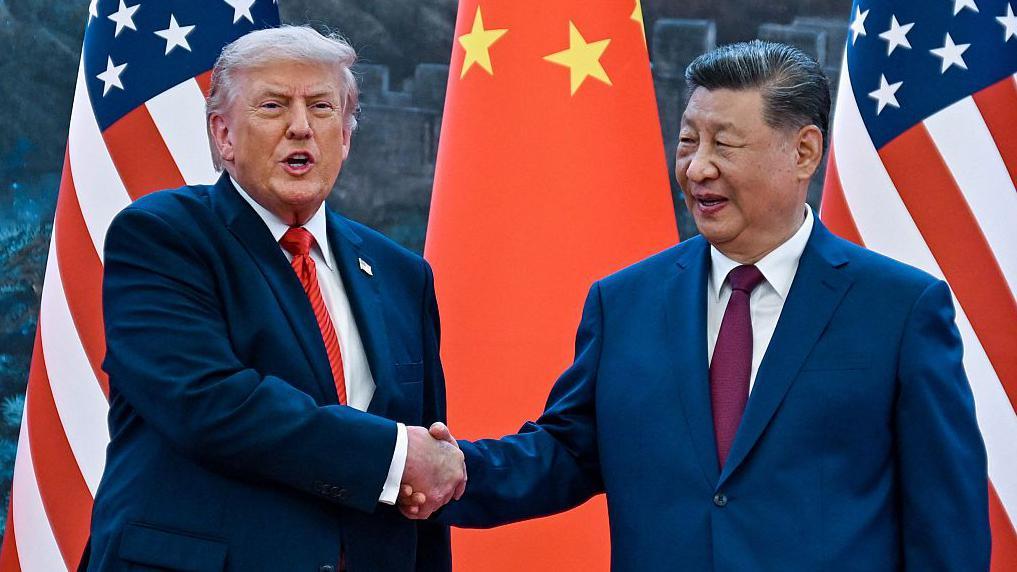

Chinese President Xi Jinping has called for China and the United States to act as “partners, not rivals,” ahead of a high-stakes summit with U.S. President Donald Trump in Beijing this Thursday, May 14.
Responding to these overtures, President Trump lauded Xi as a “great leader” and expressed optimism that the relationship between the two superpowers would become “better than ever before.” The meeting is expected to address several contentious issues, including trade tariffs, technological competition, the conflict in Iran, and the status of Taiwan.
The visit began with a formal reception outside the Great Hall of the People, where the two leaders walked the red carpet and reviewed military honor guards, greeted by cheering children. Notably, Trump is accompanied by a delegation of prominent technology executives, including Tesla’s Elon Musk and Nvidia’s Jensen Huang. Prior to his arrival, Trump signaled his intention to press China to further open its markets to American industries.
For Trump, who last visited China in 2017, the trip marks a return to a nation that has grown increasingly assertive and stable on the global stage. The leaders are set to attend a formal state banquet on Thursday evening, following a visit that was originally scheduled for March but delayed due to the ongoing Iran crisis.
A Global Crossroads
In his opening remarks, President Xi emphasized the gravity of the meeting, stating that the “whole world is watching.” He described the current international landscape as volatile, driven by shifts unseen in over a century.
“The world has arrived at a new crossroads. Can China and the U.S. avoid the Thucydides trap and create a new paradigm for their relationship? Can we work together to meet global challenges and bring more stability to the world?” Xi questioned. “These are the questions of our time that you and I must answer as leaders of great nations.”
Xi also offered congratulations to the United States on its 250th anniversary of independence. He reiterated his belief that the two nations share more common interests than differences, asserting that “China and the U.S. will both benefit from cooperation and suffer from confrontation.” He concluded by calling for a new era of coexistence, aiming to make 2026 a milestone year that opens a fresh chapter in bilateral relations.
A Diplomatic Rapport
President Trump echoed a spirit of collaboration, telling Xi it was an “honor” to meet him. “It is an honor to be your friend,” Trump remarked. The U.S. president highlighted the strength of his delegation, noting that he had brought “the best business leaders in the world” to pay their respects to the Chinese leadership. Describing the summit as potentially the “greatest meeting ever,” Trump expressed high expectations for the upcoming negotiations.

The Taiwan Factor
Analysts anticipate that Taiwan will remain a focal point of the discussions. Beijing may use the summit to exert pressure on Washington to halt arms sales to the self-governed island. Julian Gewirtz, a former senior director for China and Taiwan affairs at the U.S. National Security Council, expressed concern that the pressure could lead to concessions from the U.S. side.
While the United States adheres to a “One China” policy, it maintains robust unofficial ties with Taiwan and holds a legal obligation to provide the island with the means to defend itself. Gewirtz noted that Trump’s perspective on Taiwan differs from his predecessors, citing the president’s previous complaints regarding Taiwan’s dominance in the semiconductor industry and its geographical proximity to the Chinese mainland.
This article will be updated periodically.
- Five strategic cards for China in the trade war with the U.S.
- Are Trump’s new tariffs on Asia a direct attack on China?
- China remains undeterred by tariff threats: How will the trade war unfold?
- Trump–Xi summit: Shaping the future of superpower relations for years to come
- Why has the relationship between Trump and Xi Jinping grown strained?
- Understanding the roots of the U.S.–China trade conflict and its potential aftermath
Summary
President Xi Jinping and President Donald Trump have convened in Beijing to discuss critical bilateral issues, with both leaders expressing a desire for a cooperative relationship rather than rivalry. The summit aims to address major points of contention, including trade tariffs, technological competition, the conflict in Iran, and the complex status of Taiwan. President Trump, accompanied by a delegation of top technology executives, is expected to advocate for greater market access for American industries.
During the meeting, President Xi emphasized the global significance of U.S.-China relations, urging for a new paradigm of coexistence to ensure international stability. While the leaders displayed diplomatic rapport, analysts remain focused on the Taiwan issue, noting potential pressure from Beijing regarding U.S. arms sales. The discussions are seen as a pivotal moment that could significantly influence the future trajectory of global geopolitical and economic stability.
