
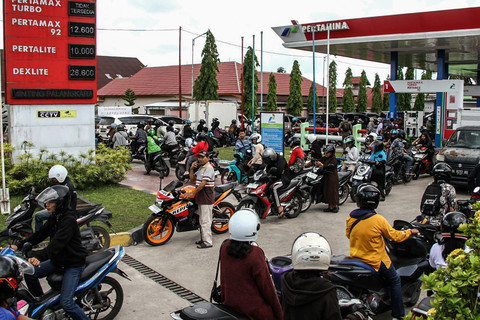
The weakening of the rupiah’s exchange rate against the US dollar is projected to significantly inflate the nation’s energy subsidy burden. Experts anticipate this cost could surge by 15-20 percent above the approximately IDR 210 trillion ceiling allocated in the 2026 State Budget (APBN).
According to Iwa Garniwa, an Energy Observer from the University of Indonesia (UI), a substantial depreciation of the rupiah, potentially reaching IDR 17,500 per US dollar, would directly escalate the energy subsidy load.
He elaborates that this increase is primarily driven by two factors. Firstly, Indonesia’s energy subsidies operate under a cost-recovery scheme, where the government covers the difference between the economic price and the government-mandated retail selling price.
The economic price itself is determined by summing the Mean of Platts Singapore (MOPS) price, distribution costs, taxes, and company margins. Crucially, the largest components influencing the MOPS price are global oil prices, denominated in US dollars, and the rupiah’s exchange rate against the US dollar.
Iwa emphasized to kumparan on Thursday (May 14) that the impact is both significant and immediate. “At an exchange rate of IDR 17,500, the 2026 energy subsidy burden could be 15-20 percent higher than the APBN ceiling if subsidized fuel prices remain unchanged,” he stated.
Iwa further elucidated that a weaker rupiah makes crude oil and fuel imports more expensive. Additionally, the cost of importing Liquefied Petroleum Gas (LPG) would rise, given that 70 percent of Indonesia’s LPG demand is met through imports. Furthermore, the US dollar-denominated debts and interest payments of state-owned enterprises PLN and Pertamina would also swell considerably.
According to government calculations and PT Pertamina’s assumptions, every IDR 1,000 depreciation in the rupiah’s exchange rate translates to an approximate annual increase of IDR 12-15 trillion in subsidy and compensation burdens.
He provided an illustrative example: if the Indonesian Crude Price (ICP) stands at USD 75 per barrel and the exchange rate reaches IDR 17,500, the economic price of subsidized diesel (Solar) could hit IDR 14,000 per liter. With the subsidized selling price fixed at IDR 6,800 per liter, the government would then bear a significant difference of IDR 7,200 per liter.
Beyond these direct effects, Iwa also pointed to significant indirect impacts. He explained that the US dollar-denominated generation costs for state electricity company PT PLN could inflate, consequently driving up electricity production expenses.
Iwa elaborated, “Approximately 40 percent of PLN’s generation costs are in USD. A weaker rupiah therefore increases electricity costs, but subsidized tariffs are held constant. As a result, compensation paid to PLN escalates.”
Meanwhile, Energy Economy Observer from Padjadjaran University (Unpad), Yayan Satyakti, offered further insights. Referencing MOPS prices for the period of March 25 – April 24, 2026, he estimated the economic price of Pertamax (RON 92) to reach IDR 17,080 per liter, and Pertalite (RON 90) to hit IDR 16,968 per liter.
These economic prices, he noted, are significantly higher than the current retail prices maintained by PT Pertamina, which are IDR 12,300 per liter for Pertamax and IDR 10,000 per liter for Pertalite, respectively.
Yayan explained that the total daily compensation burden for these two fuel types is projected to reach IDR 653.6 billion, or approximately IDR 238.6 trillion annually. This figure vastly exceeds the 2024 State Financial Report (LKPP) baseline of IDR 133.7 trillion, primarily driven by surging global oil prices.
Yayan also contended that maintaining the price of Pertamax is a prudent measure to prevent energy subsidies from escalating further due to shifts in public consumption. He calculated the estimated cross-price elasticity between Pertalite and Pertamax to be in the range of 0.30–0.55.
Furthermore, using the Nash–MCMC–OLS calculation method, he projected that the cumulative annual subsidy burden resulting from a two-month closure of the Strait of Hormuz, which would trigger a surge in crude oil prices, could reach an staggering IDR 170–210 trillion.
Yayan concluded, “This scenario would necessitate an additional fiscal reserve of approximately IDR 20–25 trillion above the baseline, predominantly during the slow recovery phase (Phase 2, Days 61–180), rather than the peak crisis phase.”
Summary
The depreciation of the Indonesian Rupiah against the US dollar is expected to significantly increase the national energy subsidy burden, potentially by 15-20 percent above the IDR 210 trillion allocated for 2026. Energy Observer Iwa Garniwa explained that a weaker rupiah, possibly reaching IDR 17,500 per dollar, directly inflates energy costs as global oil prices are USD-denominated and Indonesia relies on a cost-recovery subsidy scheme. This situation makes crude oil, fuel, and LPG imports more expensive and also escalates the USD-denominated debts of state enterprises like PLN and Pertamina. He noted that every IDR 1,000 rupiah depreciation adds approximately IDR 12-15 trillion to the annual subsidy and compensation burdens.
Economist Yayan Satyakti underscored that current economic prices for Pertamax and Pertalite are considerably higher than retail prices, projecting an annual compensation burden of IDR 238.6 trillion, far surpassing the 2024 baseline. Indirectly, approximately 40 percent of PLN’s generation costs are in USD, meaning a weaker rupiah increases electricity production expenses and thus compensation payments. Yayan also suggested that maintaining Pertamax prices is crucial to prevent further subsidy escalation, and a major event like a Strait of Hormuz closure could necessitate an additional IDR 20-25 trillion in fiscal reserves.
