
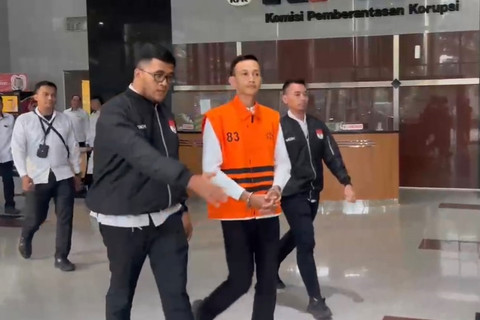
The Corruption Eradication Commission (KPK) has apprehended Marjani, an aide to former Riau Governor Abdul Wahid, officially designating him a suspect in an alleged extortion case. This crucial development builds upon the earlier designation of three other individuals already implicated in the ongoing investigation.
The individuals previously implicated by the KPK in this case include:
* Abdul Wahid, the former Governor of Riau;
* M Arief Setiawan, Head of Riau’s Public Works, Spatial Planning, Housing, Settlement Areas, and Land Office (PUPR PKPP); and
* Dani M Nursalam, Expert Staff to the Governor of Riau.
Marjani‘s formal detention transpired immediately after he underwent questioning as a suspect. He was prominently observed donning the KPK‘s signature orange detainee vest before being escorted into a waiting detention vehicle.
During a press conference held on Monday, April 13, Achmad Taufik Husein, the Acting Director of Investigation for the KPK, formally declared, “We have designated one person as a suspect, namely Mr. MJN, serving as ADC or Aide to the former Governor of Riau, Mr. AW.” Taufik further elaborated that this suspect designation was the culmination of a rigorous series of investigative actions, which included extensive searches and witness examinations.
Outlining the specifics of the detention, Taufik affirmed that “the suspect will be held for an initial period of 20 days, commencing from April 13 and concluding on May 2, 2026. The detention will take place at the State Detention Center (Rutan) of the KPK‘s ACLC (C1) Building branch.”
In a notable counterpoint to the official proceedings, Marjani vehemently denied any personal involvement in the alleged extortion scheme, asserting that his identity was merely exploited. “There is none, I was just used, my name was used,” Marjani declared as he was led away to the detention vehicle.
Marjani’s Role
The intricate narrative of the case commences in May 2025, when a pivotal meeting transpired at a café in Pekanbaru City. Attendees included Ferry Yunanda, Secretary of the PUPR PKPP, along with six Heads of UPT Regions I-VI within the PUPR PKPP office. The central agenda of this discreet gathering was to deliberate on the provision of a “fee” amounting to 2.5 percent, specifically earmarked for Abdul Wahid.
This proposed illicit fee was directly contingent upon a significant budget augmentation for 2025, allocated to the UPT Roads and Bridges Regions I-VI of the PUPR PKPP. The budget experienced a substantial increase, soaring from an initial IDR 71.6 billion to an impressive IDR 177.4 billion.
Following this initial deliberation, Ferry promptly conveyed the outcome to Arief. However, Arief, explicitly acting as Abdul Wahid‘s representative, subsequently escalated the demand, insisting on a larger fee of 5 percent, which amounted to IDR 7 billion. The ramifications of non-compliance were explicitly severe, as Taufik disclosed: “Those who did not obey this order were threatened with dismissal or transfer from their positions. Among the employees of Riau’s PUPRPKPP, this demand became notoriously known as the ‘thug’s share’.”
Consequently, all UPT Heads of the PUPRPKPP Regions, alongside the Secretary of the Riau PUPRPKPP, reconvened. During this subsequent critical meeting, they ultimately acceded to the heightened demand, consenting to provide Abdul Wahid with the stipulated 5 percent fee. The clandestine results of this crucial meeting were then cryptically conveyed to the Head of the Riau PUPR PKPP using the coded phrase ‘7 batang’ (7 rods).
Stemming from this illicit agreement, at least three distinct deposits, constituting Abdul Wahid‘s illicit “share,” were subsequently made: in June 2025, during August-October 2025, and finally in November 2025. It is within these specific transactions that Marjani is alleged to have played a pivotal role, serving as the direct intermediary for the transfer of these ill-gotten funds.
For his alleged complicity, Marjani now faces severe charges under Article 12 letter e and/or Article 12 letter f and/or Article 12B of the Anti-Corruption Law, in conjunction with Article 55 paragraph 1 section 1 of the Criminal Code.
