
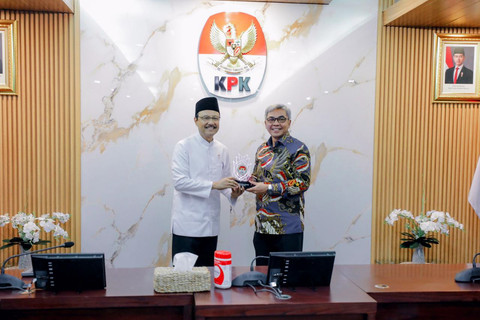

Minister of Social Affairs Saifullah Yusuf, popularly known as Gus Ipul, has proposed delegating the procurement of goods and services for the Sekolah Rakyat (People’s School) program to external agencies or institutions with greater specialized capacity. This strategic move comes as the Ministry of Social Affairs continues to address internal limitations regarding human resources in its procurement department.
To initiate this process, Gus Ipul held a formal consultation with the leadership of the Corruption Eradication Commission (KPK) at their headquarters in South Jakarta on Friday, May 8, 2026. During the meeting, he sought legal and ethical guidance to ensure the program’s implementation remains beyond reproach.
“We are once again seeking advice. If permitted, we would like to temporarily outsource procurement to other agencies via procurement agents while we work on strengthening our internal human resources at the Ministry,” Gus Ipul stated. He emphasized that the ministry’s priority is to ensure the process is handled by parties with superior experience and expertise to guarantee transparency and eliminate the risk of irregularities.

“The responsibility would be entrusted to ministries that possess the proven capacity to manage high-level procurement,” Gus Ipul added. This consultation serves as a critical moment for the Ministry of Social Affairs to evaluate its current systems. Gus Ipul candidly acknowledged that according to the National Public Procurement Agency (LKPP), the ministry’s procurement governance still requires significant improvement.
“As of today, LKPP records place us at 167th out of more than 600 institutions and agencies involved in the procurement of goods and services,” he revealed. He underscored that consulting with the KPK is a precautionary measure to safeguard one of President Prabowo Subianto’s flagship programs aimed at national poverty alleviation.
The Sekolah Rakyat program is a vital component of the broader national strategy to combat poverty, as mandated by Presidential Instruction No. 8 of 2025. Gus Ipul described the program as a “miniature model for poverty eradication” that takes a holistic approach to family welfare.
“The children attend school, the parents are empowered, and their homes are renovated to be more habitable. The parents will receive comprehensive social assistance and become members of the Kopdes Merah Putih cooperative. As part of this empowerment, once the children graduate and the parents improve their economic status, they will become independent families who no longer rely on social aid,” Gus Ipul explained.
Given the high stakes, the Ministry is committed to ensuring every stage of procurement is clean and accountable. “We are open to being audited and having every process scrutinized, particularly those from 2025. Since we are currently in the 2026 procurement cycle, this is the perfect momentum for us to receive feedback and criticism as part of our evaluation,” he said.

During the session, the KPK identified several high-risk areas for corruption in procurement, ranging from gratifications and bribes to potential conflicts of interest. Gus Ipul assured that these warnings have been taken seriously. “We have noted everything. There must be no kickbacks, gratifications, or bribery. These issues have been our focus from the very beginning,” he clarified.
Furthermore, Gus Ipul addressed the provision of school uniforms and shoes for students, noting that it is a form of state support to honor and assist children from underprivileged families. He explained that since these families live in dormitories and lack the means to purchase such items, the government must step in to facilitate the learning process as per the President’s policy.
He confirmed that students for Sekolah Rakyat are selected from the poorest families listed in Deciles 1 and 2 of the National Socio-Economic Single Data (DTSEN). “There is no registration process. Instead, we use an outreach approach,” Gus Ipul said. Potential students are identified directly by social workers and local social services based on DTSEN data, followed by field verification before being officially designated as beneficiaries by regional heads.
KPK Chairperson Setyo Budiyanto hailed the meeting as a proactive step toward strengthening corruption prevention. “We have discussed many things and provided insights into the necessary anticipatory measures. This is a vital first step, which will be followed by technical sessions,” Setyo said.
He noted that further coordination between the KPK team and the Ministry’s technical staff would ensure that specific issues are addressed in detail. Setyo emphasized that while the KPK has the power of enforcement, the focus should remain on education and prevention. “The KPK operates on three pillars: education, prevention, and enforcement. We hope that enforcement is not the primary outcome; rather, prevention and education must be prioritized to ensure government programs run smoothly and without deviation.”
The consultation took place from 10:00 to 11:00 AM WIB at the Nusantara Meeting Room in the KPK’s Merah Putih building. The forum was attended by Setyo Budiyanto along with Vice-Chairpersons Ibnu Basuki Widodo, Johanis Tanak, and Agus Joko Pramono, as well as senior KPK officials including Secretary General Cahya H. Harefa and various department directors.
Gus Ipul was accompanied by a high-level delegation from the Ministry of Social Affairs, including Vice Minister Agus Jabo Priyono, Secretary General Robben Rico, and several Directors General and inspectors, highlighting the ministry’s serious commitment to reform and transparency.

Summary
Minister of Social Affairs, Saifullah Yusuf (Gus I
