
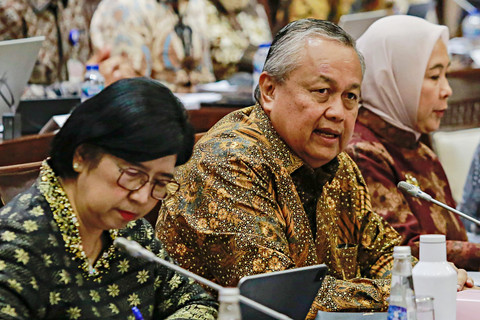
Bank Indonesia (BI) Governor Perry Warjiyo expresses strong optimism regarding the Rupiah’s future trajectory, forecasting a significant strengthening against the US dollar starting from July-August 2026. Perry acknowledged that the Rupiah is currently in an undervalued state, primarily due to heightened demand for foreign exchange.
On Monday, May 18th, at 09:00 AM Western Indonesia Time (WIB), the Rupiah traded at Rp 17,630 against the US dollar, experiencing a slight weakening of 33.00 points, or 0.19 percent. This dip, however, is considered temporary by the central bank.
“We observe a clear seasonality in April, May, and June, when demand for foreign currency typically peaks. However, we anticipate a rebound and strengthening in July and August, keeping our overall outlook positive,” Perry stated during a BI working meeting with House Commission XI at the Parliament Building in Central Jakarta on Monday, May 18th.
He further elaborated that the current elevated demand for foreign currency stems from both technical and seasonal factors. Among the prominent seasonal factors Perry highlighted is the significant foreign exchange requirement for Hajj pilgrims.
Specifically, Perry pointed out that “April, May, and June witness substantial demand for foreign exchange due to various factors, including the Hajj pilgrimage, dividend payments, and debt settlements. These are key seasonal drivers.”
Despite the Rupiah’s present conditions, Perry maintains confidence that the currency’s performance aligns with the 2026 state budget’s macro assumptions. These fundamental assumptions project a full-year average exchange rate of Rp 16,500 per US dollar.
“We remain convinced that the average exchange rate for the entire year 2026 will be Rp 16,500 per US dollar, within a projected range of Rp 16,200 to Rp 16,800. Our conviction is supported by the year-to-date average, which stands at Rp 16,900,” Perry affirmed, underscoring BI’s commitment to currency stability.
To navigate the current market dynamics and support the Rupiah, BI had previously unveiled a comprehensive seven-step strategy. These measures range from direct foreign exchange market interventions to enhanced monitoring of US dollar purchases.
Concerning foreign exchange market intervention, Perry detailed that BI will engage in both domestic and offshore markets. This will be executed through various instruments, including spot transactions, Domestic Non-Deliverable Forwards (DNDF), and offshore NDFs in major global financial hubs such as Hong Kong, Singapore, London, and New York.
The second key measure involves strengthening foreign capital inflows, primarily facilitated through the issuance of BI Rupiah Securities (SRBI). This initiative aims to offset any capital outflows from the State Securities (SBN) and stock markets. Furthermore, BI will continue its proactive purchases in the secondary market, which have already reached Rp 123.1 trillion on a year-to-date basis.
The fourth strategic step focuses on maintaining ample banking liquidity. This approach is evidenced by a robust 14.1 percent growth in primary money, ensuring sufficient funds within the financial system.
Additionally, a crucial measure involves tightening controls on foreign exchange purchases that lack underlying transactions. The dollar purchase limit, which was previously set at USD 100,000, has been reduced to USD 50,000 per person per month and is slated for further reduction to USD 25,000.
BI is also actively promoting the broader use of local currencies. This includes fostering the development of a yuan-rupiah market, a move designed to reduce the nation’s reliance on the US dollar for international transactions.
The sixth measure entails fortifying intervention in the offshore NDF market by actively involving domestic banks, thereby enhancing liquidity supply. Finally, BI, in collaboration with the Financial Services Authority (OJK), will intensify its supervision of banks and corporations identified with high dollar purchase activities, ensuring market integrity and stability.
Summary
Bank Indonesia (BI) Governor, Perry Warj
