
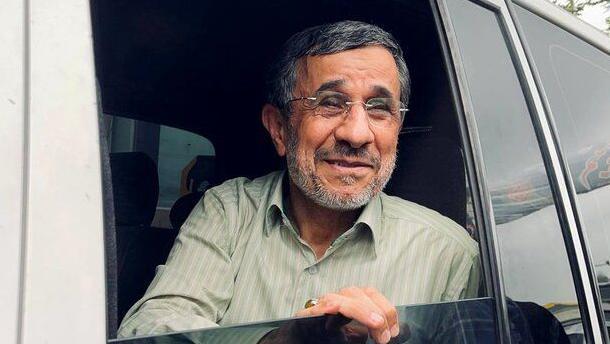

“You need to know that this hated regime [Israel] is on a path to destruction. By God’s will, this regime will collapse, and no factor can save it. This regime has reached the end of its journey and will soon be wiped off the geographical map.”
For many years, statements such as this cemented former Iranian President Mahmoud Ahmadinejad’s reputation as one of the world’s most prominent anti-Israel figures. His presidency was marked by provocative rhetoric, including denying the Holocaust, likening Israel to a “cancer cell,” and steadfastly defending Iran’s nuclear program despite international sanctions. These stances often led Israeli officials to cite him when underscoring their belief that Iran posed a tangible threat.
Ahmadinejad has recently resurfaced in the global spotlight following a New York Times report detailing alleged “post-war planning” by the United States and Israel that purportedly involved him. This controversial plan reportedly considered the option of Ahmadinejad breaking away from Iran’s existing security structure and emerging as a potential future leader of the nation.
However, according to the New York Times account, this intricate plan faltered when an early-war operation to free Ahmadinejad from house arrest reportedly resulted in him being wounded. Ahmadinejad and his allies have yet to respond to these claims, and his current whereabouts remain unknown.
The news report was met with widespread skepticism by numerous US and Israeli analysts. They questioned the rationale behind both nations considering collaboration with an individual long-associated with such virulent anti-Israel rhetoric, highlighting the profound contradiction inherent in the alleged strategy. This disparity has also prompted some to re-examine Ahmadinejad’s long-standing public image.
A Convenient Adversary for Israel?
To fully grasp the complexities of this topic, it’s essential to revisit the period when Ahmadinejad first rose to prominence in Iranian politics. In 2003, he was elected Mayor of Tehran, a significant ascent for a figure who was relatively unknown in the political landscape prior to that time. By 2005, he had secured the presidency, reportedly with the clear backing of the powerful Supreme Leader, Ali Khamenei.
During his presidential campaign, Ahmadinejad championed slogans emphasizing justice, simplicity, and the eradication of corruption. Yet, he swiftly became a global figure not primarily for his domestic policies, but rather for his inflammatory pronouncements regarding Israel, the United States, and the Holocaust. In October 2005, during the “World Without Zionism” conference in Tehran, he infamously declared that “a world without America and Zionism is achievable.”
Approximately a year later, Tehran hosted the highly controversial International Conference to Review the Global Vision of the Holocaust. This gathering was attended by notorious Holocaust deniers and triggered widespread international condemnation. Paradoxically, in the years that followed, several Israeli officials and analysts openly suggested that Ahmadinejad had, in fact, inadvertently benefited Israel.
In 2008, Efraim Halevy, the former head of Mossad, referred to Ahmadinejad as “Iran’s greatest gift to Israel.” Halevy argued that Ahmadinejad’s extreme statements made it easier for the international community to take the threat posed by Iran seriously. Supporters of Ahmadinejad, however, rejected this interpretation, asserting that he was committed to an aggressive and ideological policy directly confronting Israel and Western nations.
An Evolving Public Persona
Following the completion of his presidential term in 2013, Ahmadinejad increasingly found himself at odds with Supreme Leader Ali Khamenei and various elements within Iran’s powerful security apparatus, including the Islamic Revolutionary Guard Corps (IRGC). Consequently, he was repeatedly barred by Iran’s Guardian Council from running in subsequent presidential elections.
In response to the New York Times report, Raz Zimmt, head of the Iran and Shiite Axis program at Israel’s Institute for National Security Studies, characterized Ahmadinejad as a figure known for adopting contradictory and unpredictable stances. Zimmt notably wrote that “Ahmadinejad during his presidency was a combination of populism and opportunism.”

In recent years, Ahmadinejad has actively cultivated a more moderate international image through social media. His online presence features tweets in English, congratulations to the University of Michigan football team, and even quotes from legendary American rapper Tupac Shakur. He went as far as to praise former US President Donald Trump, whom he described as “fighting political corruption in America.”
While Zimmt acknowledges these concerted efforts to project a more moderate image both within Iran and to Western audiences, he cautions that Ahmadinejad has never commanded the level of popular support necessary to seize power in a country of over 90 million people.
US Experts Voice Skepticism
Echoing these sentiments, three US experts who spoke to BBC Persian also expressed profound doubts regarding the existence of any “serious operational plan” to restore Ahmadinejad to power in Iran. Max Abrahms, a political science professor at Northeastern University and counter-terrorism researcher, stated that the report should be treated with “very high skepticism,” given the pervasive misinformation often associated with wartime narratives.
Abrahms assessed it as highly improbable that Israel would welcome Ahmadinejad back, citing his history of Holocaust denial and his role in advancing Iran’s nuclear program. Furthermore, he argued that for former President Trump, Ahmadinejad would not align with any narrative of successful regime change. Ilan Berman of the American Foreign Policy Council similarly dismissed the purported US-Israel plan to reinstall Ahmadinejad, suggesting that even if his name were briefly considered as a potential leader, he was far from a frontrunner.

Michael Rubin of the American Enterprise Institute labeled the report “fantastic” and criticized the New York Times for what he perceived as an over-reliance on anonymous sources. Rubin contended that many in Western nations continue to misunderstand Ahmadinejad’s genuine appeal to certain segments of Iranian society. In response to the wave of skepticism, the New York Times affirmed on X that it was “fully confident” in its reporting, emphasizing that its story was based on conversations with American, Israeli, and Iranian officials, as well as other well-informed sources.
Reactions from Israel
Among Israeli security experts, discussions largely centered on Israel’s understanding of the intricate Iranian political landscape. Danny Citrinowicz of the Institute for National Security Studies wrote on X that any attempt to “crown” Ahmadinejad would reflect a profound misunderstanding of Iran’s political system. He asserted that Ahmadinejad lacks a genuine power base and would never be supported by Iran’s elite forces, the IRGC. According to Citrinowicz, Ahmadinejad could only potentially come to power if the entire existing power structure in Iran were to collapse—a feat that the US and Israel have demonstrably failed to achieve through military pressure on Iran.
Yossi Melman, a senior Israeli security analyst, also shared his strong reservations on X, stating: “This story is crazy in many ways.” He argued that the notion of triggering the collapse of the Iranian regime through a minority rebellion and airstrikes indicates that planners in Israel and the US are “living in a fantasy world.”
Why Ahmadinejad’s Name Resurfaced
Given the significant skepticism surrounding the report, the fundamental question remains: why did Mahmoud Ahmadinejad’s name emerge as a potential figure in such high-stakes discussions? The answer likely lies in a unique confluence of three key characteristics that Ahmadinejad possesses: his widespread fame, his extensive experience within Iran’s political system, and his discernible distance from the Supreme Leader.

Ahmadinejad is widely recognized across Iran, boasts considerable experience leading a government, demonstrates an understanding of the language and concerns of some lower-class segments of society, and is intimately familiar with the mechanisms of power in Iran. Concurrently, his well-publicized disputes with Khamenei prevent him from being perceived as an entrenched insider of the current regime. From the perspective of certain foreign policy experts, these specific traits might have positioned him as a potentially exploitable figure during a period of chaos—not necessarily as an ally, but as a temporary persona capable of creating divisions within the existing power structure.
Who Exactly Is Ahmadinejad?
Over the years, numerous Iranian critics and observers have argued that Ahmadinejad’s behavior—ranging from his presidential tenure and controversial foreign trips to his recent silence during ongoing conflicts—has continuously raised new questions about his true political alignment. They contend that his policies led to Iran’s international isolation, exacerbated the nuclear crisis, and ultimately provided Israel with significant political leverage against Tehran. The recent New York Times report has now reignited this long-standing debate.
This isn’t the first time Ahmadinejad has displayed such strategic adaptability. During his presidency, he built legitimacy by accusing prominent reformist figures and former senior officials of sedition—allegations that were closely tied to the mass protests following the contentious 2009 elections. However, after leaving power, Iranian media reported that he sought to reconcile with many of those same figures, even attempting to arrange a meeting with one of his predecessors, though these efforts never materialized.
This discernible tendency to shift positions and compromise, rather than strictly adhere to a rigid ideological line, likely reflects his adept maneuvering within internal power struggles, rather than indicating any hidden connections with foreign powers. Indeed, there is no concrete evidence to substantiate claims linking Ahmadinejad to Israel or the United States. Nevertheless, the clear contradiction persists: a politician long defined by his staunch anti-Israel stance is now, in some reports, presented as a potential option for Iran’s future. This dichotomy breathes new life into the ongoing inquiry of how Mahmoud Ahmadinejad should truly be understood.
- Ayatollah Ali Khamenei’s death: Who is his successor and what might happen next?
- Assassinations, dismissals, fleeing abroad, and accidents: The fate of nine Iranian heads of government since the 1979 Revolution
- Tehran condemns new US attacks in southern Iran – ‘Gross violation of ceasefire’
- Who is Mojtaba Khamenei, Iran’s new Supreme Leader?
- ‘Cut off one head, a new head will grow’ – Several officials dead, Iranian government not collapsing
- Who is Ali Larijani and will his death deepen the crisis at the heart of Iran’s leadership?
Summary
Mahmoud Ahmadinejad, the former President of Iran,
