
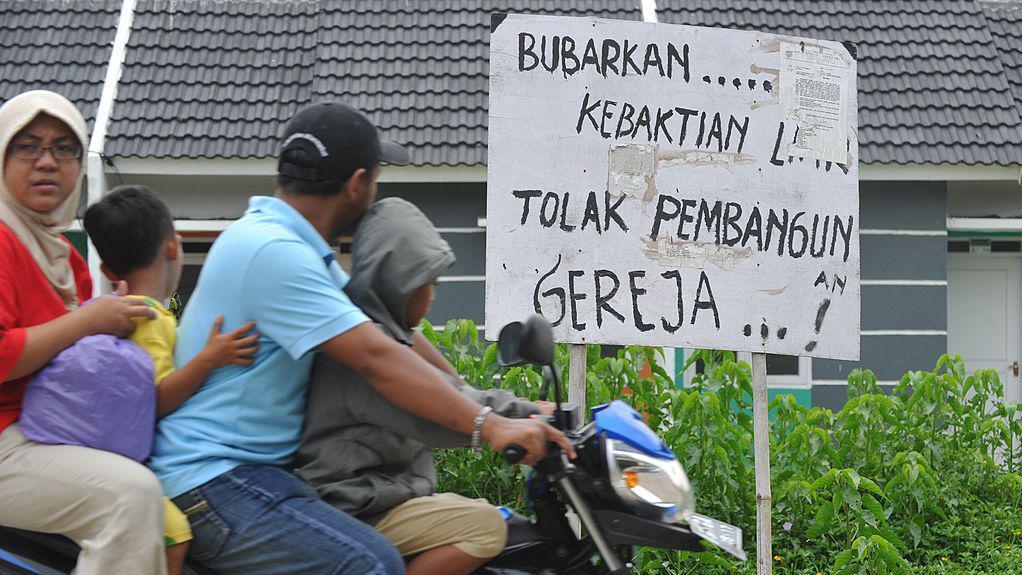

A congregation of the Gereja Misi Sejahtera (GMS) in Sewon, Bantul, faced a distressing interruption on Sunday (May 24) when members of the Islamic Jihad Forum (FJI) Yogyakarta forcibly disbanded their worship service. The incident was reportedly marked by allegations of intimidation, as well as verbal and physical threats against the congregants.
This event is not an isolated occurrence; it is part of a recurring pattern of violations against the freedom of worship and the right to establish houses of worship in Indonesia. Just two months prior, hundreds of people demanded the permanent closure of the POUK Tesalonika prayer house in Teluknaga, Tangerang Regency. Data from the Setara Institute reveals that throughout the previous year, there were 221 documented violations of religious freedom, affecting 239 victims across the country. The most frequent violations include the destruction of property, forced closures, sealing of buildings, and the outright prohibition of religious services.
These persistent conflicts raise urgent questions: Why do these violations continue to repeat? Are existing regulations sufficient to prevent such hostility, or are they inadvertently acting as the root cause of these systemic issues?
Local perspectives on the GMS presence
On Sunday, May 24, hundreds of onlookers crowded Jalan Wirjono Projodikoro, Bantul, witnessing the FJI members shut down the GMS service. Mbah Ipin, a 61-year-old local resident who runs a small stall next to the GMS building, observed the chaos firsthand. “I was busy serving customers, and my shop was packed,” he recalled on Tuesday (May 26).

Mbah Ipin, who has lived in Dusun Glugo his entire life, admitted he was unaware that a church was being established next door, initially mistaking the building for a warehouse. Despite this, he expressed no objection to his new neighbors. “Worship is a fundamental human right. As long as it does not disturb others, it should be allowed. Perhaps those who protested were simply envious or had other motives,” he added.
Zainar, another resident of Dusun Glugo, shared a similar sentiment. The 65-year-old emphasized the importance of coexistence. “It is not a problem for me. My religion teaches that there is no compulsion in faith. The most important thing is for people to be kind. If they are active here, they might shop at my store, which I would appreciate,” she said.

However, not all residents welcomed the church. The head of RT 06, Glugo Kulon, who requested anonymity, voiced his opposition, stating that the GMS had originally only applied for a permit for a foundation office, not a place of worship.
BBC News Indonesia attempted to seek comments from the hamlet head and the village head of Panggungharjo, but both declined to speak on the matter. Meanwhile, Yulius Suharta, Acting Head of the Bantul National Unity and Politics Agency (Kesbangpol), emphasized that the right to worship is protected by the constitution. “Any attempt by a group to stop religious activities is a cross-sectoral responsibility. The government is committed to ensuring that citizens can exercise their freedom of belief,” Yulius stated.
Conflicting accounts: GMS and FJI
Josiah Michael, a spokesperson for GMS Central, stated that dozens of FJI members arrived at 07:59 AM, forcing the congregation to stop their service. “The incident left the congregants, particularly the children, traumatized,” Josiah said on Tuesday. He condemned the actions as a severe blow to national tolerance and harmony.

Conversely, FJI Yogyakarta Chairman Abdurrahman defended his group’s involvement, claiming they acted in response to complaints from residents who opposed the church’s establishment. “We received reports from locals, which led to the tension,” he said. Abdurrahman argued that the GMS lacked the required building permits and community consent. “If they want to build a church, they should follow the procedure. If the residents do not object, neither will we,” he insisted.
Government response and legal standing
Following the viral spread of the incident, officials have stepped in. Bantul Regent Abdul Halim Muslih condemned the act of persecution, stating that such intimidation is unacceptable under both religious and constitutional law. The local government, along with the Ministry of Religious Affairs and the Religious Harmony Forum (FKUB), plans to review the GMS permit application in accordance with the 2006 Joint Ministerial Regulation (PBM). During the review process, the building cannot be used for worship.
Bantul Police Chief AKBP Bayu Puji Hariyanto confirmed that authorities are investigating the allegations of forced disbandment. Despite government efforts to anticipate the situation, the group managed to disrupt the service. Meanwhile, the Governor of Yogyakarta, Sri Sultan Hamengku Buwono X, and PBNU Chairman Gus Fahrur both expressed deep concern, urging for legal channels rather than intimidation to resolve administrative disputes.
The cycle of religious intolerance
The situation in Bantul reflects a broader issue across Indonesia. Data from the Setara Institute, which recorded 221 violations in 2025, highlights that the destruction and obstruction of houses of worship are widespread. Halili Hasan, Executive Director of the Setara Institute, blames the trend on “discriminatory and intolerant regulations” that continue to marginalize minority groups.

The 2006 Joint Ministerial Regulation (PBM) is frequently cited as the source of these tensions. The regulation requires houses of worship to obtain support from at least 90 congregants and 60 local residents, all verified by local officials. Critics, such as Thowik from the Union of Journalists for Diversity (Sejuk), argue that these requirements provide a mechanism for “social vetoes,” allowing the majority to block the minority’s rights.
Furthermore, there are allegations that these complex requirements create opportunities for corruption and extortion, as congregations struggle to navigate layered bureaucracy and local pressure. Activists and organizations like Komnas HAM have long urged for a revision of these rules, suggesting that requirements should be based on objective criteria such as zoning and urban planning rather than the subjective approval of others.
While former Minister of Religious Affairs Yaqut Cholil Qoumas previously proposed removing the requirement for FKUB recommendations to streamline the process, a formal policy change has yet to be implemented. Until the regulatory framework is modernized to prioritize constitutional rights over restrictive vetting processes, the cycle of intolerance and conflict over houses of worship threatens to continue.
Summary
A church service of the Gereja Misi Sejahtera (GMS) in Sewon, Bantul, was forcibly disrupted by the Islamic Jihad Forum (FJI) Yogyakarta on May 24, with allegations of intimidation and threats. This incident is part of a recurring pattern of religious freedom violations across Indonesia, as noted by the Setara Institute. While some local residents supported the GMS congregation, citing freedom of worship, others, including the head of RT 06, opposed it, claiming the permit was only for a foundation office. The Bantul Regent condemned the disbandment, and authorities are currently investigating the matter.
The government plans to review the GMS permit based on the 2006 Joint Ministerial Regulation (PBM), which demands significant community and congregant support for establishing houses of worship. Critics argue this regulation fosters “social vetoes,” allowing majority groups to impede the rights of minorities. Despite calls from activists and Komnas HAM for a revision to base permits on objective criteria rather than subjective approvals, formal policy changes remain unaddressed. Consequently, the cycle of intolerance and conflict over places of worship continues.
