
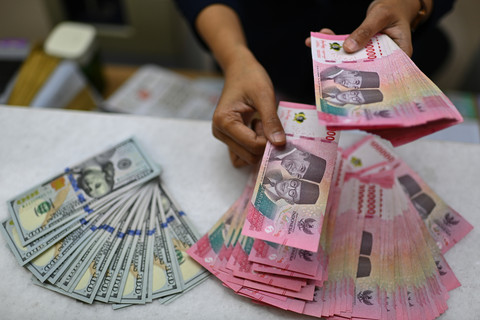
The Indonesian Rupiah is projected to continue trading around the 17,000 per US Dollar mark throughout next week’s trading sessions. Analysts suggest that the persistent pressure on the “Garuda currency” remains influenced by the prevailing uncertainties in both global and domestic sentiments.
According to Josua Pardede, an economist at Bank Permata, the Rupiah is likely to hover at the 17,000 level, with an optimistic outlook that it will not breach the 17,500 per US Dollar threshold. “Given the current conditions, we anticipate the Rupiah will remain around the 17,000 level, hopefully staying below Rp 17,500 per US dollar. The hope is that this won’t lead to any wild expectations,” Josua stated during a journalist training event hosted by Bank Indonesia, as quoted on Sunday (May 24).
He further elaborated, “Theoretically, if we consider the real effective exchange rate, the Rupiah in normal conditions should ideally be below Rp 17,000 per US Dollar.” Josua highlighted that the Rupiah’s performance is still overshadowed by several external and domestic factors, including the MSCI rebalancing sentiment and the single-door commodity export policy implemented through PT Danantara Sumberdaya Indonesia (PT DSI). “We are taking into account global risks, current existing risks, and also the policy responses already issued by Bank Indonesia,” Josua added, emphasizing a comprehensive assessment.
Rupiah Weakening: More Than Just Global Factors, Domestic Pressures Also Play a Role
Josua underscored that the depreciation of the Rupiah against the US Dollar is not solely triggered by global sentiment. Domestic pressures are also significantly burdening the movement of the Indonesian currency this year. He explained that in the second quarter of 2026, there was a noticeable surge in domestic demand for the US Dollar. This demand stemmed from various sources, including dividend payments by issuers to shareholders and the need for foreign exchange by Hajj pilgrims.
Based on his records, the Rupiah’s weakening against the US Dollar in 2026 has approached nearly 5 percent year-to-date (YTD). The depreciation is not limited to the US Dollar alone; the Rupiah has also weakened against most other major Asian currencies, including the Malaysian Ringgit, Singapore Dollar, Hong Kong Dollar, and Chinese Yuan. Interestingly, the Indian Rupee has, in contrast, shown strengthening.
“We have weakened against all Asian currencies; our deepest depreciation has been against the Malaysian Ringgit, followed by the Singapore Dollar, then the Hong Kong Dollar, and finally the Yuan. So, let’s not exclusively blame global factors,” Josua asserted.
He argued that this scenario clearly indicates that the pressure on the Rupiah cannot be attributed solely to external factors. Consequently, the implementation of Local Currency Transaction (LCT) is deemed crucial and needs continuous strengthening, including through expanded cooperation with central banks of partner countries. Josua believes that this measure is vital to reduce dependency on the US Dollar while simultaneously enhancing the efficiency of inter-country trade transactions. “Because we have been advocating extensively within other central banks, perhaps that advocacy might decrease; we are advocating to their stakeholders,” Josua remarked.
Data from Bank Indonesia up to April 2026 reveals a significant increase in LCT participants, with a monthly average reaching 5,265. This figure marks a substantial rise compared to 497 participants in 2021 and 1,741 participants in 2022. The number of LCT users further grew to 2,602 in 2023 and 5,020 in 2024. Remarkably, in 2025, the monthly average of LCT participants even touched 9,720.
Furthermore, the value of LCT transactions until April 2026 reached an impressive USD 22.61 billion, representing a staggering 309 percent year-on-year (yoy) surge compared to USD 7.33 billion in the same period last year. This remarkable increase in transactions reflects the expanding use of local currencies in international economic and financial exchanges. Indonesia’s primary partner countries in LCT implementation currently include China, Japan, and Malaysia. China contributes the largest share of transactions at 89 percent, followed by Japan at 6 percent, and Malaysia at 3 percent.
Summary
The Indonesian Rupiah is expected to trade around 17,000 per US Dollar next week, with analysts projecting it will remain below 17,500. Economist Josua Pardede attributes persistent pressure to both global and domestic uncertainties, alongside factors like MSCI rebalancing and commodity export policies. Bank Indonesia’s policy responses are also crucial in assessing the Rupiah’s performance.
Josua highlighted that domestic pressures, such as increased US Dollar demand for dividends and Hajj pilgrims, significantly contribute to the Rupiah’s nearly 5% year-to-date weakening against the USD and most Asian currencies. Consequently, strengthening Local Currency Transaction (LCT) implementation is vital to reduce reliance on the US Dollar. LCT participation and transaction values have seen substantial growth, reaching USD 22.61 billion by April 2026 with China, Japan, and Malaysia as primary partners.
