
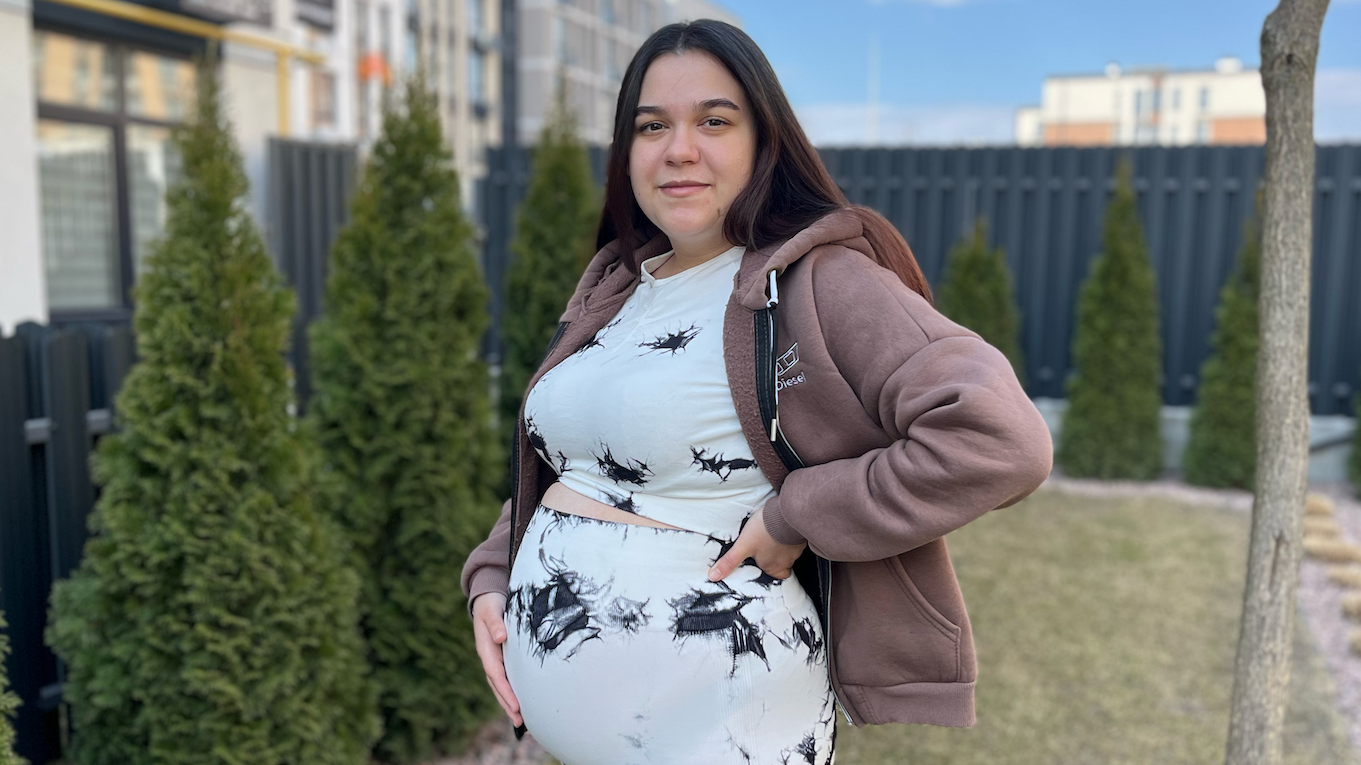

Karina is six months pregnant, but the fetus growing inside her is not her own.
At 22, the Ukrainian woman has become a surrogate, carrying a child conceived from the egg and sperm of a Chinese couple. For Karina, this decision was born out of survival. When she was 17, her hometown of Bakhmut was decimated during the initial stages of the Russian invasion. Following the destruction, she and her partner relocated to Kyiv, where they struggled to secure stable employment. Faced with empty pockets and the challenge of providing for her toddler, she turned to surrogacy to make ends meet.
The economic fallout of the war—marked by soaring inflation, business closures, and a plummeting GDP—left many like Karina feeling desperate. “At first, being a surrogate made me feel angry and disappointed, but I have come to accept it,” says Karina, who now resides in a clinic-provided apartment on the outskirts of Kyiv. She is currently carrying a baby girl. For her contribution, she will receive $17,000, roughly twice the average annual salary in Ukraine. Although the sum is significant, it was reduced from an initial $21,000 after one of the twins she was carrying passed away—a deduction mandated by her contract.
Despite the emotional toll, Karina admits she would consider carrying more babies if it meant achieving her goal of buying a home. However, her future in the industry is uncertain.

Before the conflict, Ukraine was the second-largest global hub for commercial surrogacy, surpassed only by the United States. While the war disrupted the industry, experts note that surrogate birth rates have largely returned to pre-war levels. Now, however, the Ukrainian parliament is considering a bill that could effectively end the industry by banning surrogacy for foreign clients, who currently account for 95% of the market.
Proponents argue that the current system commodifies reproduction and exploits vulnerable, low-income women. Critics also question the morality of Ukrainian women bearing children for foreigners while the nation’s own birth rate is in sharp decline due to the war. Maria Dmytrieva, a women’s rights activist, believes the practice should be banned entirely. She points to AI-generated social media advertisements—one of which forced a choice between “renting a womb” or buying children’s clothes—as evidence that clinics are intentionally preying on the financial desperation caused by the conflict.
The industry leader, BioTexCom, has faced its share of controversy. In 2018, prosecutors launched an investigation into the clinic’s CEO, Albert Tochilovsky, and former staff for alleged crimes including human trafficking. While the investigation was paused for international cooperation, the clinic has consistently denied any wrongdoing, maintaining that they operate within the law and provide essential services for those struggling to become parents. When asked about their controversial advertising tactics, including a “Black Friday discount” on babies, the clinic defended the campaigns as effective marketing.
Left Behind: The Cost of Abandonment
Beyond the legal and ethical debates, there is the heartbreaking reality of children abandoned when intended parents change their minds. While legally the intended parents are responsible for the child, enforcement across borders remains difficult. One such case is five-year-old Wei, who was born prematurely in 2021 and suffered severe brain damage. His intended parents, from Southeast Asia, abandoned him after learning of his condition. Today, Wei resides in a state-run facility for children with disabilities, unable to sit up or support his own head, requiring round-the-clock care that neither his birth mother nor his intended parents provide.

Valeria Soruchan of the Ukrainian Ministry of Health highlights that many such children are left behind, though official statistics are unavailable. She advocates for stricter regulations, specifically excluding foreign clients, to mitigate these risks. Despite the tragedy of cases like Wei’s, clinics like BioTexCom argue they are not legally responsible for the maintenance of children abandoned by their biological parents, nor do they currently contribute financially to their care in state institutions.
Building Families Amidst Uncertainty
For some, however, surrogacy has been a lifeline. Himatraj and Rajvir Bajwa, a couple from London, struggled for years to conceive before turning to surrogacy in Ukraine. After facing health challenges that prevented pregnancy, they chose Ukraine over the UK, where only altruistic surrogacy—which forbids financial compensation—is legal. They were drawn to the structured, commercial model in Kyiv and the significantly lower costs compared to the US.

Their experience was marked by both joy and peril; when they arrived in Kyiv to collect their son last year, they were forced to take cover in bomb shelters during Russian air strikes. Despite the danger, the couple credits the clinic with fulfilling their dream of parenthood. “They gave us something we never imagined—they made us a family,” says Himatraj. They remain firm in their belief that the women involved are not exploited, viewing the arrangement as a mutually beneficial transaction between consenting adults.

For Karina, the debate remains distant from her own reality. She rejects the notion that she is being exploited, emphasizing that the choice to be a surrogate is hers alone. “No one is forcing us. This is my body, my decision,” she says. As she waits for the birth of a child that she will one day have to hand over, she finds comfort in the life she is carrying. “I know this is not my child, but I love them. I talk to them. I just hope they have a good life.”

Summary
Surrogacy in Ukraine has become a vital survival strategy for many women facing economic hardship due to the ongoing war, despite the significant emotional and ethical complexities involved. While some intended parents view the commercial surrogacy model as a lifeline to parenthood, the industry faces intense scrutiny over the potential exploitation of vulnerable women and the tragic reality of children being abandoned by international clients. There are now active legislative efforts in Ukraine to potentially ban surrogacy for foreign nationals to address these concerns.
The industry remains deeply polarized, with critics condemning it as the commodification of reproduction and supporters arguing that it provides mutually beneficial opportunities for consenting adults. High-profile clinics continue to operate amid investigations and controversy, while cases of abandoned children highlight the severe lack of accountability and regulation across borders. Ultimately, for surrogate mothers like Karina, the practice represents a difficult personal choice driven by the need to secure a future for their families amidst national instability.
