
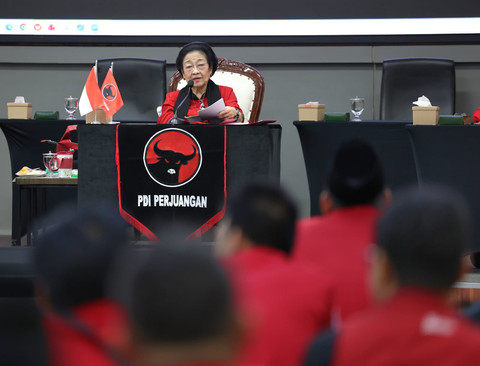

Megawati Soekarnoputri, the General Chair of the PDI Perjuangan party and Indonesia’s 5th President, delivered a significant message to Indonesian workers during the commemoration of International Labor Day 2026. This pivotal address was given at an event organized by the PDI Perjuangan Central Leadership Board (DPP) at GOR Otista, Jatinegara, East Jakarta, on Sunday, May 3rd.
In her video-recorded message, Megawati urged workers to perceive International Labor Day, traditionally observed on May 1st, as more than just an annual ceremony. She emphasized the importance of viewing this day through crucial historical and cultural lenses, stating, “The commemoration of May 1st as Labor Day must be seen from a historical and cultural perspective.” This call for deeper reflection highlights the enduring legacy and ongoing significance of the labor movement.
 Highlighting History and Oppression
Megawati firmly asserted that the struggle of Indonesian workers is intrinsically linked to resistance against various forms of oppression, particularly those fueled by capitalism and imperialism. She drew parallels to Indonesia’s own painful colonial history, specifically mentioning the implemention of the cultuurstelsel, or cultivation system, by the Dutch colonial government, which inflicted prolonged suffering upon the nation. “The struggle of workers is a manifestation of resistance against the shackles of colonialism brought about by capitalism and imperialism,” Megawati declared, adding, “The Indonesian nation experienced prolonged suffering when the cultuurstelsel was implemented during Dutch colonial rule.”
Her powerful message underscored how past exploitation continues to resonate, framing contemporary labor challenges within a broader historical context of enduring economic and social injustice. By invoking this dark chapter, she connected the contemporary fight for workers’ rights to a foundational struggle for national dignity and freedom.
Economic Justice within Pancasila
Within the framework of the national ideology, Pancasila, Megawati positioned the pursuit of economic justice as a fundamental value. She argued that economic justice is not merely an agenda for the labor force but serves as a core objective for Indonesia’s independence. “The struggle for justice in the economic sector is an essential essence of socio-democracy within Pancasila,” she affirmed. This statement reinforces the idea that robust worker welfare and equitable economic systems are inseparable from the nation’s foundational principles and aspirations.
Encouraging Worker Quality Improvement
Concurrently, Megawati also issued a crucial reminder to Indonesian workers about the necessity of adapting to an increasingly competitive global landscape. She stressed the paramount importance of continuously enhancing workers’ quality, skills, professionalism, and productivity. To achieve this, she suggested a collaborative approach involving the government, employers, workers themselves, and relevant institutions such as the National Research and Innovation Agency (Badan Riset dan Inovasi Nasional) and educational institutions. “However, at the same time, in facing international competition, continuous efforts are needed to improve the quality, skills, professionalism, and productivity of Indonesian workers,” Megawati articulated, highlighting the dual responsibility of historical awareness and future readiness.
 Workers as Pillars of the Nation
Concluding her impactful address, Megawati unequivocally declared that workers are far more than mere economic statistics; they are vital pillars in the nation’s ongoing struggle. She passionately asserted, “Workers are not just factors of production, but rather the mainstays (‘soko guru’) of our struggle, and alongside farmers and fishermen, they form the orientation for national self-reliance.” This powerful metaphor elevates the status of laborers to foundational contributors to national identity and strength.
Megawati concluded her message with a heartfelt “Happy Labor Day” and a resolute call to action. She urged all Indonesian workers to continue their fight for welfare as an integral part of realizing social justice for every citizen across the beloved “Indonesia Raya.” Her words served as a powerful reminder of the enduring significance of labor in shaping a just and prosperous Indonesia.
Summary
Megawati Soekarnoputri, in her May Day message, urged Indonesian workers to view International Labor Day historically and culturally, beyond a mere ceremony. She stressed that the workers’ struggle represents resistance against capitalism and imperialism, drawing parallels to Indonesia’s colonial history and the *cultuurstelsel*. Megawati further asserted that achieving economic justice is a fundamental essence of socio-democracy within Pancasila, crucial for national independence.
Concurrently, Megawati reminded workers to continuously enhance their quality, skills, professionalism, and productivity to face global competition, suggesting collaboration among stakeholders. She concluded by declaring workers as vital pillars (“soko guru”) of the nation’s struggle, alongside farmers and fishermen, crucial for national self-reliance. Her message called for workers to fight for welfare as an integral part of realizing social justice across Indonesia.
