
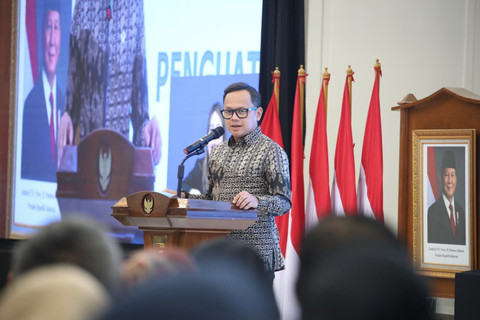

Deputy Minister of Home Affairs (Wamendagri) Bima Arya Sugiarto recently underscored the critical importance of synchronizing programs between the central and regional governments when formulating the 2027 Government Work Plan (RKP). He highlighted that aligning planning and budgeting processes is fundamental to ensuring that national priority programs are effectively implemented across all regions.
Bima Arya conveyed these vital insights while serving as a keynote speaker and providing guidance at the Central Development Coordination Meeting (Rakorbangpus), which focused on the preparation of the 2027 RKP. The significant event took place at the Djunaedi Hadisumarto Meeting Room, located within the Ministry of National Development Planning (PPN)/National Development Planning Agency (Bappenas) in Jakarta, on Thursday, May 7, 2026.
According to Bima Arya, the current context of synchronization is exceptionally crucial for Indonesia’s developmental trajectory. This urgency stems from the fact that today’s regional heads confront challenges that are starkly different from those faced by previous generations. “The challenges now are very different,” he stated, emphasizing the contemporary complexities.
Bima identified at least three primary challenges currently confronting regional leaders. These encompass geopolitical challenges at the global level, the effective oversight of national priority programs, and the delicate balance of political promises alongside public expectations at the local level. Despite these multifaceted challenges, Bima stressed that the most fundamental requirement remains the diligent implementation of Minimum Service Standards (SPM). These essential services cover critical areas such as education, health, public works, public housing, peace and public order, community protection (Trantibumlinmas), and social welfare.
“In Law No. 23 of 2014, it is explicitly clear that we possess the guidelines to achieve this synchronization. The Ministry of Home Affairs, in collaboration with the Ministry of Planning, is committed to ensuring this alignment takes place,” he elaborated, referencing the legislative framework. He further explained that if these six Minimum Service Standards (SPM) are not optimally implemented, achieving effective synchronization between central and regional programs will prove challenging. This is because all SPM must be integrated into planning documents, adequately budgeted through specific programs, and assigned clear performance targets.
Consequently, the Ministry of Home Affairs consistently evaluates regional governments that still face obstacles in executing these vital programs. “We must ensure that they are capable of meeting these most basic Minimum Service Standards. This is our collective homework. It signifies that before we even discuss national priority programs, we must first address the state of these essential SPM,” he emphasized, highlighting a foundational responsibility.
Bima also asserted that the robust implementation of national strategic programs at the regional level can significantly leverage development progress. He cited the exemplary practices of the Jambi City Government in overseeing various national priority programs, which successfully supported regional development financing. “Just last week, we visited Jambi City. After calculating, thanks to the mayor’s proactive approach, the development financing support from various sources amounted to almost two trillion, nearly matching their own regional budget (APBD),” he explained, illustrating remarkable financial leverage.
Concluding his presentation, Bima urged regional governments to maintain consistency in their planning and budgeting documents to bolster national development success. Furthermore, he emphasized the critical need for alignment with the eight national priority clusters, strict adherence to mandatory spending regulations, fostering fiscal innovation and investment ease, and strengthening synergy in regional development efforts.
The Central Development Coordination Meeting (Rakorbangpus) also saw the attendance of other distinguished officials, including Minister of PPN/Head of Bappenas Rachmat Pambudy, Head of BPS Amalia Adininggar Widyasanti, Deputy Minister of Finance Juda Agung, and representatives from Regional Development Planning Agencies (Bappeda) across Indonesia.
Summary
Deputy Minister of Home Affairs (Wamendagri) Bima Arya Sugiarto underscored the critical importance of synchronizing programs between central and regional governments when formulating the 2027 Government Work Plan (RKP). He highlighted that the current, distinct challenges faced by regional heads make aligning planning and budgeting processes exceptionally crucial for national development. A fundamental requirement for this synchronization is the diligent implementation of Minimum Service Standards (SPM) in key areas such as education and health, which must be fully integrated into planning documents and adequately budgeted.
Bima Arya explained that Law No. 23 of 2014 provides the framework for this alignment, with the Ministry of Home Affairs actively evaluating regions struggling to meet these essential SPM. He emphasized that addressing these foundational standards is paramount before effectively implementing national priority programs, citing examples where robust regional participation significantly leveraged development financing. Regional governments are urged to maintain consistency in their planning and budgeting, align with national priority clusters, and foster fiscal innovation to strengthen overall national development success.
