
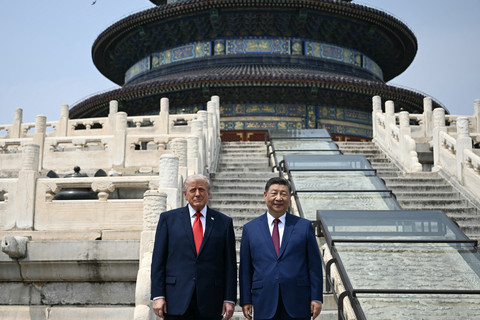

United States President Donald Trump has arrived in Beijing for a high-stakes state visit—the first by an American leader in nine years. The trip comes as the world’s two largest economies strive to stabilize bilateral relations amidst the complex backdrop of the ongoing conflict in Iran.
Air Force One touched down at Beijing Capital International Airport on Wednesday, May 13, at approximately 8:00 p.m. local time. President Trump was greeted by Chinese Vice President Han Zheng, a military honor guard, and hundreds of children waving flags during a formal red-carpet arrival ceremony.
The primary agenda commences Thursday morning, May 14, with a scheduled meeting between President Trump and Chinese President Xi Jinping at the Great Hall of the People. President Xi enters these talks from a position of relative strength following their previous summit in South Korea last year. During that encounter, Beijing successfully leveraged its rare-earth metal reserves to pressure the U.S. into dropping planned tariffs. Since then, the U.S. Supreme Court has curtailed President Trump’s authority to impose new trade barriers, while the political fallout from the Iran conflict has complicated his domestic standing.
Despite these challenges, the Trump administration has emphasized that the visit will be used to press Beijing on sensitive issues, ranging from China’s role in the Middle East conflict to trade barriers facing American corporations. In a social media post, President Trump expressed his intention to urge President Xi to “open up” China to U.S. businesses. “I will be asking President Xi, a tremendous leader, to open China so these brilliant people can show their abilities and help bring the People’s Republic of China to the next level,” Trump wrote, referring to the high-profile executives accompanying him.
Reports from Bloomberg and Reuters indicate that the U.S. and China are exploring a new framework that could identify approximately $30 billion in goods for tariff relief, provided it does not compromise national security. This initiative highlights the delicate balancing act Trump faces as he balances economic goals with geopolitical pressure.
The 36-hour summit includes a state banquet, a visit to the Temple of Heaven, and informal tea talks at the Zhongnanhai leadership compound. The schedule had been delayed for weeks as President Trump focused on diplomatic efforts to end the conflict in Iran. Recent frustrations over Tehran’s reluctance to provide sufficient concessions on its nuclear program have left current ceasefire agreements fragile, though Trump has indicated a desire to prioritize trade negotiations during his stay in Beijing.

The relationship remains strained by U.S. sanctions against Chinese firms involved in purchasing Iranian oil or providing satellite imagery to the regime. According to U.S. officials, these economic ties and potential arms exports are critical points of contention. Concurrently, President Trump is seeking to finalize business deals in the agricultural, energy, and aerospace sectors while establishing a new trade council to manage long-term economic competition.
The business delegation accompanying the President includes industry titans such as Tesla CEO Elon Musk, Apple CEO Tim Cook, and Boeing CEO Kelly Ortberg. In a surprise addition, Nvidia CEO Jensen Huang joined the Air Force One entourage, signaling that artificial intelligence and technology will be central themes of the visit.
The diplomatic delegation also includes Secretary of State Marco Rubio—who previously faced two rounds of Chinese sanctions during his time as a senator—and Secretary of Defense Pete Hegseth. This marks the first visit of a U.S. Defense Secretary to China since James Mattis met with Xi in 2018. Discussions are expected to cover the extension of a trade truce reached last October, which includes tariff reductions and the easing of export controls on rare earth materials.
Ahead of the summit, U.S. Treasury Secretary Scott Bessent held three hours of preliminary talks with Chinese Vice Premier He Lifeng in South Korea to pave the way for the leaders’ meeting. Secretary of State Rubio recently described the U.S.-China relationship as the greatest geopolitical challenge and the most vital dynamic the United States must manage.
The Taiwan issue remains a flashpoint. President Trump has signaled his intent to discuss U.S. arms sales to the island, having previously delayed a $14 billion aid package. While some lawmakers have expressed concern that such delays undermine U.S. commitments, President Xi has personally requested that Trump handle the Taiwan issue with extreme caution. Furthermore, President Trump has pledged to advocate for the case of Jimmy Lai, the imprisoned former Hong Kong media owner, continuing a conversation he initiated during their October summit.
The visit has dominated social media discourse in China, with users tracking the path of Air Force One and speculating on the implications of the high-profile business delegation, particularly the sudden inclusion of Jensen Huang, as both nations look to navigate this pivotal moment in global diplomacy.
Summary
President Donald Trump has arrived in Beijing for a high-stakes 36-hour summit with President Xi Jinping to address critical bilateral issues, including trade barriers, geopolitical tensions, and artificial intelligence strategy. Accompanied by prominent business leaders such as Elon Musk and Jensen Huang, the administration aims to secure economic deals while navigating complexities related to the Iran conflict and the sensitive issue of Taiwan. The visit marks the first by a U.S. leader in nine years and includes high-level diplomatic discussions on tariff relief and long-term economic competition.
The summit follows extensive preliminary talks between officials, focusing on potentially easing $30 billion in trade barriers and managing export controls on rare earth materials. Despite significant points of contention regarding U.S. sanctions on Chinese firms and regional security, both nations are exploring a new framework to balance economic goals with national interests. This meeting represents a pivotal attempt to stabilize relations and redefine the trade truce established during their previous engagement.
