
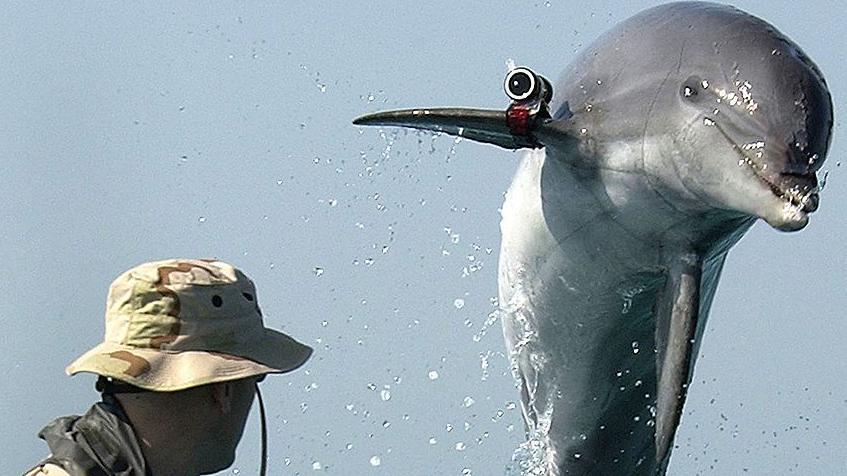

During a Pentagon press conference on Tuesday, May 5, regarding the ongoing tensions between the United States and Iran, an unexpected question surfaced: “Are the Iranians using suicide dolphins?”
The inquiry came from a reporter for The Daily Wire, who pressed U.S. Secretary of Defense Pete Hegseth to address reports suggesting the deployment of “suicide dolphins” in naval warfare. Hegseth responded cautiously, stating, “I can neither confirm nor deny the existence of our own suicide dolphins, but I can confirm that they do not have anything of the sort.”
General Dan Caine, Chairman of the Joint Chiefs of Staff, echoed the sentiment, noting he had not seen any intelligence reports to that effect. He quipped, “This sounds like the story about sharks with frickin’ laser beams, doesn’t it?”
These comments were prompted by a Wall Street Journal report published just five days earlier, titled “Iran Is Looking for a Way to Counter a Blockade It Cannot Break.” The article suggested that U.S. naval blockades have exposed vulnerabilities in Iran’s strategy to control the Strait of Hormuz, prompting Tehran to explore unconventional defensive measures.

According to the Wall Street Journal, Iranian officials have hinted at utilizing previously unseen weaponry to strike American warships, ranging from advanced submarines to dolphins equipped with mines. Furthermore, the Islamic Revolutionary Guard Corps has allegedly threatened to disrupt global internet traffic by severing fiber-optic cables in the Strait of Hormuz.
While the concept of military-trained marine mammals sounds like science fiction, the history of such programs spans decades. On March 8, 2000, the BBC reported that Iran had acquired dolphins previously trained by the Soviet Navy. Although their precise purpose in the Persian Gulf at that time remained ambiguous, the intent behind the acquisition sparked global concern.
These dolphins were originally trained by Soviet experts to intercept enemy divers and strike naval vessels. When Soviet funding evaporated following the collapse of the USSR, many of the animals were moved to private facilities for tourist entertainment. Their primary trainer, Boris Zhurid—a former submarine officer—eventually sold the animals to Iran, claiming he could no longer afford the mounting costs of food and medical care.
“If I were a cruel man, I could have stayed in Sevastopol,” Zhurid told the Russian newspaper Komsomolskaya Pravda at the time. “But I could not bear to see my animals starving. Our medicine, which costs thousands of dollars, was gone, and we had no more fish or nutritional supplements.”
Read more:
- Iran’s ‘mosquito fleet’ challenges U.S. Navy in the Strait of Hormuz
- From humble beginnings in the 1980s: How did Iran develop its drone arsenal?
- ‘My body trembles from stress’: The psychological toll of war in Iran
BBC reports from that era indicated that a total of 27 animals, including walruses, sea lions, seals, and a white beluga whale, were transported via cargo plane from Sevastopol in the Crimean Peninsula to the Persian Gulf. Among them were four dolphins and a white whale that had been trained at a Russian Pacific Fleet base before arriving in Crimea in 1991. These animals had reportedly been trained to combat enemy divers, either by using spears mounted on their backs or by dragging targets to the surface for capture.

Following the 2003 invasion of Iraq, the U.S. Navy utilized trained dolphins to identify and clear sea mines in the Persian Gulf. Historically, military dolphins have also been trained to carry explosive charges intended to detonate upon contact with a vessel’s hull. It is often claimed that these creatures can distinguish between different types of submarines based on the specific acoustic signature of their propellers.
Komsomolskaya Pravda once described Zhurid’s research as strictly military, labeling the animals as “mercenaries.” Zhurid himself noted, “In reality, Iran has bought our former secret weapons from Ukraine at a bargain price.” He added that he was indifferent to the specific missions the animals might face, stating, “I am ready to go to God or even the Devil, as long as my animals are treated well.”
Read more:
- The mystery of the beluga whale accused of being a Russian spy
- Beluga whales, cats, and bats: Animals turned into intelligence assets
Beyond Russia, the United States maintains the most prominent marine mammal program, based in San Diego, California. In recent years, unverified reports have suggested similar efforts by other nations, including North Korea. Satellite imagery has purportedly shown dolphin pens in North Korea, fueling speculation about a specialized program in Pyongyang.
Today, Russia and the U.S. continue to operate the most advanced military marine mammal programs globally. Since the invasion of Ukraine, Russia has reportedly intensified the use of military dolphins at the Sevastopol port to counter enemy divers and protect its Black Sea fleet.
Dolphins are intelligent and follow orders well
Former Iranian President Akbar Hashemi Rafsanjani touched on the events of April 2, 2000, in his memoir, Reforms in Crisis. He noted that the swimming pools for the marine animals on Kish Island were nearing completion, housing walruses, sea lions, seals, and dolphins imported from Ukraine. He mentioned that Ukrainian handlers had accompanied the animals to manage the facility and train local Iranian staff.
Rafsanjani firmly denied Western media reports that the animals were undergoing military training for mine warfare, insisting that the acquisition was purely for commercial purposes. He stated that the government had filed lawsuits against those spreading such claims.

According to Rafsanjani, the dolphins were well-cared for, receiving a diet of fish and shrimp, and requiring temperature-controlled pools to simulate their native Arctic environment. He described the animals as highly intelligent, noting that they followed their trainers’ commands with precision, though they proved resistant to musical performances. “This will likely become one of the most popular attractions on Kish,” he wrote at the time.
- The Strait of Hormuz, Iran, and the Taiwan issue: What did Trump and Xi Jinping agree upon?
- The psychological damage to children in Iran due to war: ‘Endless fear’
- Iran’s ‘mosquito fleet’ challenges U.S. Navy in the Strait of Hormuz
Summary
The possibility of Iran using “suicide dolphins” against U.S. naval blockades was raised during a recent Pentagon press conference, though U.S. officials denied any such intelligence. This inquiry stemmed from a Wall Street Journal report suggesting Iran might use unconventional defensive measures in the Strait of Hormuz. Historically, Iran acquired Soviet-trained military dolphins in March 2000; their primary trainer, Boris Zhurid, sold the animals after the collapse of the USSR due to financial constraints.
These dolphins were originally trained by Soviet experts to intercept enemy divers or strike naval vessels, with some reports indicating they could be equipped with spears or used for mine warfare. Iran reportedly received 27 marine animals, including four dolphins, from Crimea. However, former Iranian President Akbar Hashemi Rafsanjani denied any military use, asserting the dolphins were acquired solely for commercial tourism and entertainment on Kish Island.
