
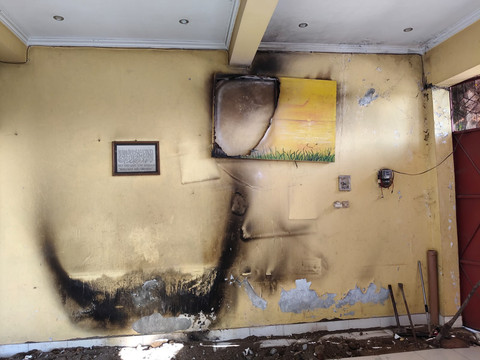
 The baffling phenomenon of 51 mysterious fires erupting within a single week at a residence in Margomulyo, Kapanewon Seyegan, Sleman Regency, DI Yogyakarta, continues to grip public attention. A diverse array of stakeholders, from local government officials to academic research teams, have launched a direct investigation to pinpoint the source of these sporadic ignitions occurring in various corners of the house. Preliminary examinations have provisionally pointed towards the accumulation of methane gas as the likely culprit. A dedicated team from Gadjah Mada University (UGM), collaborating with the DIY Regional Government and other relevant parties, is meticulously scrutinizing the house and its surroundings, including plumbing lines, septic tanks, and the immediate environment, to definitively identify the origin of these alarming fires.
House in Sleman Mysteriously Catches Fire 51 Times in a Week
The sheer frequency of these inexplicable incidents is staggering, with the Margomulyo home experiencing 51 mysterious fires within a mere seven days. Recounting the ordeal, resident Mutvia shared her family’s distress on Friday, May 29th, noting, “Another fire, that’s four times already today.” Her father, 61-year-old Agus Yani, vividly described the initial fire, which incinerated a cloth. “Around that time, we heard a sound, like a knocking ‘tek-tek.’ My daughter had just finished ironing. Then, she looked and said, ‘Dad, fire!’ I was almost asleep and thought nothing of it at first. But then, a second fire erupted near the same spot,” Agus explained, highlighting the rapid, unsettling recurrence.
 Reluctant to Attribute Incidents to Mystical Causes
Despite the perplexing nature of the events, Mutvia and her family firmly reject any suggestions that their ordeal is linked to mystical occurrences or black magic, known locally as “santet.” They maintain a strong belief that the phenomenon can be rationally explained through scientific principles. “I don’t go along with speculating about ‘santet.’ This can still be directed towards logical explanations,” Mutvia asserted. “For example, a towel on a doorknob could store gas and potentially generate static. It’s difficult for me, who doesn’t understand such things, to connect it to mystical factors.” She further clarified that she does not have any personal issues or conflicts significant enough to warrant such a terrifying ordeal. “Everyone has problems, but it doesn’t seem to be related to that kind of situation,” she commented. While Mutvia acknowledged that some spiritual healers have visited to offer assistance, she welcomes their help as long as their intentions are good. She emphasized her family’s stance: “As a family, we fundamentally believe in the physical and scientific presence of methane gas. In essence, let’s be realistic. But if someone offers spiritual or other forms of help, we accept it out of respect. We believe they have good intentions in helping, and for that, we are grateful.”
 Suspected Methane Gas Accumulation from Septic Tank
The DIY Public Works, Housing, and Mineral Resources Agency (PUPESDM) has identified various potential triggers for the fires, with methane gas emanating from a septic tank being a primary suspect. Anna Rina Herbranti, Head of PUPESDM DIY, explained on Saturday, May 30th, that “the phenomenon of sporadic fire outbreaks can be influenced by multiple factors, including environmental conditions, the presence of flammable materials, the potential accumulation of organic gases at a local scale, and non-geological technical factors. In this particular case, based on field observations, there is an indication of methane gas accumulation from the septic tank.” Supporting this theory, Sarju Winardi, a lecturer at UGM’s Department of Geological Engineering, confirmed that police had already measured gas levels at the site. “The strongest evidence thus far indicates that the fires are associated with the emission of methane gas,” he stated on the same day.
UGM to Inspect Piping System for Gas Contamination Following 51 Fires in Sleman House
To further investigate the puzzling ignitions, Dr. Sarju Winardi from UGM’s Department of Geological Engineering announced that his team would inspect the property’s piping infrastructure. He highlighted a crucial observation: “Some time ago, gas emissions were also observed coinciding with pipe lines, including water pipes and wells, where fires appeared.” Consequently, the team plans to collect and analyze water samples to determine if they are contaminated with methane. This comprehensive examination of the piping area is slated for the following week. “Perhaps next week we will bring equipment to measure the gas content present at this location, as well as collect water samples,” Sarju elaborated.
 UGM and DIY Regional Government Jointly Investigate 51 Mysterious Fires in Sleman Home
Adding to the concerted efforts, Alva Edy Tontowi, Coordinator of the Center for Entropy Slowing Studies (PKPE) at UGM’s Faculty of Engineering, confirmed that a multidisciplinary team from the university would commence on-site observations on Saturday, May 30th. “Initially, it’s an observation. The observation will focus on identifying the source of the fires, the areas affected by the fires, and the surrounding environment,” Alva informed reporters on Friday, May 29th. The DIY Public Works, Housing, and Mineral Resources Agency (PUPESDM) is also actively monitoring the mysterious recurring fires at the Margomulyo residence. Anna Rina Herbranti, Head of PUPESDM DIY, stated in a written release on Friday, May 29th, that “the DIY PUPESDM is continuously conducting monitoring and coordinating with the Sleman Regional Disaster Management Agency (BPBD) and PLN (state electricity company).”
Dark, Gas-Bearing Rocks Discovered 300 Meters from Mysterious Fire Site in Sleman
Further expanding the scope of the investigation, Professor Dr. Ir. RM. Basuki Rahmad, Dean of UPN Veteran Yogyakarta’s Faculty of Mineral and Energy Technology (FTME), personally inspected the vicinity of the affected Sleman home. His team conducted an on-foot investigation, revealing significant geological findings approximately 300 meters away. “We investigated by walking about 300 meters, where we found a river and a rock outcrop. We observed these rocks, and they appeared dark-colored. Within the rock outcrop, there was stagnant water, and we traced indications of gas bubbles,” he reported on Saturday, May 30th. The results of this investigation, Basuki continued, strongly indicated that these gas bubbles were methane (CH4). He concluded, “Thus, there is a strong indication that this gas source is methane originating from a nearby swamp.”
 Methane Gas in Sleman Mysterious Fires: Expert Explains How it Can Adhere to Clothing
Providing crucial insights into the behavior of methane gas, Dr. Sarju Winardi, Assistant Professor in UGM’s Department of Geological Engineering, explained that his team has been measuring heat temperatures using thermal cameras. He noted that methane accumulation requires specific conditions to ignite: “Sometimes it takes a while. It gathers on sofas, clothes, and fabrics in sufficient quantities over a period of time to ignite. But if the concentration is still low, it won’t ignite,” Sarju clarified on Saturday, May 30th. He elaborated that porous items like clothing and sofas can act as reservoirs, trapping the gas. Sarju also offered safety advice: “It is relatively safer when air circulation is open. With a fan, the concentration is significantly reduced. God willing, it will be safe because the potential for combustion decreases when it is outdoors.”
Summary
A house in Margomulyo, Sleman, experienced
