
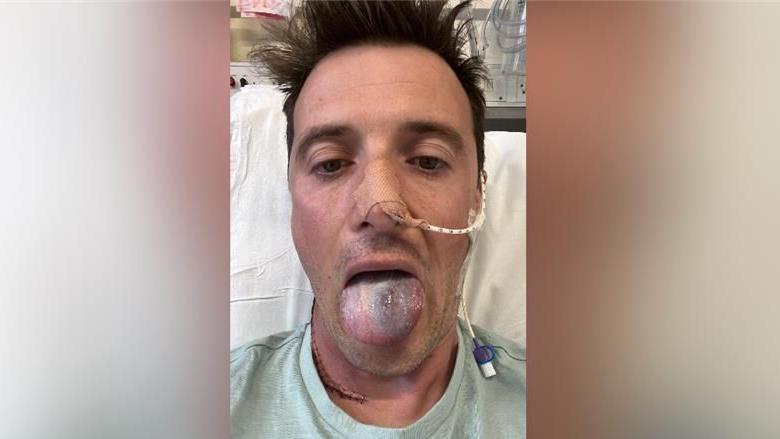

A father of two nearly lost his tongue after a seemingly innocuous small lump beneath his jaw was diagnosed as cancer.
Anthony Perriam, from Wales, sought medical advice from his GP after discovering the lump for the first time.
Within weeks, he received a devastating diagnosis: human papillomavirus (HPV)-related head and neck cancer.
HPV is a common group of viruses primarily affecting the skin.
While often harmless and cleared naturally by the body, certain strains of the virus can lead to serious health issues, including various cancers and genital warts.
Anthony expressed his shock, stating: “I only ever heard about HPV in relation to cervical cancer. I didn’t realise it could cause this type of cancer, especially in men.” His experience highlights a critical lack of awareness about the broader implications of HPV.
Warning: This article contains images that some readers may find distressing.
Reflecting on his harrowing ordeal, Anthony added: “I feel lucky to still be able to eat and talk, but if I’d left it any longer I could have lost my tongue or even died.” His words underscore the life-saving importance of early detection.
The NHS in Wales confirms that while many people’s bodies naturally clear the HPV virus, this isn’t always the case.
When the virus persists, it can lead to conditions like genital warts or progress into various forms of cancer, most commonly head and neck cancer in men and cervical cancer in women.
To combat this, NHS Wales strongly recommends the HPV vaccine for children aged 12 and 13, as well as for individuals at higher risk of exposure to the virus.
“If you find a lump, even if it doesn’t hurt, get it checked out,” urged the health service.
“This type of cancer is less talked about, especially in men. Early action really does save lives.” This powerful message highlights the need for greater public awareness and vigilance.

Despite experiencing no other symptoms, a series of comprehensive tests – including a CT scan, biopsy, and MRI – confirmed Anthony’s cancer diagnosis in March 2023.
The 41-year-old father recalled his immediate fear: “I had a three and six-year-old at the time. My first thought wasn’t about me, it was about them. I was absolutely terrified for their future.”
Related Reading:
- Facts about the HPV vaccine for cervical cancer prevention
- Surrounded by hoaxes, anti-vaccine groups, and misinformation – How far will the mandatory cervical cancer vaccination program succeed?
Anthony underwent extensive surgery to remove 44 lymph nodes from his neck. The primary tumor, located at the base of his tongue, was successfully extracted through robot-assisted surgery.
“The medical staff told me they found it just in time,” he recounted, emphasizing the urgency of his situation.
“One of the lymph nodes was almost breaking through. If it had been worse, it could have spread,” he explained, highlighting the narrow escape from further complications.

The subsequent course of radiotherapy and chemotherapy took a severe toll on Anthony’s body. He lost a staggering 22 kg (48.5 lbs) during his treatment.
“All my saliva went,” he shared, describing one of the debilitating side effects.
“Even drinking was difficult, everything turned to powder in my mouth. I was so weak I ended up needing a wheelchair,” he added, illustrating the profound physical challenges he faced.
The emotional burden was equally heavy. “Being pushed along corridors and into radiotherapy rooms started affecting my mental health,” he admitted.
However, his family provided an anchor of strength: “But my family gave me the motivation to get through it and I wanted to live to celebrate my 40th birthday.”
What is HPV?
HPV, or Human Papillomavirus, is a common viral infection that primarily affects the skin, with over 100 known types.
It can be transmitted through skin-to-skin contact in the genital area, as well as via vaginal, anal, or oral sex.
The HPV vaccine is most effective when administered to children aged 12 and 13, ideally before potential exposure to the virus.
University Hospital of Wales reports compelling evidence of the vaccine’s success, noting that since its introduction in 2008, vaccination has led to a nearly 90% reduction in cervical cancer cases among women in their 20s.

Sandeep Berry, a consultant ENT and head and neck surgeon at Cardiff and Vale University Health Board, passionately urged parents to ensure their children receive the vaccination.
He emphasized: “The HPV vaccine has been used around the world for many years, is safe and effective, and is part of the national immunisation programme in Wales.”
“It helps boys and girls stay healthy, prevents HPV-related cancers, and strengthens overall public health,” Berry explained, stressing the broad benefits of vaccination.
He further clarified the optimal timing: “The vaccine is given in Year 8 because that is when the immune system responds most strongly and before sexual activity starts.”
- Surrounded by hoaxes, anti-vaccine groups, and misinformation – How far will the mandatory cervical cancer vaccination program succeed?
- World Cancer Day: Early detection hindered by Covid-19 pandemic, cervical cancer cases at risk of worsening
- Julia Perez passed away after three years battling cervical cancer