
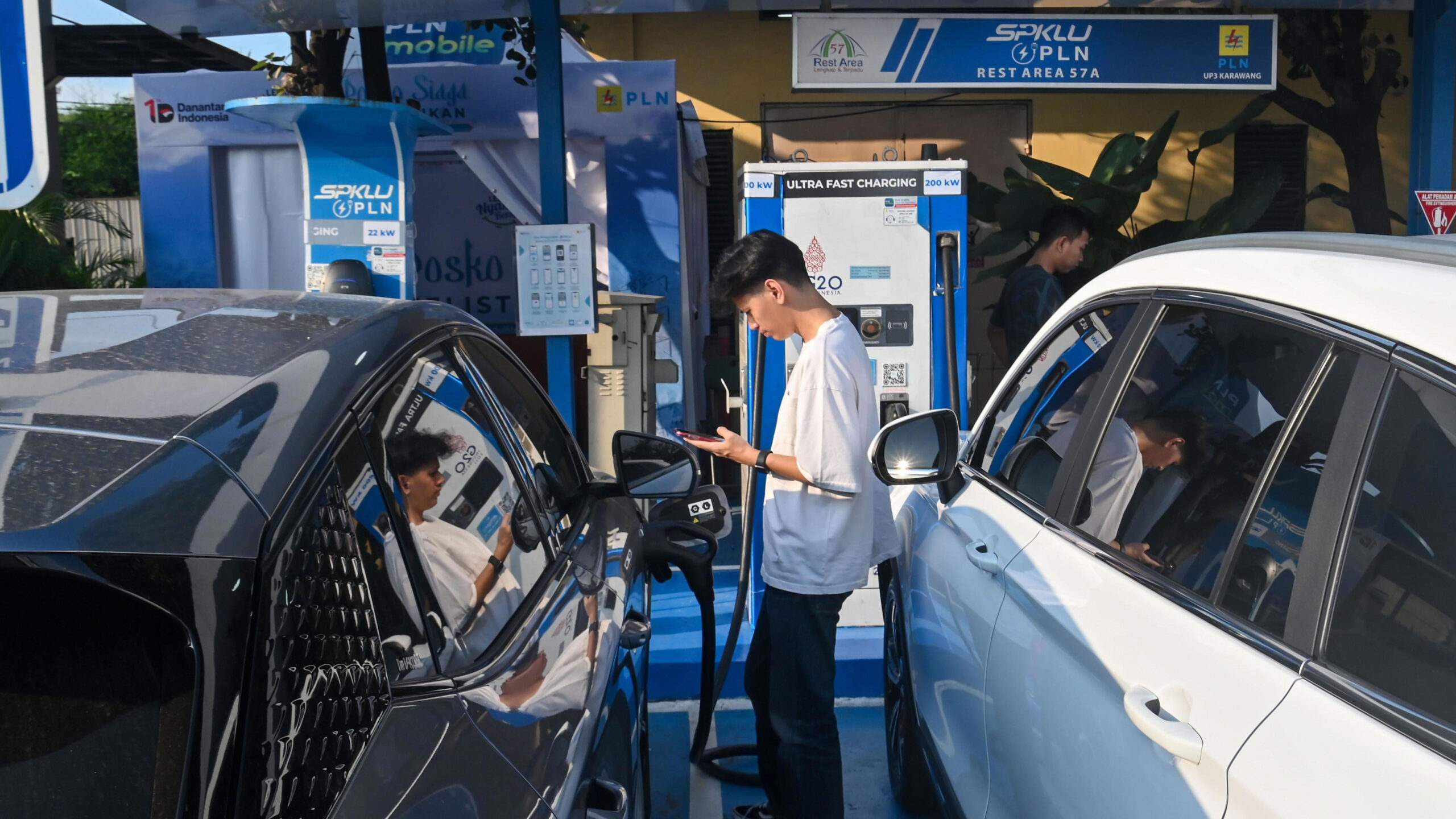
President Prabowo Subianto has unveiled an ambitious plan to convert all gasoline-powered vehicles to electric power amidst the global energy crisis, hailing it as a ‘game changer.’ However, experts warn that numerous hurdles must be overcome for this vision to materialize.
During discussions with national media leaders, President Prabowo outlined two primary goals for his electric vehicle conversion initiative. “I want total [vehicle] electrification,” Prabowo declared, envisioning a future where “All our motorcycles will be converted to electric motorcycles, all cars, all trucks, all tractors must be electric-powered.” From an economic standpoint, he noted, “So later, wealthy individuals who own Lamborghinis, Ferraris, can go ahead and use their petrol, just pay [according to] world [oil] prices.” Crucially, his aspiration extends to the power source itself, stating, “I want the electricity to come from solar [power].” President Prabowo, speaking on his YouTube channel ‘Presiden Prabowo Menjawab!!!’, projected that Indonesia should have solar power plants generating 100 GW of electricity within at least two years.
In the narrow, winding alleys on the outskirts of Jakarta, Haliman, a 55-year-old online motorcycle taxi driver, occasionally honks his horn to alert pedestrians of his approach. His electric motorcycle is so quiet that its engine is barely audible. Haliman recounts the significant savings he enjoys, spending no more than Rp10,000 to fully charge his bike. “Before using an electric motorcycle, I spent Rp60,000 on petrol every day. Now, charging to full battery takes four hours and only costs Rp8,000,” he shared. This switch has slashed his daily fuel expenses by nearly 90%. Yet, Haliman also faces a significant financial commitment, setting aside Rp55,000 daily for 1.5 years to pay off his electric motorcycle loan. The bike comes with a two-year warranty, while the battery is guaranteed for five years. “If the warranty expires and the battery breaks, the cost could be tens of millions [of rupiah],” he added, highlighting a common concern among EV users.
Haliman’s electric motorcycle is one of just 236,000 such vehicles in Indonesia. This figure pales in comparison to the staggering 139,450,013 fossil-fueled motorcycles across the nation, according to the National Statistics Agency (BPS). Similarly, electric cars number around 123,000 units, a mere fraction of the 20,444,507 fossil-fueled cars. For electric vehicles to truly dominate, experts agree that several critical obstacles must be overcome.
1. The Electric Vehicle Ecosystem
A significant hurdle lies in establishing a robust electric vehicle ecosystem. Ferry Triansyah, Coordinator of Electricity Business Services at the Directorate General of Electricity, Ministry of Energy and Mineral Resources (ESDM), revealed that as of October 2025, the ratio of Public Electric Vehicle Charging Stations (SPKLU) to electric vehicles stood at 1:26. This means one SPKLU serves 26 EVs, falling short of the ideal ratio of 1:17, as stated on the ESDM Ministry’s website. By September 2025, the state-owned electricity company PLN had operated 4,272 SPKLU machines across 2,811 locations and provided over 57,000 home charging services nationwide. Despite these efforts, a gap in SPKLU numbers for 2025 exists according to ESDM Ministerial Decree Number 24.K/TL.01/MEM.L/2025, which outlines the SPKLU Development Plan for 2025-2030. Last year’s projection aimed for 5,810 units, with numbers expected to surge to 62,918 by 2030, predominantly located on Java Island.
The projected increase in SPKLUs over the next four years is intended to coincide with the conversion of approximately 120 million fossil-fueled motorcycles to electric vehicles. ESDM Minister Bahlil Lahadalia claimed that around 200,000 motorcycles have been converted annually in previous years, expressing optimism that the program can accelerate, making conversions more affordable. “Now, there is technology that is cheaper, so perhaps around Rp5-6 million,” Bahlil remarked on March 5th after a limited meeting at the Merdeka Palace. Earlier, in 2024, the government had launched a motorcycle EV conversion subsidy program offering Rp7-10 million.

However, the EV ecosystem extends beyond just vehicles and charging stations. Bhima Yudhistira, Executive Director of the Center of Economic and Law Studies (CELIOS), questioned, “What about spare parts? When converted, many parties complain if the battery has problems; is battery replacement also subsidized?” Bhima emphasized that the government has only addressed the conversion stage, neglecting upstream-to-downstream issues. “For example, if the battery is damaged, does Indonesia have recycling facilities? That will become a new problem if there’s no containment for battery waste,” he warned. Indeed, as of March last year, Ary Sudjianto, Deputy for Climate Change Control and Carbon Economic Value Governance at the Ministry of Environment, admitted that Indonesia currently lacks facilities or industries to support the processing of electric vehicle batteries. “We are also aware that we will face this, perhaps in three or four years… how we process battery waste is something that needs attention as the number of batteries used for electric vehicles increases,” Ary explained. With an estimated 15 million electric vehicles projected by 2030, encompassing both new and converted units, this issue becomes increasingly urgent.

Environmental watchdog Wahana Lingkungan Hidup Indonesia (WALHI) argues that the government is offering a “false energy solution.” WALHI asserts that this path will exacerbate ecological impacts and human rights violations, including deforestation, land degradation, environmental pollution, agrarian conflicts, and ecological disasters, all logical consequences of energy business exploitation. Uli Arta Siagian, Coordinator of National Executive Campaigners at WALHI, stated, “When the president proposes converting all vehicles to electric, greater exploitation is needed to meet those electric vehicle demands. This cannot be presented as a solution to today’s energy crisis.”
2. The Source of Electric Vehicle Power
Another critical aspect is the origin of the electricity itself. During the Christmas and New Year (Nataru) holiday season of 2026, from December 15, 2025, to January 5, 2026, a total of 5,619 MWh of electricity was channeled for EV charging at SPKLUs. This period saw 234,136 charging sessions, a remarkable 479% increase compared to the same period in the previous year. In November 2025, PLN assured that the electricity supply for SPKLU needs was ready to support the EV ecosystem, utilizing only 5% of the national electricity reserve, which stands at 10,400 MW.
Despite President Prabowo’s aspiration for Indonesia to eventually rely on eco-friendly energy sources, a BBC News Indonesia report from 2023 highlighted that the majority of electricity used by electric vehicles still originates from Coal-Fired Power Plants (PLTU). A look at the 2024 Electricity Statistics reveals the ambitious president’s goal remains challenging to achieve. PLN’s power generation is predominantly coal-based (around 66.43%), followed by gas (17.65%), and oil (3.93%). In essence, electricity production is still heavily dominated by PLTUs. What President Prabowo envisions for renewable energy sources like solar power currently accounts for a mere 0.26% of the mix.

Bhima Yudhistira of CELIOS underscores this dilemma: “If yesterday’s traffic jams involved fossil-fueled vehicles, and now traffic jams involve electric vehicles powered by non-renewable energy, it ultimately doesn’t solve the fundamental problem.” A WALHI report further notes that while electric vehicles may not produce emissions on the road, their supply chain leaves a significant ecological footprint in mining regions. Data from Auriga indicates that the “electric vehicle fever” over the past two decades has led to the loss of 193,830 hectares of natural forest in Indonesia. Uli from WALHI asserts, “Ultimately, this energy crisis can be exploited by the government to expand the exploitation of several commodities.”
Moreover, while Indonesia’s electrification ratio stands at an impressive 99.83% according to PLN, approximately 1.3 million households still lack access to PLN electricity, as stated by ESDM Minister Bahlil Lahadalia on the Ministry’s website. President Prabowo has responded to this challenge, expressing confidence that “It feels like [within] five years, we can solve that.”
Are There Other Solutions to Consider?

According to Bhima, the most effective approach to reducing fuel consumption and carbon emissions is to prioritize public transportation. “Therefore, the most viable long-term and quick solution is subsidies for public transportation, including its infrastructure,” Bhima asserted. Regrettably, he notes that this solution has not been made a primary focus. Commenting on Prabowo’s EV conversion concept, Bhima described it as “a jumpy solution, moving from one solution to another, which is actually incomplete.”
WALHI’s records indicate that the transportation sector consumes approximately 52% of the total national fuel, with a staggering 93% used by private vehicles. “The remaining 7% is for public transportation. Looking at this, it means the development of the public transportation ecosystem is not optimal,” added Uli. Uli further pointed out the absence of policies to curb private vehicle purchases, which continuously drives up energy consumption. “It’s the same when switching from fuel to electric vehicles; if there are no restrictions, energy consumption will be similar to fuel use, so it will remain high.”

Ultimately, Uli contends that the fundamental issue lies in reforming the ecosystem balancing private and public transportation. She stressed that without this reform, “it will simply be the same; we will become dependent on one energy-generating commodity.” Consequently, Bhima views Prabowo’s electric vehicle conversion initiative as a “partial solution” or one that is “half-baked.” This is because a surge in electric vehicle users, particularly for private use, will inevitably lead to an increased reliance on coal for PLTUs. Thus, vehicle electrification goes beyond mere conversion; it necessitates a comprehensive overhaul of its upstream-to-downstream ecosystem, a target that CELIOS believes remains far from reach.
Summary
President Prabowo Subianto intends to convert all fossil fuel