

Warning: This article contains details that some readers may find disturbing.
Satellite imagery analysis has revealed a series of devastating attacks and scorched ruins surrounding a school in southern Iran. These findings strongly suggest the location was struck multiple times in an assault that, according to the Iranian government, claimed the lives of 168 people last Saturday, February 28.
Verified video footage and satellite images depict extensive damage around the Shajareh Tayebeh Primary School in Minab and the adjacent compound belonging to the Islamic Revolutionary Guard Corps (IRGC). N.R. Jenzen Jones, an ammunition expert, noted that the evidence indicates the area was “hit by multiple simultaneous or near-simultaneous strikes.”
Among the visible devastation, two buildings stand out: one structure within the IRGC base was completely leveled, while the school building suffered a partial collapse. The immediate aftermath of the strikes was captured in verified footage, showing distraught families screaming and individuals desperately searching for victims amidst the rubble. In some of these harrowing videos, people can be seen holding up children’s school bags and books toward the camera.
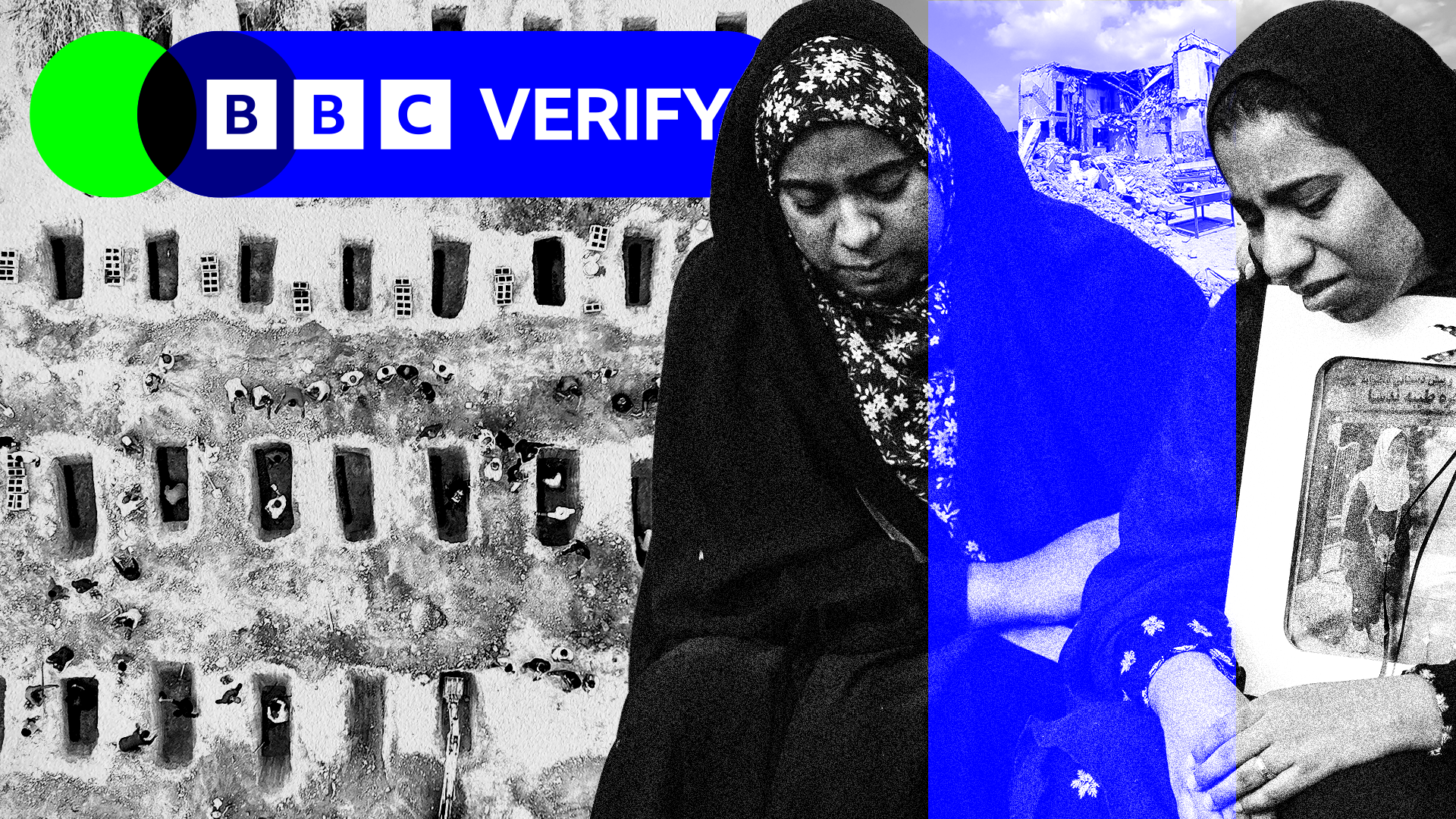
Three days later, aerial footage further underscored the tragedy, revealing at least 100 neatly marked or freshly dug graves, a somber testament to the lives lost.
Iranian officials promptly attributed responsibility for the attacks to the United States and Israel. However, neither nation has claimed involvement. Israel stated it had no knowledge of operations in the area, while then-U.S. President Donald Trump, conversely, placed the blame on Iran. “No, I think, based on what I’ve seen, it was done by Iran,” Trump asserted. Then-U.S. Secretary of Defense Pete Hegseth, meanwhile, affirmed that Washington was still investigating the incident, reiterating that the U.S. “would never target civilian sites.” The ongoing internet blackout across Iran has significantly complicated independent verification of the incident’s intricate details.
What Do We Know About the Incident?
Speculation surrounding the precise target of the attacks continues to mount. According to Iranian authorities, the strikes occurred around 10:45 local time (07:15 GMT). BBC Verify confirmed footage uploaded to social media on Saturday morning. In Iran, the work week runs from Saturday to Thursday, with Friday being a public holiday.
One video captures a man running into the schoolyard, located northeast of the IRGC headquarters. A partial sign above the entrance is visible, displaying initial letters consistent with “primary school” in Persian. From within the schoolyard, four plumes of black smoke are discernible, with two smaller plumes emanating from the upper windows of the main building. A wall adorned with children’s murals and Persian script separates the schoolyard from the IRGC headquarters.
Another piece of footage, filmed from a moving vehicle on the southern side of the IRGC complex, shows an entrance sign. Two IRGC logos are visible on the gate leading to the “Seyed al-Shohada Education and Culture Corps” and a medical clinic, which Iranian media reports belong to the IRGC navy. At least three columns of black smoke are seen in this recording: two near the headquarters’ entrance and one further back behind the medical clinic. The locations of these smoke plumes in the verified videos correlate precisely with the damage points observed in satellite imagery.

Later video documentation from that same day revealed severe damage to the school building. Emergency service personnel meticulously searched for the deceased and injured amidst the ruins, while distraught families waited anxiously around the courtyard, some overcome with wailing grief. A widely circulated video, geolocated to the school, showed rescue teams on site discovering a child’s severed arm beneath the debris. Blood-stained schoolbooks and backpacks were also visible among the wreckage, painting a grim picture of the attack’s impact.
What Did Satellite Imagery Reveal?
In the absence of more on-the-ground footage or direct testimonies, satellite imagery has become crucial for piecing together the events. Satellite images taken by Planet Labs on March 4 – four days after the incident – revealed far more extensive damage than initially confirmed through video evidence. Numerous buildings in the vicinity appeared partially or completely destroyed. BBC Verify identified at least five structures with clear craters and black scorch marks, definitively indicating multiple strikes.

“The sheer number of affected locations in close (relative) proximity suggests that there were one or more targets adjacent to one another,” remarked Jamon Van den Hoek, a satellite imagery analyst from Oregon State University. He added, “[It seems] the attack was intentional to hit the area,” but cautioned, “we don’t know what they intended to hit.” Oz Smith, a senior analyst from McKenzie Intelligence Services, informed BBC Verify that the crater observed on the ground floor of the two-story school building suggested that specialized ammunition might have been deployed to “penetrate to lower floors.”
Was the School Separate from the IRGC Base?
The school building stands in close proximity to the IRGC headquarters. Intriguingly, satellite imagery from 2013 appears to show the school building as part of the same complex, before a separating wall was erected in 2016, creating distinct entities.

Who Is Responsible for the Attack?
Iran maintains that the attacks were carried out by the U.S. and Israel. However, neither Israel nor the U.S. has accepted responsibility for the damage inflicted upon the school. Israel stated it was “unaware” of any Israel Defense Forces (IDF) operations in the area, though it informed BBC Verify that it was investigating the incident.
On Saturday, March 7, then-U.S. President Donald Trump was directly asked whether the U.S. was responsible for an attack on a girls’ school near an Islamic Revolutionary Guard Corps (IRGC) headquarters. He deflected, stating, “No, I think, based on what I’ve seen, it was done by Iran.” When a reporter subsequently pressed then-U.S. Secretary of Defense Pete Hegseth on the matter, Hegseth responded, “We are investigating, but the only ones who target civilians are Iran.” Trump then emphatically reiterated, “We think it was done by Iran… They’re very inaccurate, as you know, with their munitions. They have no accuracy whatsoever. It was done by Iran.” Earlier, on Wednesday, March 4, Pete Hegseth had told the BBC that the U.S. was still investigating the incident, adding, “Of course we never target civilian sites, but we are investigating that.”
During a press conference, an illustrative map was displayed detailing the “first 100 hours” of a hypothetical U.S.-Israel war with Iran. This map marked attack locations and Iranian air defenses along Iran’s southern coast, encompassing the Minab area. Without further footage of munition remnants, it remains impossible to conclusively identify those responsible.

A widely circulated video on social media sparked claims that the explosion was caused by a failed missile launch by the IRGC. However, investigations revealed that the image originated from an unrelated incident in Zanjan, more than 1,000 kilometers from Minab. Jenzen Jones, director of Armament Research Services, definitively stated, “The devastating blast damage seen here could not have been caused by an Iranian surface-to-air missile, which carries a relatively small explosive warhead.”
Who Was Killed?
Iranian officials reported that a tragic 168 people died, with the majority being children. BBC Verify has not been able to independently corroborate these specific details through the available footage of the incident. It also remains unclear whether any IRGC members were among the deceased or who might have been operating at the site.
According to Iran’s Ministry of Education, the school itself had a total enrollment of 264 students. A handwritten list published by Iranian media presented the names of 56 individuals reportedly killed in the incident, along with their birth dates. A heartbreaking 48 of these names were children aged between six and eleven years old. While BBC Verify has not been able to independently verify every detail on this list, at least three of the names correspond to those seen in other videos where coffins were labeled with identical names. Photos also emerged showing what appeared to be three children inside body bags, further highlighting the human toll.

The U.S.-based Human Rights News Agency (Hrana) has documented the deaths of 1,114 Iranian civilians since the start of the conflict, including 183 children. Days after the incident, state-run Iranian media broadcast footage of thousands lining the streets for funeral processions. Men were seen carrying coffins – some clearly child-sized – draped with the flag of the Islamic Republic. Crowds of women also held photographs of young boys and girls, mourning their losses. The semi-official Tasnim news agency, affiliated with the IRGC, published a photograph and reported that 14 school teachers had also perished in the attacks.
Additional reporting by Paul Brown.

- Photos of the funerals of students and staff killed in the US-Israel attacks in Iran
- ‘If we are not killed, we will stay here’ – The fate of Iranians amidst US-Israel attacks
- Israel attacks fuel depots in Tehran – ‘Night turned into day’
- What is the US-Israel objective in attacking Iran?
- Will Gulf states retaliate against Iranian attacks and be drawn into war?
- ‘The first casualties of this war are 40 children in Minab’ – Iranian public response to US-Israel attacks
- US-Israel attacks Iran, where are Russia and China?
- What happens if Iran closes the Strait of Hormuz, a global oil route?
- ‘This is not the Dubai we know’ – Testimonies from residents and tourists as Iran attacks the United Arab Emirates
- ‘If we are not killed, we will stay here’ – The fate of Iranians amidst US-Israel attacks
- Photos of the funerals of students and staff killed in the US-Israel attacks in Iran
- Will Gulf states retaliate against Iranian attacks and be drawn into war?
Summary
Satellite imagery and verified video confirm multiple missile strikes on a school and an adjacent Islamic Revolutionary Guard Corps (IRGC) base in Minab, southern Iran, on Saturday, February 28. The attacks caused extensive damage, including a leveled IRGC building and a partially collapsed Shajareh Tayebeh Primary School. Evidence suggests multiple simultaneous strikes, and aerial footage later revealed at least 100 freshly dug graves.
Iranian officials reported 168 fatalities, predominantly children, with a published list identifying 48 child victims aged six to eleven. While Iran attributed responsibility to the United States and Israel, both nations denied involvement; the U.S. President at the time, Donald Trump, conversely blamed Iran. The ongoing internet blackout has complicated independent verification of these complex details.