
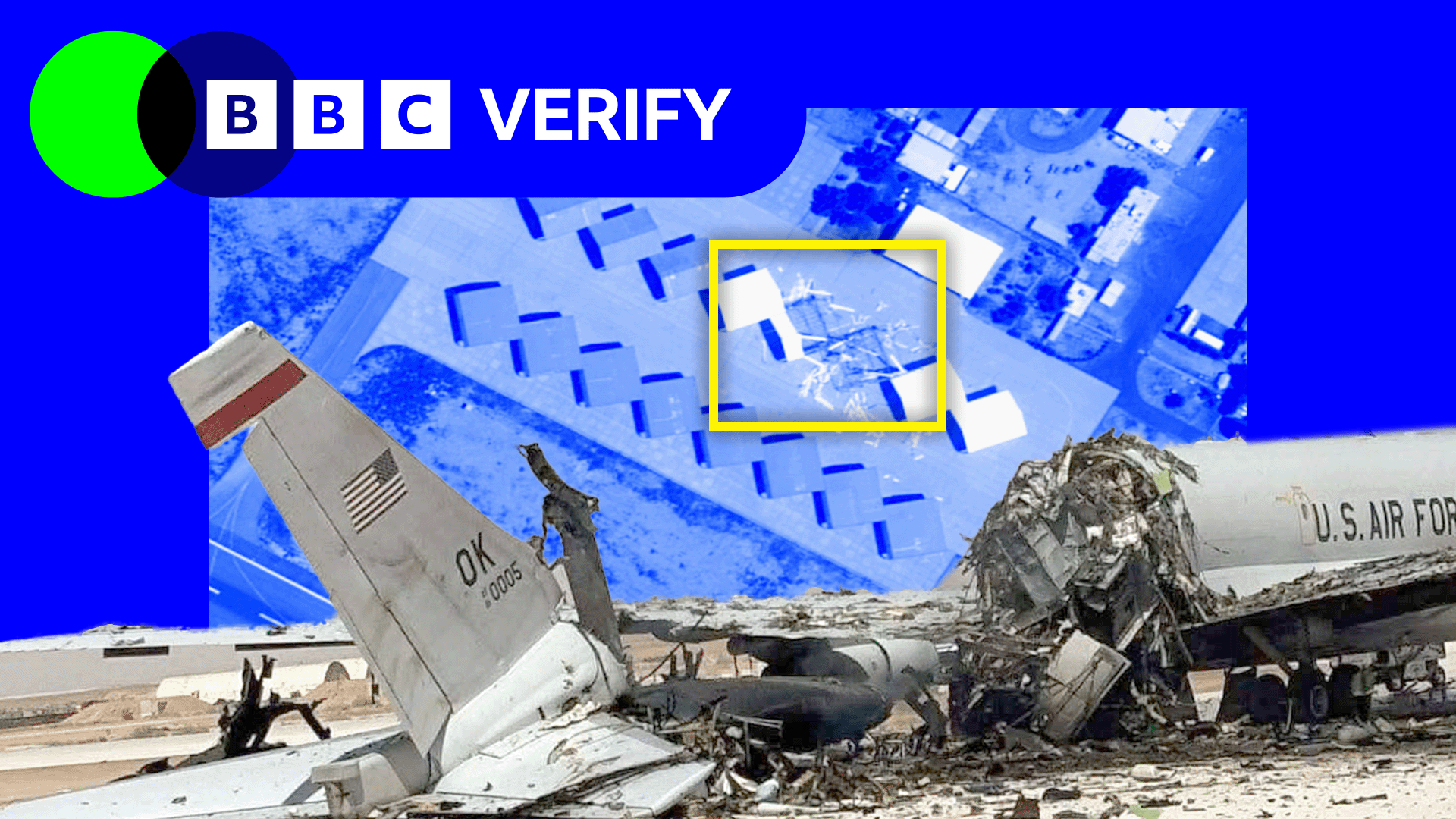

Iran has inflicted significant damage on 20 United States military facilities since the outbreak of war in late February 2026, a comprehensive analysis by BBC Verify reveals. Findings derived from satellite imagery and video footage indicate that the scale of these assaults is far more extensive than publicly acknowledged by US officials.
Since the conflict intensified, Iran has systematically targeted key US installations across eight countries in the Middle East. These critical facilities are situated in Saudi Arabia, the United Arab Emirates (UAE), Qatar, Kuwait, Iraq, Jordan, Bahrain, and Oman, underscoring the widespread nature of the Iranian offensive.
The actual number of strikes may even be higher, with some independent analysts estimating that as many as 28 US military bases have been successfully hit. This discrepancy suggests a potential underreporting of the full impact of Iran’s operations.
These coordinated attacks have resulted in millions of dollars worth of damage to sophisticated air defense systems, essential refueling aircraft, and crucial radar installations, severely impacting US operational capabilities in the region.
The targeting of US bases and joint military facilities by Iran comes in the wake of a three-month period marked by US-Israeli attacks on both Iranian and Lebanese territories, signaling a retaliatory cycle of violence.
Adding to the escalating rhetoric, Mojtaba Khamenei, who now serves as Iran’s Supreme Leader, declared on Tuesday, May 26, that the Middle East is no longer a “safe place” for American military bases, asserting a shift in regional power dynamics.

In stark contrast, the US Department of Defense, the Pentagon, has publicly claimed to have struck over 13,000 targets within Iran since the commencement of “Operation Epic Fury.” Similarly, the White House has repeatedly asserted that Iran’s military has been “almost completely neutralized,” projecting an image of overwhelming US success.
However, analysts examining the visible damage to US military facilities contend that Iran’s retaliatory strikes have been both more precise and geographically broader than US officials have admitted, casting doubt on the official narrative.
When approached for comment regarding BBC Verify’s findings, US defense officials declined, citing reasons of “operational security,” which further fuels speculation about the true extent of the damage.
Furthermore, the United States has actively sought to restrict the availability and analysis of satellite imagery within the conflict zone. Planet, a leading provider of satellite imagery, confirmed it was requested to place “indefinite” restrictions on new images of Iran and significant portions of the broader Middle East.
Planet justified this controversial move by stating that the US wished to prevent its imagery from being used “by opposing parties to target allied personnel and civilians, and NATO partners.” This highlights concerns over the strategic implications of open-source intelligence.
To circumvent these restrictions and meticulously track the damage inflicted by Iranian attacks, BBC Verify utilized satellite imagery from various other international providers, complementing it with older, unrestricted images from Planet.
What Key US Equipment Was Affected by the Attacks?
The damage sustained at these military installations has reportedly devastated critical equipment, exacerbating the operational challenges faced by US forces.
Among the crucial assets impacted were three advanced anti-ballistic missile launcher systems located at Al Ruwais and Al Sader airbases in the UAE, as well as the Muwaffaq Salti Air Base in Jordan, signifying a substantial blow to regional defense capabilities.
The US operates only eight Terminal High Altitude Area Defense (THAAD) systems globally, making these losses particularly significant. Each THAAD system carries a production cost of approximately US$1 billion (equivalent to Rp17.8 trillion). Operating each launcher requires about 100 personnel, and each missile fired is valued at around US$12.7 million per unit (approximately Rp226.1 billion).
Vice Admiral Mark Mellett, the former chief of staff of the Irish Armed Forces, informed BBC Verify that these missile launcher systems are indispensable to a “highly complex” regional defense network and “cannot be quickly or easily replaced,” underscoring their strategic importance and the difficulty of recovery.
Beyond missile defenses, Iranian attacks also caused substantial damage to US refueling and reconnaissance aircraft stationed at Prince Sultan Air Base in Saudi Arabia, impacting critical support and intelligence gathering operations.
Expert analysis of satellite imagery clearly shows the damaged aircraft. One particular aircraft was identified by analysts at MAIAR as an E-3 Sentry reconnaissance plane. US media outlets have reported that the replacement cost for such an aircraft could reach a staggering US$700 million.
Elsewhere, Iranian forces targeted the Ali Al Salem Air Base and Camp Arifjan in Kuwait. MAIAR analysts confirmed that fuel storage bunkers, aircraft hangars, and troop accommodation facilities were destroyed after enduring multiple strikes throughout the conflict, illustrating a broad assault on infrastructure.
At Camp Arifjan, the defense intelligence firm Janes identified widespread damage to satellite communication equipment, further compromising critical logistical and operational capabilities.

Despite these detailed findings, the full extent of the damage to US facilities remains challenging to quantify precisely. However, the Pentagon’s report in May allocated a total cost of US$29 billion to Operation Epic Fury, with a significant portion likely earmarked for “repair or replacement costs for equipment” obliterated in the ongoing conflict.
Notably, Democratic politicians have voiced concerns that this allocated figure represents a considerable underestimate of the true financial burden on US taxpayers.
The report also revealed that at least 42 aircraft—including advanced F-15 and F-35 fighter jets, 24 MQ-9 Reaper drones, and an A-10 attack aircraft—have been either destroyed or damaged since February, highlighting substantial material losses.
What About Iran?
Iran, in its offensive operations against targets across the Middle East, has reportedly relied on inexpensive and easily replaceable drones, showcasing a strategic approach focused on asymmetrical warfare and resource conservation.
Experts who spoke with BBC Verify detailed how Iran’s tactics have significantly evolved during the course of the war. They noted a strategic shift from massive, indiscriminate missile barrages targeting cities and bases towards more precise and highly targeted strikes.
“Iran’s initial attacks were designed to rely on mass waves aiming to overwhelm air and missile defenses through sheer numbers,” stated Dr. Kelly Grieco, an analyst from the US-based Stimson Center think tank. “However, within days, Iran shifted to smaller, more targeted barrages. They conserved their remaining missiles and drones for high-value targets and concentrated attacks in locations where even near misses could cause severe damage,” she elaborated on Iran’s tactical adaptation.
Analysts at MAIAR informed BBC Verify that the US military “appears guilty of complacency in the early stages of the war,” failing to relocate aircraft beyond the range of Iranian drones and missiles even as Iran’s tactics became more sophisticated and effective.
A notable example is the Prince Sultan Air Base, which had already been attacked before the significant destruction of aircraft occurred, suggesting a missed opportunity for preventative measures.
Further emphasizing Iran’s assertive stance, Supreme Leader Mojtaba Khamenei vowed that “the nations and regions of this area will no longer be a shield for American bases.” He emphatically added: “The US will no longer have a safe place in this region, even to establish military bases. And day by day it will move further away from its previous position,” indicating a long-term strategy to diminish US influence.
Khamenei’s potent statements emerged just days before a fragile ceasefire between the US and Iran experienced renewed tensions, further complicating the delicate diplomatic landscape.
On Thursday, May 28, the Islamic Revolutionary Guard Corps (IRGC) of Iran announced it had attacked a US base in the region, following new US strikes in southern Iran, illustrating the precarious nature of the ceasefire and the potential for rapid escalation.
Dr. Grieco cautioned that if the delicate ceasefire between the US and Iran were to collapse and fighting resume, the damage already inflicted on US bases suggests that facilities across the entire Gulf region could become critically vulnerable.
“The current conflict has significantly depleted US and allied air defense stockpiles,” she explained. “There is no quick way to replenish those supplies, meaning new Iranian attacks will be met with only a fraction of the amount of defenses available when the conflict began,” she warned, painting a grim picture of future defensive capabilities.
Additional reporting from Barbara Metzler and Tom Gould.

- US strikes Iranian radar site as Kuwait faces missile and drone attacks
- US again strikes targets in Iran for second time in three days, Tehran condemns – ‘Serious violation of ceasefire’
- Iran’s ‘mosquito fleet’ challenges US Navy in the Strait of Hormuz
- ‘Started in a small workshop in the 1980s’ – How did Iran develop its drone arsenal?
- US-Israel vs Iran: Who runs out of ammunition first, and does ammunition stock determine the war’s winner?
- Iranian missiles breach Israeli air defense, hit two cities near nuclear facilities
Summary
Sebuah analisis komprehensif oleh BBC Verify menggunakan citra satelit mengungkapkan bahwa serangan Iran sejak akhir Februari 2026 telah merusak setidaknya 20 hingga 28 fasilitas militer Amerika Serikat di Timur Tengah. Kerusakan tersebut mencakup aset bernilai tinggi, seperti sistem pertahanan rudal THAAD, pesawat pengintai E-3 Sentry, serta berbagai hangar dan peralatan komunikasi di delapan negara berbeda. Temuan ini berlawanan dengan narasi resmi pemerintah AS yang mengeklaim telah menetralkan militer Iran secara signifikan.
Kementerian Pertahanan AS sejauh ini menolak memberikan komentar terkait rincian kerusakan tersebut dan telah membatasi akses publik terhadap citra satelit di zona konflik. Sementara itu, Iran dilaporkan telah mengubah taktik mereka dengan menggunakan serangan drone yang lebih presisi dan efisien untuk menyasar target strategis. Para ahli memperingatkan bahwa konflik yang terus berlanjut telah menguras persediaan pertahanan udara AS, yang membuat posisi militer Amerika di wilayah tersebut menjadi semakin rentan.
