
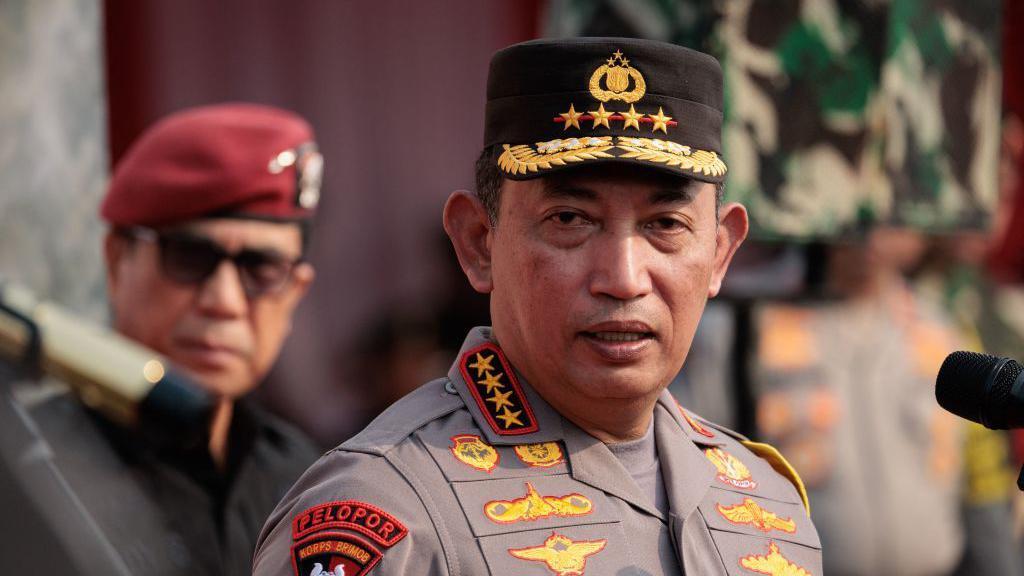

Proposed changes to Indonesia’s Police Law—which could extend the retirement age of four-star generals to 60 and potentially 63 at the President’s discretion—carry a heavy political scent ahead of the 2029 elections, according to the Commission for the Disappeared and Victims of Violence (Kontras).
Dimas Bagus Arya, the Coordinator of Kontras, pointed out that National Police Chief (Kapolri) Listyo Sigit Prabowo, currently 57, would normally be required to retire next year under existing legislation. The timing of the revision has sparked concerns that the move is specifically designed to keep the current leadership in place.
However, Minister of Law Supratman Andi Agtas has dismissed claims that the revision is a maneuver to extend General Listyo Sigit’s tenure. He argued that the proposal is rooted in the principle of fairness, aligning the police force with other branches of the civil service and the military.
“There is absolutely no connection to whether the National Police Chief’s tenure is extended or not,” Supratman claimed. Despite these assurances, the police’s Public Relations Division has yet to provide an official response to inquiries regarding the matter.
What are the key points of the Police Bill (RUU Polri)?
During the 19th Plenary Session of the House of Representatives (DPR) in mid-May, all political factions agreed to designate the revision of the Police Law as a DPR initiative. The decision was formalized by Deputy Speaker Saan Mustopa after a review of written opinions from various factions.
Proponents of the bill argue that Law No. 2 of 2002 is outdated, having been in effect for over two decades. They emphasize the need to harmonize police regulations with modern national laws, including the newly enacted Criminal Code (KUHP) and the Criminal Procedure Code (KUHAP).
The proposed revision outlines seven primary objectives:
- Clarifying the direction of police reform to ensure a transparent, professional, and high-quality public service.
- Strengthening oversight functions and transparency through the integration of modern information technology.
- Guaranteeing neutrality and professionalism in human resource management and career development.
- Establishing strict regulations for police officers assigned to external institutions.
- Adjusting the retirement age based on organizational needs with clearer, measurable criteria.
- Implementing an educational curriculum rooted in humanism, democracy, and the protection of human rights.
- Strengthening the duties and repositioning the National Police Commission (Kompolnas).
The rationale behind extending the retirement age
The latest draft of the RUU Polri significantly alters Article 30, Paragraph 2. Currently, the standard retirement age is 58, with a possible two-year extension for those with “special expertise.”
Under the proposed changes, the retirement age for all ranks—from enlisted personnel to three-star generals—would be set at 60. For four-star generals, the limit is also 60, but it can be extended to 63 if the President deems it necessary.
Minister Supratman Andi Agtas maintains that this is a matter of equity. He noted that the retirement age for civil servants (ASN), the military (TNI), and prosecutors has already been adjusted to 60, with some functional roles reaching 65.
“It is about justice. Civil servants now retire at 60, and the TNI law has also been amended. We must also account for increasing life expectancy, which extends a person’s productive years,” Supratman explained. He further noted that producing high-quality law enforcement officers requires significant investment, making it logical to retain experienced personnel longer.

Regarding the specific case of General Listyo Sigit, Supratman clarified that any extension would not be automatic or indefinite. “The extension would be evaluated year by year, depending on whether the President still requires that individual’s service to the state,” he added.
Potential impacts: A “bottleneck” and political risks
Kontras Coordinator Dimas Bagus Arya warned of significant negative repercussions if the bill passes. The first concern involves human resource management within an institution that now comprises nearly 600,000 personnel.

Dimas argues that extending the retirement age will stall internal regeneration. “It creates a bottleneck. When the path to becoming a middle-ranking or high-ranking officer narrows, it becomes a ‘time bomb’ for potential corruption and the buying and selling of positions,” he cautioned. Such a situation, he added, would undermine efforts to eliminate collusion and nepotism within the force.
The second concern relates to the stagnation of leadership. Under President Joko Widodo, Listyo Sigit has already become one of the longest-serving police chiefs in the Reformasi era, surpassing the tenure of his predecessors. Historically, the leadership cycle averages about two years.
“Healthy regeneration ensures a healthy institution. A regular change in leadership brings fresh paradigms and professionalism,” Dimas said. He suggested that keeping the same leadership through the 2029 elections raises red flags about political neutrality.
“The public hasn’t forgotten the police’s role in the 2019 and 2024 elections. It is difficult to believe that this extension is devoid of political interests,” he claimed.

Avoiding institutional jealousy
Susno Duaji, former head of the Criminal Investigation Department (Bareskrim), expressed skepticism regarding the “fairness” argument. He noted that if the goal were true equality with other legal professions, the retirement age should be 70, matching that of judges.
Susno emphasized that any change must be based on three factors: the general health of officers, life expectancy, and institutional health. “Will this extension disrupt career development? It could trigger jealousy and clog the system,” he warned.
He suggested that if the change is implemented, it should be done gradually—perhaps starting at 58 or 59—and applied uniformly across all ranks to avoid internal friction.
Next steps for the Police Law revision
DPR Deputy Speaker Sufmi Dasco Ahmad clarified that the proposal is still in the early stages within the working committee (Panja). He reiterated that the primary motivation is to synchronize regulations across law enforcement agencies.
“Prosecutors retire at 61, or 62 for functional roles. We want to ensure there isn’t too wide a gap between the police, the military, and other law enforcement bodies,” Dasco told reporters at the Parliament Complex.
- The controversy of the Police Bill and the KUHAP Revision – What are the problematic points?
- Placing the police under a ministry rejected by the Kapolri—why is it not seen as a solution?
- Police Law Revision: ‘Changes should focus on stopping wrongful arrests and police violence’
- When the state arrests youth after the August 2025 protests – ‘The largest manhunt since the 1998 Reform’
- Police use of firearms ‘without calculation’ kills teenager in Makassar – ‘If they shot upward, how was my son hit?’
- Police in Tual beat a child to death – ‘As with previous incidents, the victim was slandered’
- Fact-Finding Commission findings on the August 2025 riots: ‘Accumulated public anger and operational patterns similar to Malari 1974’
- Gandhi Sehat pulls album ‘Cita-citaku (Ga Jadi Polisi)’ – Why is society now self-censoring?
- Placing the police under a ministry rejected by the Kapolri—why is it not seen as a solution?
Summary
A proposed revision to Indonesia’s Police Law (RUU Polri) seeks to extend the mandatory retirement age for four-star generals from 58 to 60, with a potential extension to 63 at the President’s discretion, and for other ranks to 60. Critics, including Kontras, view this as politically motivated, aiming to extend the tenure of current National Police Chief Listyo Sigit Prabowo ahead of the 2029 elections. Conversely, Minister of Law Supratman Andi Agtas maintains the change is rooted in fairness, aligning police retirement ages with those of civil servants and the military, and considering increased life expectancy.
Opponents warn that extending the retirement age risks creating a “bottleneck” in career progression, potentially fostering corruption and stifling internal regeneration within the nearly 600,000-strong institution. Concerns also include potential stagnation of leadership and jeopardizing the police’s political neutrality, particularly given their past roles in elections. While the bill’s proponents emphasize modernizing the two-decade-old law and harmonizing it with current national legislation, critics remain skeptical that the extension is devoid of political interests.
