
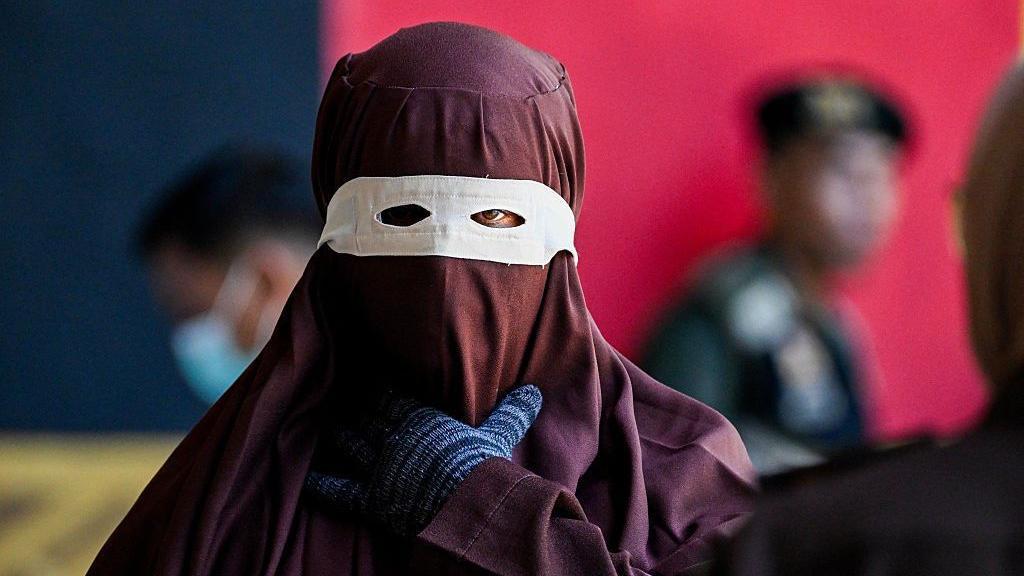
In an unprecedented event last January, an Islamic Sharia police officer in Aceh received corporal punishment, marking the first time such an official has been publicly caned. This occurred amidst another case where a convict endured 140 lashes, the highest number of strokes administered since Sharia law was implemented in Aceh. Human rights activists have voiced strong criticism, highlighting concerns about discrimination, the inherent violence, and the questionable deterrent effect of caning in the region.
The Sharia police officer, identified by his initials TSA, was subjected to caning for engaging in pre-marital sexual relations or intimacy and consuming alcohol. These acts are strictly prohibited under Sharia law in Aceh, which stands as the only province in Indonesia to enforce such statutes.
TSA, an employee with the Public Order Agency and Wilayatul Hisbah (Sharia Police), was caned at Taman Sari Bustanusalatin in Banda Aceh on Thursday, January 29. He had been detained in mid-November 2025 (note: original text says 2025, assuming it’s a typo and meant 2024 or earlier, but retaining as per instruction to not add new info) after being caught “alone with a woman who was not his muhrim” (a prohibited intimate interaction, known as jarimah ikhtilath) in a boarding house in Banda Aceh. He received 23 lashes, a number reduced due to his two months in detention. His partner, identified as AD, also received 23 lashes at the same location. Both were found guilty of committing jarimah ikhtilath, violating Article 25 Paragraph (1) of Aceh Qanun No. 16 of 2014.
Beyond TSA and AD, four other individuals were also caned, with the number of lashes varying according to their respective sentences. Among them, a couple identified as HA and VO received a staggering 140 lashes each. They were convicted of adultery (jarimah zina) and consuming alcoholic beverages (khamar). As reported by Hidayatullah for BBC News Indonesia, these 140 lashes represent “the highest number ever during caning executions in Aceh.” Hidayatullah, who was present at the scene, noted that the female convict, VO, “was seen whimpering in pain” and “waved her hands upwards with each stroke of the rattan on her back.”
During VO’s punishment, three female executioners took turns wielding the rattan. Hidayatullah recounted, “At several moments, she even embraced her body with her hands, crying.” HA and VO were found guilty of violating Article 33 Paragraph (1) and Article 15 Paragraph (1) of Aceh Qanun No. 6 of 2014 concerning Jinayat Law, Jarimah Zina, and Jarimah Khamar. Separately, two other convicts, AR and A, were caned 42 and 52 times, respectively, for engaging in intimacy and consuming alcohol.
Female Convict’s 140 Lashes Questioned
Azharul Husna, Coordinator for the Commission for Missing Persons and Victims of Violence (Kontras) Aceh, specifically highlighted the 140 lashes administered to the female convict, VO. Husna questioned the nature of the caning, emphasizing that it should not involve elements of violence or torture. “There are quite humane rules, where caning is not meant to hurt. But we know in practice, because there are no standard rules,” Husna stated on Friday, January 30. “How can we measure a person’s energy, strength, and so on?” she added rhetorically, pointing to the arbitrary nature of the punishment.
Read also:
-
Member of Aceh’s Ulema Council caned for ‘being alone with another man’s wife’, first case involving a religious leader
-
Aceh’s Qanun Jinayat deemed ‘discriminatory’: ‘If the common people make a mistake, they are immediately brought to justice’
During the caning execution on Thursday, January 29, in Banda Aceh, a female convict reportedly fainted while undergoing her punishment. She was subsequently carried off the stage on a stretcher and placed into an ambulance. Responding to the caning of the Banda Aceh Satpol PP-WH officer, Husna acknowledged it as a demonstration of “equality before the law and being treated equally without discrimination.” However, she quickly added, “But, for how long can this jinayah punishment deter people? Because there are still many repeat offenders of caning sentences.” Husna contended that certain regulations within the qanun jinayah (Aceh’s Islamic Sharia Regional Regulation) require amendment, offering examples of necessary improvements.
“How about victim reparation and victim recovery after punishment? Not to mention in several cases of Sharia violations that have not decreased [in number], such as cases of violence against children and women,” Husna elaborated, underscoring the broader societal impact.
‘Staining the Enforcement of Islamic Sharia’
Muhammad Rizal, Head of Banda Aceh Satpol PP-WH, framed the caning of his officer, TSA, as a testament to their commitment to enforcing Islamic Sharia. “One Satpol PP-WH officer, executed today, stands as our promise and commitment to the enforcement of Islamic Sharia, because he has stained the good name of Islamic Sharia enforcement,” Muhammad Rizal declared. In addition to being caned, TSA will also be dismissed from his position. Rizal confirmed, “Today, we will also hand over the dismissal letter to the convict.” This particular case of a Sharia law enforcement officer receiving corporal punishment is the first of its kind in Aceh.
TSA, who was a Government Employee with a Work Agreement (P3K) in the Public Order Agency and Wilayatul Hisbah, was originally slated to receive a permanent work letter (SK) in January 2026. However, due to his actions, he has been dismissed for violating ethical conduct, according to relevant officials. Isnawati, Head of General Crimes at the Banda Aceh Prosecutor’s Office, explained that TSA and his partner AD were charged under Article 25 Paragraph (1) of Aceh Qanun No. 6 of 2014 concerning Jinayah Law, specifically for the Sharia violation of intimate interaction or being alone with a non-muhrim. “They were caught alone in a boarding house, then we processed them until the caning, which was originally 25 times minus two strokes for the period of detention,” Isna clarified.
Separately, Irwan Adaby, a lecturer at UIN Ar-Raniry and a drafter of the qanun jinayah, stated that every Sharia violator must be punished under that law, provided they are Acehnese and committed the offense in Aceh. He further asserted that the punishment for TSA, being a ‘Sharia police’ member, should be more severe. “For officials, caning alone is not enough; there must also be internal sanctions and penalties,” Irwan suggested. Furthermore, Irwan posited that the implementation of Islamic Sharia in Aceh is relatively more transparent compared to “closed” Islamic countries in their application of Sharia. “We have a judicial process and so on; we don’t arbitrarily apply Islamic Sharia in Aceh. There’s a better process compared to closed Islamic countries like Afghanistan, Saudi Arabia,” Irwan claimed.
Criticized by Human Rights Activists, Deemed Detrimental to Women
From its inception, human rights activists have criticized the Qanun Jinayah, or Islamic Sharia Regional Regulation, in Aceh, urging a comprehensive review of the rules. They argue that some of its content and implementation contradict the Indonesian Constitution and disadvantage women. In 2014, the Aceh Parliament officially ratified the Islamic Sharia Regional Regulation—initially drafted in 2002—which covers offenses such as khalwat (indecency), khamr (alcohol), and maisr (gambling). Over time, this qanun has expanded to regulate a total of 10 criminal acts, including sexual harassment, rape, and same-sex relations.
The penal threats under Qanun Jinayah for perpetrators of Islamic Sharia violations in Aceh range widely, from 10 to 200 lashes. Alternative punishments include fines from 200 to 2,000 grams of pure gold, or imprisonment from 20 to 200 months. The lightest punishment is typically for acts of indecency, while the most severe penalties are reserved for child rapists. Meanwhile, some residents of Aceh perceive that the implementation of caning in the province, often called the ‘Verandah of Mecca’, disproportionately targets lower-income individuals, while officials appear to be ‘immune to the law’.
Read also:
-
Aceh caning punishment: ‘I ask that the punishment is not just for the small people’
-
Is the implementation of caning law in Aceh still ‘partial’?
-
Aceh’s Jinayat Regulation continues to be condemned
These critics demand that the qanun jinayah—the regulation outlining criminal offenses subject to caning—should not solely address personal matters such as adultery, gambling, and LGBT issues, but also public interest cases, including corruption. Such perceptions have been challenged by several officials in Aceh, who assert that the qanun jinayah ‘shows no favoritism’.
-
Deemed detrimental, Aceh’s Islamic Sharia Regional Regulation proposed for review
-
Member of Ulema Council in Aceh caned for ‘being alone with another man’s wife’
-
Aceh residents urge corrupt officials to be punished according to Islamic Sharia

Summary
In an unprecedented event, an Islamic Sharia police officer in Aceh was publicly caned for pre-marital intimacy and alcohol consumption, marking the first time such an official received this punishment. His partner also received 23 lashes. Concurrently, a female convict endured 140 lashes for adultery and alcohol consumption, reportedly the highest number ever administered in Aceh, prompting her to whimper in pain and faint. These punishments were carried out under Aceh’s Sharia law, which is unique to this Indonesian province.
While authorities framed the officer’s caning as a commitment to Sharia enforcement and equality before the law, human rights activists strongly criticized the punishments. They voiced concerns about the inherent violence, discriminatory aspects, and the questionable deterrent effect of caning. Critics argue that Aceh’s Qanun Jinayah contradicts the Indonesian Constitution, disadvantages women, and often disproportionately targets lower-income individuals, calling for a comprehensive review of the regulations.