
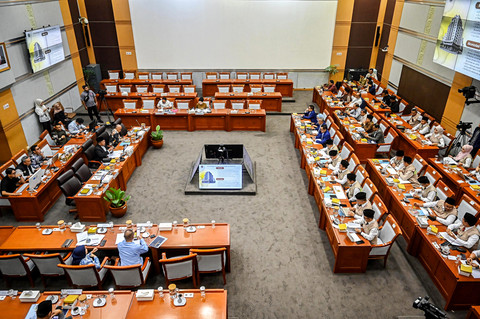

As preparations for the 2026 Hajj season intensify, Indonesia’s House of Representatives (DPR) Commission VIII convened a crucial working meeting with the Ministry of Hajj and Umrah on Wednesday, April 8th. This high-stakes meeting aimed to meticulously review progress, identify shortcomings, and address the latest developments concerning the forthcoming pilgrimage. The session saw the direct presence of Minister of Hajj and Umrah, Mochamad Irfan Yusuf, widely known as Gus Irfan, alongside his dedicated team, underscoring the government’s commitment to ensuring a seamless Hajj experience.
Held at the Parliament Complex, the working meeting specifically delved into the comprehensive preparations for the 1447 Hijriah/2026 CE Hajj pilgrimage. Abdul Wachid, Deputy Chairman of DPR Commission VIII, highlighted the prevailing global conditions that could potentially influence the operational costs of next year’s Hajj. He emphasized the pressing need for governmental clarity regarding potential cost increases and the proposed funding mechanisms, particularly in light of ongoing security concerns in the Middle East.
A significant point of discussion revolved around the potential surge in Hajj flight costs for 2026, as revealed by Minister Mochamad Irfan Yusuf during the meeting. He stated that the average flight cost per pilgrim is estimated at around Rp 33.5 million, a figure projected to rise significantly due to a confluence of global factors. These include soaring jet fuel prices, escalating operational costs, and the weakening of the rupiah’s exchange rate. Furthermore, the volatile geopolitical landscape could necessitate flight rerouting to bypass conflict zones, adding another layer of expense. Minister Irfan conveyed President Prabowo’s emphatic directive: under no circumstances should any potential cost increases be borne by Indonesian Hajj pilgrims.
Complementing this assurance, Deputy Minister of Hajj and Umrah, Dahnil Anzar Simanjuntak, later confirmed that the state would absorb these additional flight expenses. The surge, attributed to the prolonged Middle East conflict driving up jet fuel prices, led both Garuda Indonesia and Saudia Airlines to increase their per-pilgrim flight charges by Rp 7.9 million and $480 respectively. President Prabowo explicitly mandated that these additional costs, totaling Rp 1.77 trillion, would be covered directly by the State Budget (APBN) through efficiency measures, thereby safeguarding pilgrims from any financial burden.
Beyond financial concerns, Minister Irfan Yusuf detailed several logistical hurdles impacting the provision of Hajj consumption for 2026. A substantial challenge emerged with the delay of 2,200 tons of rice, a shipment that regrettably became ensnared in the Iran conflict just two days after its dispatch. While the remaining available rice is now being prioritized for Hajj officers via air cargo, securing supplies remains a complex task. Additionally, there have been issues with obtaining health certificates from the Food and Drug Supervisory Agency (BPOM) for spice shipments, leading to coordination delays and even the re-export by air of 32 tons of spices that failed sea shipment.
Despite these challenges, the Minister also provided reassuring updates on the Hajj 2026 timeline and visa progress. He outlined a meticulous schedule, with pilgrims expected to enter Hajj dormitories on April 21, 2026. The first wave of departures is set for April 22, 2026, heading to Medina before proceeding to Mecca. The spiritual pinnacle of Hajj, the movement to Arafah and the Wuquf, is anticipated to occur on May 25-26. Repatriation of pilgrims will commence on June 1, 2026, with the first wave returning from Mecca via Jeddah, and the entire process is slated for completion by July 1, 2026. Minister Irfan confirmed that visa processing for pilgrims is nearing completion, indicating significant progress in this critical area.

However, the meeting was not without its criticisms, particularly regarding pilgrim accommodation. Selly Andriany Gantina, a member of Commission VIII, expressed profound disappointment over hotel placements. She highlighted the case of Al-Hidayah Hotel, which, despite an agreed maximum distance of 4-5 kilometers from key worship sites, was found to be nearly 13 kilometers away. Her concerns extended to the hotel’s facilities, describing prayer rooms and ablution areas as inadequate, and the overall condition of the hotel as old and unsuitable for pilgrim comfort. Fellow Commission VIII member, M. Husni, echoed these complaints, vividly describing dusty, discolored curtains and carpets that appeared decades old, emphasizing the need for higher standards.

Adding to the list of operational concerns, Commission VIII also scrutinized delays in luggage distribution. Minister Mochamad Irfan Yusuf acknowledged that approximately 1,600 out of a total of 20,000 pilgrim suitcases had yet to reach the Ministry of Hajj’s regional offices, primarily due to shipping complications. While Saudia Airlines’ overall progress stood at 58%, Garuda Indonesia committed to ensuring all suitcases would be delivered by April 16th, an assurance met with urgency by Deputy Chairman Abdul Wachid. He stressed that these delays were causing considerable anxiety among pilgrims eagerly awaiting their departure, underscoring the critical importance of timely and efficient luggage management.
In summary, the 2026 Hajj preparations are progressing amidst complex financial, logistical, and quality control challenges. While the government, under President Prabowo’s directive, has taken decisive action to shield pilgrims from rising flight costs through state budget allocations, careful attention is still needed to resolve issues related to food supply, accommodation standards, and luggage distribution. The collaborative efforts between the DPR Commission VIII and the Ministry of Hajj and Umrah remain crucial in navigating these obstacles, striving to uphold the sanctity and comfort of the Indonesian Hajj pilgrimage.
