
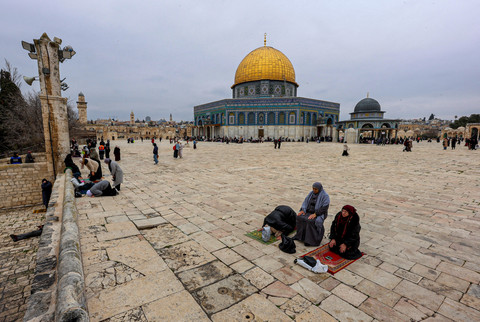
The Jerusalem Provincial Government has accused Israel of actively obstructing Ramadan preparations at the revered Al-Aqsa Mosque. These actions are condemned as an attempt to impose unilateral facts, directly contradicting the established historical and legal status of the holy site.

Reports from Jordanian media outlet Khaberni on Monday, February 16, indicate that Israeli authorities have issued more than 250 expulsion orders from the sacred Al-Aqsa complex. This aggressive stance underscores the escalating tensions in the region.
A statement from the Jerusalem Government, also cited by Khaberni, emphatically declared, “All occupation measures in Jerusalem and both Islamic and Christian holy sites are null and void under international law.” This highlights a firm rejection of Israel’s policies.
Further compounding the issue, the Jerusalem Provincial Government detailed how Israel has actively prevented the execution of crucial logistical plans designed to accommodate Ramadan worshippers. This includes the prohibition of installing protective tents, essential for shielding pilgrims from heat or rain, as well as the establishment of temporary field clinics vital for health and safety.
“The occupation continues to exert pressure on employees of the Islamic Waqf Department,” the Jerusalem Government’s statement affirmed, pointing to a broader campaign against the administrators of the holy site. Approximately 25 employees have reportedly been expelled, with four others detained amidst these escalating pressures.
Al-Aqsa Imam Detained Ahead of Ramadan
In a significant development amidst these contentious circumstances, Sheikh Muhammad Ali Abbasi, the Imam of Al-Aqsa Mosque, has reportedly been detained by Israeli authorities. This detention follows a prior week-long ban that prevented him from accessing the mosque complex.
Anadolu Agency further reported that Israeli authorities imposed this ban on the Al-Aqsa Mosque Imam in occupied East Jerusalem for one week, mere days before the commencement of Ramadan. Such actions invariably heighten religious and political sensitivities.

Adding to the chorus of concerns, prominent Palestinian religious figure Sheikh Ekrima Sabri previously drew attention to severe restrictions on access to Al-Aqsa. He explicitly stated that “Israeli authorities have banned dozens of youths from entering the mosque,” emphasizing the deliberate limitation of worship.
This series of restrictive policies significantly amplifies tensions across East Jerusalem as Ramadan approaches. Furthermore, the contentious issue of limiting quotas and imposing age restrictions on worshippers from the West Bank has fueled widespread apprehension, raising fears of potential friction and instability in the sensitive area.
Historically, Israel occupied East Jerusalem, which is home to the Al-Aqsa Mosque, during the 1967 Arab-Israeli War. While Israel unilaterally annexed the entire city in 1980, this annexation has consistently lacked recognition from the international community, underscoring its disputed status.
Summary
The Jerusalem Provincial Government has accused Israel of actively obstructing Ramadan preparations at Al-Aqsa Mosque, attempting to impose unilateral facts that contradict the holy site’s established status. Israeli authorities reportedly issued over 250 expulsion orders from the complex and prevented crucial logistical plans like installing protective tents and temporary field clinics. Additionally, pressure has been exerted on Islamic Waqf Department employees, with several reportedly expelled and detained.
Amidst these actions, Al-Aqsa Imam Sheikh Muhammad Ali Abbasi was detained and banned from the mosque just before Ramadan. Palestinian figures also highlighted that Israeli authorities have prohibited dozens of youths and imposed age restrictions on West Bank worshippers. These restrictive policies are significantly heightening tensions across East Jerusalem as Ramadan approaches, raising fears of potential friction and instability.