
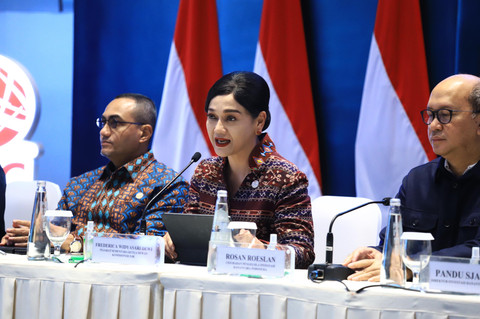
The Indonesian Financial Services Authority (OJK) has reported a robust performance for the nation’s financial services sector in the fourth quarter of 2025. This impressive growth, reaching 7.92 percent year-on-year (YoY), marks the highest rate observed since June 2021, underscoring the sector’s significant momentum.
Friderica Widyasari Dewi, Acting Chairperson of the OJK Board of Commissioners, highlighted the sector’s increasing contribution to the national economy. This is evident as the ratio of financial assets and products to GDP has soared to 184 percent. Speaking at the OJK Institute Economy Outlook 2026 Webinar, Dewi, affectionately known as Kiki, further elaborated that the significant expansion was primarily fueled by the strong rebound in sub-sectors like insurance, pension funds, and financial support services. These areas experienced positive growth in 2025 after two years of contraction, a robust growth trajectory confirmed by data from Statistics Indonesia (BPS).
Delving into the specifics, the national financial assets and products are comprised of various components. Market capitalization and outstanding bonds contribute a substantial Rp 24,773 trillion, equivalent to 104 percent of GDP. Banking assets alone account for Rp 13,889 trillion, or 58.3 percent of the total. Following closely, assets from the insurance sector, guarantees, pension funds, financing institutions, venture capital, microfinance institutions, and other financial services collectively reached Rp 4,056 trillion, representing 17 percent. Additionally, capital market institution assets stood at Rp 87.67 trillion (0.4 percent), with managed funds totaling Rp 1,043 trillion (4.4 percent).
Looking ahead, Kiki affirmed OJK’s commitment to maintaining the stability of the financial services sector through a proactive three-pronged approach. This strategy involves strengthening industrial resilience, fostering a dynamic financial ecosystem to maximize its economic contribution, and sustainably deepening financial markets, which includes enhancing sustainable financing initiatives. She emphasized that the sector’s solid performance serves as a crucial foundation, enabling it to effectively navigate potential global pressures anticipated in 2026 while continuing its strong and contributive growth path in the current year.
The OJK’s projections for 2026 paint an optimistic picture for various segments. Banking credit is anticipated to grow by 10–12 percent, supported by a projected 7–9 percent increase in third-party funds. Assets within insurance programs are expected to rise by 5–7 percent, while pension fund assets could see a 10–12 percent expansion. Guarantee program assets are forecasted for a robust 14–16 percent growth. Furthermore, financing company receivables are predicted to increase by 6–8 percent, and capital market fundraising is targeted to reach an impressive Rp 250 trillion.
Complementing the OJK’s assessment, Hery Gunardi, President Director of PT Bank Rakyat Indonesia (BRI), underscored the strategic importance of the financial services industry. He highlighted its vital role in preserving financial system stability, reinforcing policy transmission, and actively supporting productive sectors of the economy. Gunardi asserted that the banking sector is currently in a strong position to bolster future credit growth.
Gunardi further elaborated on the sector’s robust health. Liquidity, for instance, has rebounded impressively, with third-party funds growing back to a double-digit level of 11.4 percent year-on-year. The loan-to-deposit ratio (LDR) remains prudently managed at around 84 percent, indicating ample room for credit expansion without creating undue liquidity stress. Moreover, the banking industry’s capital base is exceptionally strong, with the Capital Adequacy Ratio (CAR) hovering around 26 percent, significantly exceeding regulatory minimum requirements. Hery concluded that this substantial capital buffer not only enhances resilience against potential asset quality risks but also facilitates prudent and sustainable credit growth. “With the synergy of regulators and industry players, strong governance, disciplined risk management, and a commitment to transformation, I am confident that Indonesia’s financial system will remain resilient and capable of healthy growth amidst global challenges,” Hery affirmed.
Summary
The Indonesian Financial Services Authority (OJK) reported a robust 7.92% year-on-year growth for the nation’s financial services sector in Q4 2025, marking its highest rate since June 2021. This significant expansion has boosted the sector’s contribution to the national economy, with financial assets and products reaching 184% of GDP. OJK is committed to maintaining this stability by strengthening industrial resilience, fostering a dynamic financial ecosystem, and sustainably deepening financial markets.
Looking ahead to 2026, OJK projects optimistic growth, with banking credit anticipated to increase by 10-12% and third-party funds by 7-9%. Furthermore, insurance program assets are expected to rise by 5-7%, and pension fund assets by 10-12%. Hery Gunardi of BRI affirmed the banking sector’s strong position, highlighted by robust liquidity, a prudent Loan-to-Deposit Ratio (LDR), and a high Capital Adequacy Ratio (CAR), which collectively support future credit growth and overall resilience.