
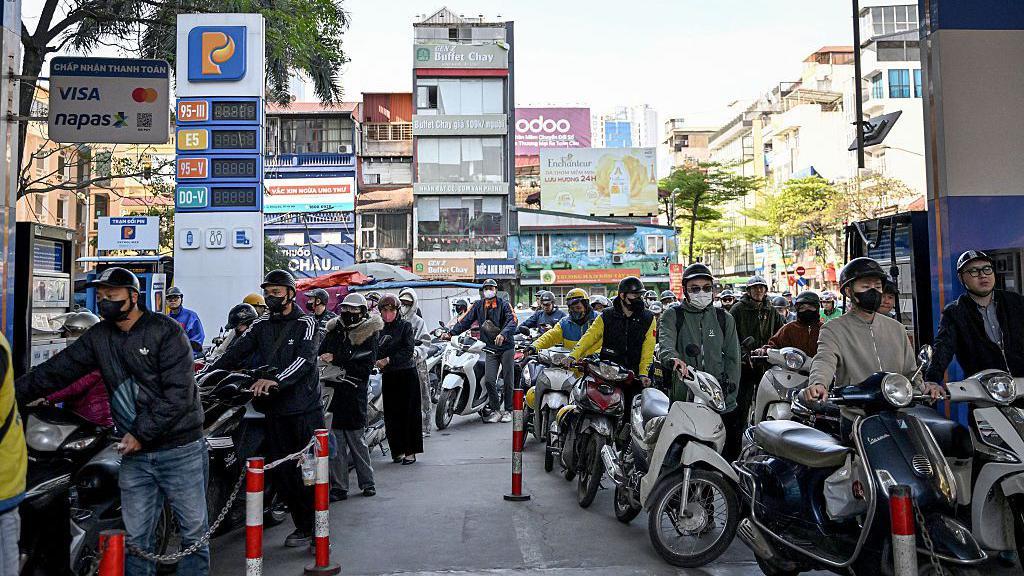

Amidst the escalating US-Israel conflict with Iran, which has sent global oil and gas prices soaring, several Asian nations are swiftly implementing measures to mitigate the severe economic fallout. These critical interventions range from imposing domestic fuel price caps to introducing government subsidies, aiming to shield their citizens from the financial strain.
The urgency of these actions became palpable on Monday, March 9, when crude oil prices surged past US$100 per barrel. This sharp increase was fueled by growing anxieties over potential energy supply disruptions from the Middle East, exacerbated by the prospect of a protracted regional conflict.
Further escalating geopolitical tensions, Iran’s appointment of Mojtaba Khamenei as the new Supreme Leader last weekend was widely interpreted as a consolidation of power by hardline factions. This move is seen as a definitive signal of Iran’s unwavering defiance towards the United States and Israel, contributing to market volatility.
Concurrently, the regional landscape is marked by intensifying hostilities, with reports of recent airstrikes in the area and some Gulf states reportedly halting oil production, further tightening global supply.
East Asian economies, in particular, face a severe impact from this escalating conflict. Their profound reliance on energy supplies transported through the strategic Strait of Hormuz renders them exceptionally vulnerable to any disruptions.
- What would be the global ramifications if Iran were to close the Strait of Hormuz, a vital artery for international oil shipments?

In response to these dire circumstances, specific national governments have outlined their strategies. Both the South Korean and Thai governments have announced their intention to implement domestic fuel price caps.
This means fuel station prices will not be permitted to surpass a predetermined threshold, even amidst surging global oil costs. The inevitable consequence is that governments will absorb a portion of these increased expenses through subsidies.
South Korean President Lee Jae Myung affirmed his administration’s commitment to “swiftly implement” these fuel price ceilings. During an emergency cabinet meeting, President Lee underscored that the Iran conflict has imposed a “significant burden” on the nation’s economy, given its heavy reliance on energy imports from the volatile Middle East region.

He further indicated that Seoul stands ready to enact additional measures, including potentially expanding its financial market stabilization program, currently valued at 100 trillion won (approximately Rp1,130 trillion), should economic conditions necessitate it.
In a related development, the South Korean Ministry of Trade issued a stern warning to oil companies, stating that any attempts to exploit the ongoing crisis for undue profit would be met with severe punitive action. The ministry called for “transparent and fair” pricing practices, especially after recent days saw a notable increase in gasoline prices.
Meanwhile, in Thailand, Prime Minister Anutin Charnvirakul appealed to the public to refrain from fuel hoarding and declared an immediate plan to implement a 15-day price cap specifically on diesel fuel. This plea came as long queues had already begun forming at fuel stations across the nation in recent days, with reports of diminishing supplies at several pumps.
The Vietnamese Ministry of Finance has also indicated its intention to temporarily abolish fuel import taxes, a measure aimed at easing the financial burden.

Across Southeast Asia, the Philippines is also implementing new energy conservation measures. On Friday, March 6, President Ferdinand Marcos Jr. unveiled plans to introduce a four-day work week for most government offices. This energy-saving initiative will, however, exempt critical services such as fire departments and hospitals.
Similarly, in Bangladesh, state media reported that universities began closing their doors on Monday, March 9, as part of national energy conservation efforts.
President Prabowo: ‘Our fuel will eventually come from palm oil, cassava, corn, sugarcane’
In contrast to many of its Asian counterparts, Indonesia’s officials appear to be responding with greater composure to the global oil and gas price volatility. As yet, no prominent new government measures have been officially announced.
Minister of Energy and Mineral Resources (ESDM) Bahlil Lahaladia affirmed that national oil and gas supplies are secure for the public leading up to the Eid al-Fitr festivities. He highlighted Indonesia’s current fuel storage capacity, which can last up to 25 days, and outlined government plans to significantly expand this capacity to achieve a three-month reserve. Notably, Bahlil provided a guarantee that subsidized fuel prices would remain unchanged, at least until Eid al-Fitr in 2026.
”The problem we face now is not with supply; our stocks are secure and plentiful. Our current challenge lies solely with pricing,” he stated in an official release on the ESDM Ministry’s website on Monday, March 9.
On Tuesday afternoon, March 10, Minister Bahlil was summoned by President Prabowo. He indicated that the discussions likely centered on the ongoing Middle East turmoil and its repercussions for global oil prices. Bahlil acknowledged that sustained volatility in global oil prices would inevitably exert pressure on the national budget.
”If these fluctuations persist, they will impact the budget, requiring the government to increase subsidy allocations,” Bahlil told Antara. ”However, we are actively mitigating this by exploring alternative energy sources beyond fossil fuels, including the enhanced utilization of bioenergy.”
Read also:
- US-Israel vs Iran: Who will run out of ammunition first, and does ammunition stock determine war winners?
- Dozens of Indonesian citizens evacuated from Iran arrive in Jakarta – ‘Ten bombs passed, embassy windows rattled’
- ‘US missile hit near school’ – Investigation into perpetrators of attack on girls’ school in Iran points to US
As of now, no official announcements have been released regarding the outcomes of the President’s recent meeting with his ministers.
Earlier, Minister of Finance Purbaya Yudhi Sadewa asserted that the national budget remains “safe and strong” despite the current oil and gas price volatility. ”The recent price surge has only lasted a few days,” Purbaya clarified, as quoted by Kompas.com on Tuesday, March 10. ”Our subsidy calculations span a full year, based on an average assumption of $70 per barrel. Therefore, these short-term fluctuations are not yet sufficient to necessitate a revision of our budget.”
In a recent address, President Prabowo Subianto articulated his long-term vision for Indonesia: an era where the nation achieves energy self-sufficiency and no longer relies on oil imports from other countries. He expressed strong conviction that Indonesia possesses the capability to produce its own fuel domestically, leveraging abundant natural resources such as palm oil, cassava, corn, and sugarcane.
”For many years, I have championed the cause of energy self-sufficiency for our fuel needs,” Prabowo declared. ”We have been blessed with an immense gift from the Almighty, enabling us to meet our future fuel requirements not through foreign imports, but directly from our own crops – from palm oil, cassava, corn, and sugarcane.”
- A related concern: The 10% ethanol-in-fuel policy is feared to exacerbate deforestation and land conflicts.
Amidst these discussions, some circles have previously suggested that in the face of extreme pressure, the government should consider re-evaluating large-budget programs like the Free Nutritious Meals (MBG) initiative. Funds from such programs could potentially be redirected to bolster small and medium-sized economic structures and to reinforce fuel subsidies.
Professor Vedi R. Hadiz, an expert from Asian Studies at the Asia Institute, University of Melbourne, weighed in on the potential challenges. He posited that under severe economic strain, the Indonesian government would confront a difficult dilemma: either raise fuel prices, risking widespread inflation and public protests, “or significantly increase subsidies within the context of a state budget that already appears vulnerable.”
Professor Hadiz further elaborated that global uncertainties typically lead to a strengthening of the US dollar while simultaneously exerting downward pressure on the Indonesian rupiah. A weaker rupiah, in turn, translates to more expensive imports, encompassing vital commodities like energy and food, thereby inevitably fueling inflation.
”The core issue,” he explained, ”is that these pressures emerge at a time when fiscal space is already constrained by significant debt repayment obligations and commitments to priority spending, such as infrastructure projects and programs like MBG, whose implementation can seem somewhat illogical. This confluence of factors poses a considerable and sharp risk to short-term economic stability.”
What Could Restore Stability?
According to Roc Shi, an expert from the University of Technology Sydney, the crucial step to alleviating energy prices in Asia lies in reopening the Strait of Hormuz for international shipments. This is because a significant number of the region’s major economies are heavily dependent on Middle Eastern energy supplies transported through this waterway.
He stressed that an effective closure of this vital waterway would constitute “a supply chain crisis, not merely a price surge,” particularly for nations like Japan and South Korea, both of whom import the vast majority of their energy from Gulf states. Shi further noted that while plans to impose fuel price caps are “politically attractive” due to offering “visible relief,” they carry the significant risk of backfiring if such measures inadvertently trigger panic buying and subsequent fuel shortages.
The duration of the current oil price surge, according to Christopher Wong, a strategist at OCBC bank, is directly contingent on the length of the conflict and the extent of any supply disruptions. Wong articulated two potential scenarios: oil prices could decline “relatively quickly” if regional tensions de-escalate, but they are equally likely to continue their ascent if further disruptions to production or shipping occur.
In a controversial statement on Sunday, March 8, former US President Donald Trump characterized the short-term surge in oil prices as a “small price to pay” for neutralizing Iran’s nuclear threat. US Energy Secretary Chris Wright likewise suggested that oil and gas prices would decline once the United States successfully cripples Iran’s capability to target tankers in the Strait of Hormuz—a crucial waterway responsible for transporting approximately 20% of the world’s oil and gas supply.
Currently, shipments through this vital strait have reportedly been disrupted following Iran’s threats to attack vessels attempting passage, made in retaliation for recent US and Israeli airstrikes.
- National fuel reserves only sufficient for 20 days – ‘Very risky,’ says analyst
- To what extent does the US-Israel war with Iran impact Indonesia’s economic-political stability?
- ‘A very expensive disaster’ – The fate of Middle Eastern and African countries intervened by the US military
- Iran has a special strategy against US-Israel
- Will Iran still compete in the 2026 World Cup in the US?
- ‘If we are not killed, we will stay here’ – The fate of Iranian citizens amid US-Israel attacks