
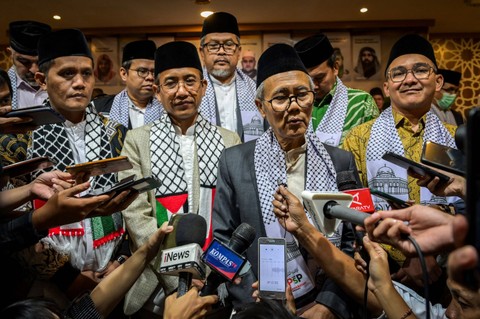

The Indonesian Ulema Council (MUI) has vehemently condemned the decision by the Israeli parliament, the Knesset, to approve the death penalty for Palestinian prisoners. This ruling is widely regarded by the council as a grave state crime.
“On behalf of MUI, I strongly and deeply condemn the Knesset’s enactment of a law that imposes the death penalty on Palestinians, including children, currently held in Israeli detention,” stated Sudarnoto Abdul Hakim, Chairman of MUI’s Foreign Relations and International Cooperation, in a press release on Sunday (5/4).
Sudarnoto emphasized that this policy represents a blatant practice of structural violence. He asserted that it not only undermines the sense of justice but also profoundly shakes the very conscience of humanity.
“This is a tangible manifestation of state crime that must be considered a common enemy,” he declared, underscoring the severity of the Israeli decision.
The MUI leader further elaborated that the Indonesian Ulema Council views this policy not merely as an internal Israeli legal matter, but as a critical global humanitarian issue that impacts the future of justice and human values worldwide.
“When children become legitimate targets for the death penalty, it is truly the world’s conscience that is being gambled with,” he expressed, highlighting the profound moral implications.
Consequently, MUI calls upon all national stakeholders and the international community to collectively reject this contentious regulation and to actively champion the establishment of true justice and lasting peace.

From a political standpoint, Sudarnoto observed that Israel’s enactment of this rule starkly reveals a repressive policy explicitly designed to justify violence, particularly against the Palestinian people.
Diplomatically, he continued, the approval of this regulation further deepens Israel’s moral delegitimization in the eyes of the global community. Furthermore, it significantly weakens the entire architecture of peace diplomacy meticulously constructed by the international community, including efforts by the United Nations.
He stressed that such a move stands in direct contradiction to the fundamental principles enshrined in the Geneva Conventions and the Convention on the Rights of the Child, both of which unequivocally prohibit the death penalty for minors and mandate maximum protection for civilians in conflict situations.
Sudarnoto warned that the implementation of this controversial rule would inevitably fuel an escalation of the conflict towards an increasingly uncontrollable phase. It would also erode the foundations of trust in international legal and diplomatic mechanisms, thereby prolonging the suffering endured by Palestinians.

In light of these critical concerns, the MUI issues the following urgent appeals:
1. To the United Nations (UN): To move beyond mere normative statements and immediately undertake concrete and decisive actions, including utilizing international legal mechanisms, to halt these severe violations.
2. To the Organisation of Islamic Cooperation (OIC): To consolidate the political and diplomatic strength of the Islamic world to exert tangible and measurable pressure on Israel.
3. To the international community and influential nations: To designate this issue as a global humanitarian priority and to ensure no impunity for the grave violations committed.
4. To interfaith and global civilization leaders: To unite in a strong moral voice, unequivocally rejecting all policies that legitimize the killing of civilians, especially children.
5. To the Government of the Republic of Indonesia: To remain at the forefront in championing justice for Palestine, including strengthening multilateral diplomacy, advocating for international accountability, and fostering broader global solidarity.