
News Summary:
- Minister of Women’s Empowerment and Child Protection (PPPA), Arifah Fauzi, has proposed relocating women-only train cars on KRL commuter lines.
- This proposal follows a tragic collision between a KRL commuter train and the Argo Bromo Anggrek train at Bekasi Timur Station on Monday night, April 27, 2026.
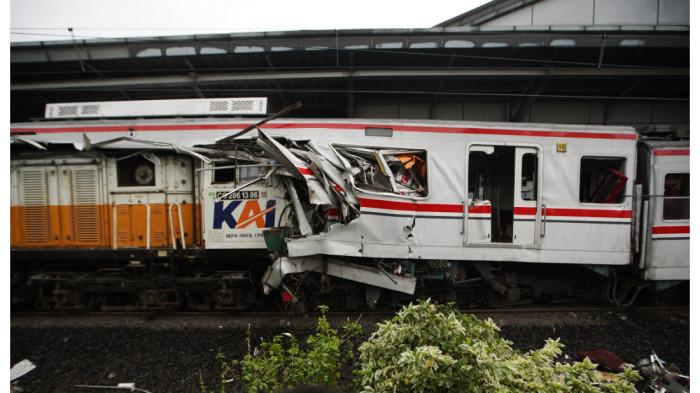
- The violent impact caused the Argo Bromo Anggrek locomotive to crush the rearmost car of the KRL, which was designated as a women-only carriage.
JAKARTA – Minister of Women’s Empowerment and Child Protection (PPPA), Arifah Fauzi, has formally proposed a shift in the positioning of women-only carriages on KRL commuter trains following a fatal collision at Bekasi Timur Station on Monday evening, April 27, 2026.
The collision, which involved a KRL commuter train and the Argo Bromo Anggrek, resulted in a devastating impact. The locomotive of the Argo Bromo Anggrek train was severely damaged and plowed directly into the 10th car—the women-only carriage located at the very back of the commuter train. As of Tuesday morning, April 28, 2026, authorities have confirmed that 14 people have lost their lives in the tragedy.

Emergency responders and medical teams worked tirelessly to evacuate numerous passengers trapped within the crushed wreckage of the women’s carriage.
Minister Arifah confirmed that the proposal has already been presented to PT Kereta Api Indonesia (KAI). Historically, women-only carriages have been positioned at the very front and back of trains to prevent passenger overcrowding and maintain order during boarding.
“In our discussions with KAI, it was explained that these cars were placed at the front and back to prevent surges in boarding. However, in light of this incident, we are proposing that these women-only carriages be moved to the center of the train,” Arifah stated during her visit to survivors at the Bekasi Regional General Hospital (RSUD) on Tuesday.
Arifah argued that relocating women-only cars to the middle of the train would significantly enhance safety, particularly during emergencies or accidents. By shifting to the center, these carriages would no longer be situated at the most vulnerable points of the train composition, which are often the most heavily impacted during collisions.
She envisions a configuration where male passengers occupy the front and rear sections, while the dedicated women’s section remains protected in the heart of the train. While the proposal is currently on the table, it remains subject to further deliberation and coordination with relevant authorities.
Psychological Support for Survivors 
Beyond structural safety improvements, the Ministry of PPPA has committed to providing comprehensive psychological support for the female victims of the crash. Minister Arifah emphasized that the recovery process must address both physical injuries and the profound mental trauma experienced by those involved.
During her hospital visit, the Minister observed that many survivors were still grappling with the shock of the incident. With injuries ranging from minor bruises to severe bone fractures, the government has ensured that all victims are receiving intensive medical care.
“The Ministry of PPPA is focused on more than just medical treatment; we are committed to full physical and psychological recovery. We have identified victims suffering from severe trauma, and that requires specialized, dedicated support,” she concluded.
Summary
Minister of Women’s Empowerment and Child Protection, Arifah Fauzi, has proposed relocating women-only carriages on KRL commuter trains. This proposal follows a fatal collision on April 27, 2026, at Bekasi Timur Station, where the rearmost women-only car was crushed, resulting in 14 fatalities. Historically placed at the front and back to manage boarding, the Minister now advocates moving these carriages to the train’s center.
Arifah Fauzi argues that positioning women-only cars in the middle would significantly enhance safety, protecting them from the most vulnerable points during accidents. This configuration would place male passengers at the front and rear, safeguarding the dedicated women’s section. Additionally, the Ministry is committed to providing comprehensive psychological support for female victims to address both physical and mental trauma.
