
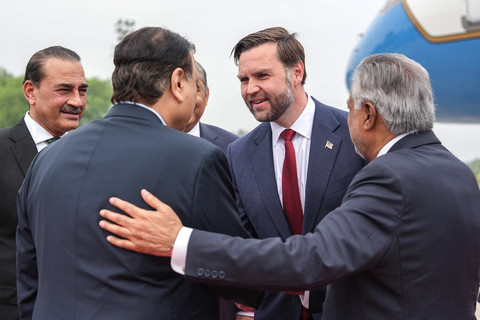

In a significant development for international diplomacy, high-level delegations from the United States and Iran have converged in Islamabad, Pakistan, for critical peace talks. The crucial meeting between representatives of the two nations commenced on Saturday, April 11, local time.
The American delegation was notably led by Vice President JD Vance, accompanied by special envoy Steve Witkoff and Jared Kushner, President Donald Trump’s son-in-law. Their presence underscored the importance the US placed on these discussions.
Across the negotiating table, Iran presented a formidable team, comprising over 70 members. This large delegation was headed by Parliament Speaker Mohammad Bagher Ghalibaf and included the influential Foreign Minister Abbas Araghchi.
So, what transpired during these pivotal discussions?

According to reports from AFP, the negotiations were structured as trilateral talks, with Pakistan serving as the accommodating host in its capital, Islamabad. This facilitated a neutral ground for the historically estranged nations to engage.
A Pakistani official, speaking on condition of anonymity, indicated that the discussions were “moving in the right direction.” He further elaborated that the talks had already progressed through two comprehensive rounds, demonstrating a commitment from both sides to the process.
“I can say that the discussions have been positive, and the overall atmosphere is friendly,” the official stated, suggesting a constructive tone despite underlying complexities. This positive outlook hints at a potential breakthrough in long-standing tensions.
Both Iranian state television and another Pakistani official have since suggested that the discussions are likely to advance to a third round, reflecting ongoing engagement and a willingness to continue dialogue.

The anticipated third round of US-Iran peace talks was projected to take place either on Saturday evening or Sunday, April 12, local time. This swift continuation signaled a pressing agenda and perhaps cautious optimism among the negotiators.
IRIB, Iran’s state broadcaster, reported, “According to information given to a state TV correspondent by someone close to the negotiating team, the next round of negotiations is likely to be held tonight or tomorrow.” This information provided a glimpse into the ongoing, tightly-scheduled diplomatic efforts.
While the full agenda of the discussions has not been publicly disclosed, a key point of contention has emerged. The Iranian news agency Tasnim reported that the strategic Strait of Hormuz, a vital global shipping lane through which a significant portion of the world’s oil transits, was a subject of serious disagreement among the negotiators. This revelation points to the deep economic and geopolitical interests at play.
Trump Warns Iran Against Levying Fees on Ships in Strait of Hormuz

Prior to the commencement of these critical Islamabad negotiations, US President Donald Trump issued a stern warning to Iran, reiterating that it should not impose fees on vessels traversing the Strait of Hormuz. This pre-emptive statement set a tense backdrop for the upcoming talks, highlighting a major flashpoint between the two nations.
As reported by Bloomberg on Saturday, April 11, President Trump emphasized that levying such fees in the Strait of Hormuz could severely disrupt global energy supplies. His comments underscored the potential for widespread economic repercussions if Iran were to proceed with its proposed charges.
“There are reports that Iran is charging tankers passing through the Strait of Hormuz,” Trump posted on Truth Social, directly addressing the claims and indicating his administration’s close monitoring of the situation.
He followed up with an unequivocal declaration: “They better not, and if they (do), they better stop now!” This forceful message clearly articulated the US stance and the potential for a strong response should Iran attempt to implement such a policy.
Previously, Iran had indeed expressed an intention to charge fees for tankers utilizing the Strait of Hormuz. This initiative was reportedly aimed at generating revenue to rebuild the nation’s infrastructure, which has suffered extensively from war and sanctions.
Intriguingly, the Financial Times reported that Iran planned to accept payments in Bitcoin, a move that caught the attention of financial markets. Bloomberg had earlier suggested other payment alternatives under consideration, including the Chinese yuan and various stablecoins. This exploration of alternative payment methods underscored Iran’s efforts to circumvent traditional financial systems.
Conceptually, the use of cryptocurrency was seen as particularly appealing to Iran, as it would enable transactions outside the US dollar-based financial system. This system has long been the primary mechanism for enforcing Western sanctions, making crypto an attractive, albeit risky, alternative for Iran to conduct international trade.
However, market participants quickly raised concerns regarding the practical and legal feasibility of such a plan. The consensus was that implementing a crypto-based payment system for oil transit fees would face significant hurdles.
Jake Ostrovskis from Wintermute, a leading crypto trading firm, articulated these challenges, stating, “Shipping companies are already under fairly strict scrutiny worldwide, given they are in a high-risk industry.” His remarks highlighted the immense regulatory and compliance burdens that would likely deter most legitimate shipping operators from participating in such a scheme, further complicating Iran’s ambitions.
Summary
High-level delegations from the United States and Iran convened for critical peace talks in Islamabad, Pakistan, commencing on Saturday, April 11. The US team, led by Vice President JD Vance and accompanied by Jared Kushner, engaged with Iran’s large delegation, headed by Parliament Speaker Mohammad Bagher Ghalibaf and Foreign Minister Abbas Araghchi. Pakistani officials reported the trilateral discussions were positive and moving in the right direction, with a third round anticipated, though the strategic Strait of Hormuz emerged as a point of contention.
Prior to the talks, US President Donald Trump had issued a stern warning against Iran imposing fees on vessels in the Strait of Hormuz, citing potential global energy supply disruptions. Iran had previously expressed intent to charge such fees, reportedly considering Bitcoin or other cryptocurrencies for payments to circumvent sanctions. However, market participants raised concerns about the practical and legal feasibility of a crypto-based payment system for shipping companies, given strict industry scrutiny.