
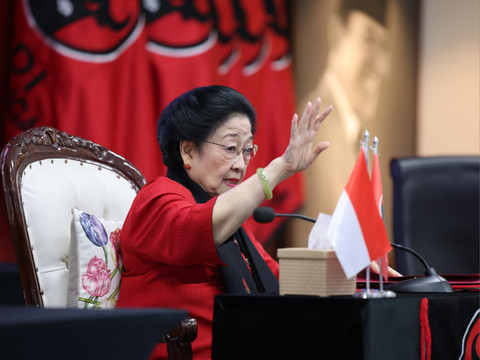

Megawati Soekarnoputri, the Chairperson of the Indonesian Democratic Party of Struggle (PDI Perjuangan), has called for a comprehensive overhaul of the United Nations (UN). Her bold proposals include the elimination of the veto power and the integration of Pancasila, Indonesia’s state ideology, into the UN Charter. These significant pronouncements were made during her national address at the 71st commemoration of the Asian-African Conference (AAC), held at the PDIP Party School in Lenteng Agung, South Jakarta, on Saturday, April 18.
Megawati argues that the contemporary structure of the UN is no longer fit for purpose, having been originally conceived in the political landscape following World War II. In her address, she powerfully invoked the spirit of Indonesia’s first President, Soekarno, by referencing his seminal 1960 speech to the UN General Assembly titled ‘To Build The World Anew‘. “Bung Karno called for a reform or ‘re-tooling’ of the UN. Equality among nations was Bung Karno’s greatest agenda,” Megawati stated, emphasizing the historical precedent for her current demands.
Central to her reform agenda is the urgent need to abolish the veto power currently wielded by major nations. Megawati firmly believes that this exclusive privilege perpetuates systemic inequality within the global framework, hindering effective international cooperation. This stance is not new; Megawati has consistently advocated for the importance of equality among nations within the UN, echoing sentiments previously championed by her father. “Bung Karno proposed the abolition of the veto right held by the victorious nations of World War II. Additionally, there needs to be a revision of the UN Charter to incorporate Pancasila as an international foundation,” she affirmed, underscoring the depth of her vision for a more equitable world order.

Beyond the veto, Megawati further advocated for the structural reform of the UN Security Council. She also proposed relocating the organization’s headquarters to a neutral country. This strategic move, she posited, would safeguard the UN from becoming ensnared in the competing interests and power struggles of dominant global forces, thereby ensuring its impartiality and effectiveness in maintaining international peace and security.
Megawati stressed the critical necessity of these reforms, particularly in light of the increasingly volatile global geopolitical landscape. She highlighted various international conflicts as undeniable evidence that the current world system is experiencing profound instability. “The world now requires alternative thinking on how global peace can be achieved. From this perspective, the spirit of the AAC, the Non-Aligned Movement, and the ‘To Build The World Anew‘ speech provide the answer,” she explained, presenting a historical and ideological framework for a path forward.
Furthermore, Megawati issued a stark reminder that neocolonialism and imperialism persist in new, insidious forms in the modern era. To counter these enduring threats and protect the sovereignty of developing nations, she passionately urged for the convening of an Asian-African Conference Volume II. “The implementation of Asian-African Conference Volume II is highly relevant. It is here that Bung Karno’s geopolitical thinking serves as a compass for the future of our nation and the world,” Megawati concluded, positioning Indonesia’s historical legacy as a guiding principle for contemporary global challenges.
Summary
Megawati Soekarnoputri, Chairperson of PDI Perjuangan, called for a comprehensive overhaul of the United Nations. Her proposals include eliminating the veto power and integrating Pancasila into the UN Charter, ideas she presented at the 71st Asian-African Conference commemoration. She emphasized that the UN’s current structure is outdated and perpetuates inequality, echoing President Soekarno’s historical call for reform.
Furthermore, Megawati advocated for structural reform of the UN Security Council and relocating the UN headquarters to a neutral country to ensure impartiality. These reforms are deemed critical due to the volatile global geopolitical landscape and the persistence of neocolonialism. She urged for an Asian-African Conference Volume II, aligning with the spirit of the AAC and the Non-Aligned Movement, to address these ongoing challenges.
