
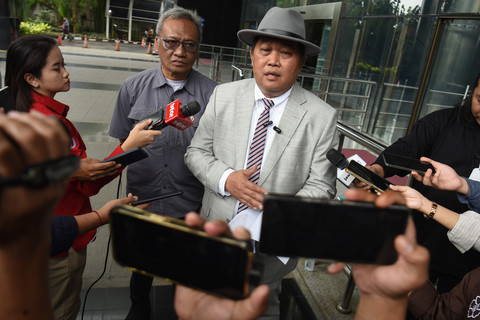
 The Indonesian Anti-Corruption Society (MAKI) has formally requested the House of Representatives (DPR RI) Commission III to establish a special Working Committee (Panja). This urgent appeal, conveyed via a letter sent through the DPR’s complaint system on Thursday (March 26), seeks a thorough investigation into the controversial transfer of former Minister of Religious Affairs, Yaqut Cholil Qoumas, from pre-trial detention to home detention. Yaqut is currently a suspect in an alleged hajj quota corruption case.
Boyamin Saiman, Coordinator of MAKI, emphasized that the request aims for the DPR to rigorously examine potential procedural and legal breaches surrounding the Corruption Eradication Commission’s (KPK) decision. “The Indonesian Anti-Corruption Society has submitted a request for the DPR RI Commission III to form a Working Committee to delve into and/or investigate alleged performance and legal violations by the KPK concerning the transfer of suspect Yaqut Cholil Qoumas to home detention,” Boyamin stated, underscoring the gravity of their concerns.
Decision Sparks Public Controversy
Boyamin asserted that the KPK’s decision to shift Yaqut’s status from detention at the KPK’s facility to home detention has undeniably ignited a significant public controversy. He highlighted that the public is well aware of this move, which involves a former high-ranking official, Yaqut Cholil Qoumas, who is implicated in a corruption scandal.
This particular decision, Boyamin explained, has generated widespread debate and concern among the public. It has fostered a perception of “special treatment” for a corruption suspect, a practice deemed highly unusual and inconsistent with the established law enforcement procedures historically upheld by the KPK. Such perceived preferential handling raises serious questions about equity and fairness in the fight against corruption.

Health Reasons Draw Scrutiny
Boyamin further drew attention to the evolving justifications provided for the detention transfer. Initially, the decision was reportedly based on a request from Yaqut’s family while the suspect was apparently in good health. However, as widely reported by national media, this rationale later shifted, citing health issues such as GERD (gastroesophageal reflux disease) and asthma as the underlying reasons for the change in detention status.
MAKI firmly believes that this ambiguous reasoning and the subsequent transfer to home detention without compelling, objective grounds inherently risk creating an impression of preferential treatment. Boyamin elaborated, “We assess that there is an alleged special treatment towards a corruption suspect. In the established law enforcement practices carried out by the KPK, suspects of criminal acts of corruption generally undergo detention at the KPK detention center.” He underscored that “a transfer to home detention without strong objective reasons potentially creates the impression of special treatment for a specific suspect.”
Concerns Over Eroding Public Trust
MAKI conveyed its profound concern that such decisions could severely undermine public confidence in the KPK. The organization expressed a fervent hope that the DPR would meticulously oversee this matter, thereby safeguarding the integrity and public trust placed in the anti-graft body. Boyamin articulated, “This decision has the potential to trigger a public trust crisis for the KPK. A decision to transfer detention without a comprehensive public explanation can generate negative perceptions and diminish the public’s confidence in the KPK as an institution dedicated to eradicating corruption.”
Adding context to the ongoing saga, Boyamin and MAKI had previously reported several KPK leaders and deputies to the KPK’s Supervisory Board (Dewas) regarding the initial transfer of Yaqut’s detention. Interestingly, Yaqut Cholil Qoumas has since been returned to the KPK detention center as of Tuesday (March 24), following the significant public outcry and controversy surrounding his brief period of home detention.

Summary
The Indonesian Anti-Corruption Society (MAKI) has formally requested the House of Representatives (DPR RI) Commission III to establish a special Working Committee (Panja). This committee would investigate the controversial transfer of former Minister of Religious Affairs, Yaqut Cholil Qoumas, from pre-trial to home detention in an alleged hajj quota corruption case. MAKI suspects potential procedural and legal breaches by the Corruption Eradication Commission (KPK), raising concerns of “special treatment.”
The KPK’s decision sparked widespread public controversy and concerns of “special treatment” due to ambiguous justifications, which shifted from family requests to health issues. MAKI fears this undermines public trust in the KPK’s fairness and integrity, lacking strong objective grounds for the transfer. Notably, Yaqut has since been returned to the KPK detention center following significant public outcry.