
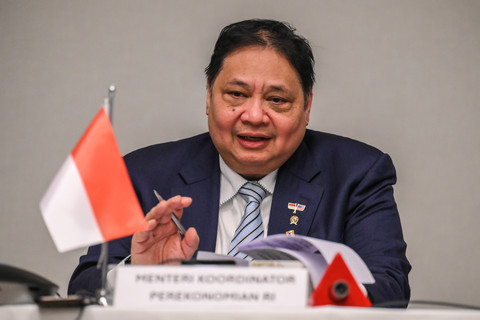
Indonesia’s Coordinating Minister for Economic Affairs, Airlangga Hartarto, has addressed the recent decision by the United States (US) Supreme Court to invalidate the Trump administration’s global tariff policy. He affirmed that the existing reciprocal tariff agreement between Indonesia and the United States will proceed as per the agreed-upon mechanisms.
The US Supreme Court ruled that former President Donald Trump exceeded his authority in implementing tariffs under the International Emergency Economic Powers Act (IEEPA). This landmark decision effectively blocks a key instrument previously used in the reciprocal tariff policy, which had significantly impacted global trade dynamics.
Minister Hartarto elaborated that for Indonesia, having signed a bilateral agreement with the US, the implementation of this specific deal remains ongoing and has an effective period of 60 days from its signing date.
“For Indonesia, which has already signed the agreement, this is a pact between two nations,” Airlangga stated from Washington DC, quoted on Sunday (February 22). He further clarified, “It is still progressing because the agreement stipulates a 60-day effective period post-signing, during which each party consults with necessary institutions.”
He added that during this crucial 60-day period, both countries will engage in consultations with their respective relevant bodies. In the US, this process could involve the Congress or Senate, while in Indonesia, it would be through the House of Representatives (DPR).
Furthermore, Airlangga highlighted the 10 percent global tariffs that were previously imposed, noting that this policy was always intended to be temporary.
“However, the 10 percent decision yesterday was only valid for 150 days. After that period, they could either extend it or modify it based on existing regulations,” he explained.
He assured that Indonesia has a crucial 60-day window to closely monitor developments. The government has also been coordinating with the Office of the United States Trade Representative (USTR) regarding follow-up actions for countries that have already signed trade agreements.
“And thankfully, Indonesia signed the agreement yesterday,” Airlangga stated. “Our request was that while a 10 percent tariff might apply to others, the 0 percent tariffs already granted to us should remain in effect.”
He confirmed that several agricultural commodities, such as coffee and cocoa, which have already secured zero tariffs, will not be revoked, as these are regulated through a separate executive order. Beyond agriculture, Indonesia is also advocating for zero tariffs on electronic supply chains, Crude Palm Oil (CPO), textiles, and footwear.
“Therefore, we are waiting for further developments over the next 60 days,” he concluded.
Airlangga further emphasized that there will be a distinct difference in policy for countries that have signed bilateral agreements compared to the general application of global tariffs. “There will be a distinction,” he added. “Because several countries that have already signed will be granted different policies compared to the global standard.”
Regarding President Prabowo Subianto’s response, Airlangga mentioned that a report has been submitted, and the government is preparing various scenarios to address potential outcomes.
“We reported to the President yesterday, and he instructed us to study all potential risks that might arise,” Airlangga stated. He asserted, “Indonesia is prepared with various scenarios, as the implications of the American Supreme Court’s decision were already discussed with the USTR before we even signed the agreement.”
Meanwhile, Cabinet Secretary Teddy Indra Wijaya reinforced that the Indonesian government had anticipated various possibilities from the very outset of trade negotiations.
“Essentially, Indonesia is ready to face all eventualities,” Teddy declared. He further revealed, “Even before the Supreme Court’s decision, we had already negotiated from 32 percent down to 19 percent with the President and his team. It is possible that this could even be reduced further.”
Summary
The US Supreme Court has invalidated former President Donald Trump’s global tariff policy, but Indonesia’s Coordinating Minister for Economic Affairs, Airlangga Hartarto, confirmed that the existing reciprocal tariff agreement with the United States will proceed. Indonesia, having signed a bilateral agreement, now enters a crucial 60-day period for consultations with respective legislative bodies, such as the US Congress and Indonesia’s DPR, to monitor developments.
Minister Hartarto clarified that countries with bilateral agreements will receive distinct treatment, noting Indonesia has already secured zero tariffs for agricultural commodities like coffee and cocoa, and is advocating for others including electronics and CPO. The Indonesian government has prepared various scenarios, having anticipated the Supreme Court’s decision and discussed implications with the USTR even before signing the agreement, reinforcing its readiness for all eventualities.