
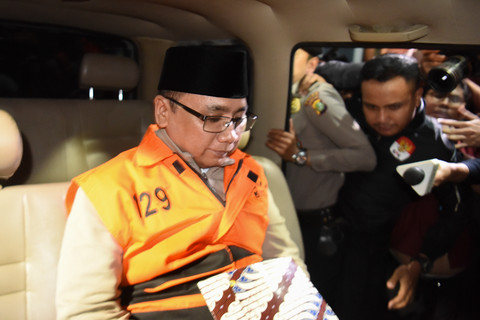

The Corruption Eradication Commission (KPK) is facing intense scrutiny over its decision to place former Religious Affairs Minister, Yaqut Cholil Qoumas, widely known as Gus Yaqut, under house arrest during the recent Eid al-Fitr festivities. This move has ignited a storm of questions, particularly as he had only recently been detained as a suspect in a significant hajj quota corruption case.
The unusual absence of Gus Yaqut from the KPK detention center first came to public attention through Silvia Rinita Harefa, the wife of former Deputy Manpower Minister Immanuel Ebenezer.

Silvia was at the facility visiting her husband, who himself is being held on suspicion of involvement in an alleged extortion case concerning K3 certification within the Ministry of Manpower.
“I didn’t see Gus Yaqut there. I was informed he had left on Thursday night,” Silvia recounted to reporters several days prior.
Should Have Remained in Detention
Ahmad Sahroni, Deputy Chairman of Commission III of the House of Representatives (DPR RI), firmly challenged Gus Yaqut’s absence from the KPK detention facility, asserting that he should have remained in custody.
“He should undeniably be detained. While the KPK may have internal policy considerations for such a move, it is paramount to ensure he does not flee or disappear, as such an event would severely compromise the institution’s integrity,” Sahroni emphasized on Saturday (21/3).
KPK Accused of Granting Gus Yaqut Special Treatment
Lakso Anindito, Chairman of the IM57+ Institute, unequivocally stated his belief that the KPK has extended special treatment to Gus Yaqut.
“This action cannot be interpreted as a routine legal procedure under the Criminal Procedure Code. It is an extraordinary privilege, especially considering it has been granted exclusively to Yaqut, a suspect in a serious hajj corruption case,” Lakso remarked yesterday.
Lakso emphasized that throughout the entire history of the KPK’s case handling, no such special privilege has ever been observed. Even detainees facing severe illness are typically only granted permission to seek medical treatment at a hospital.
“Consequently, this action gravely undermines the fundamental principle of equality before the law by affording Yaqut a distinct and preferential treatment,” he elaborated.
Lakso urged the KPK to transparently disclose the precise reasons behind this contentious transfer of detention. Furthermore, he called upon President Prabowo Subianto to intervene directly to safeguard the crucial independence of the anti-graft agency.
“It is imperative that this action by the KPK is not perceived as being influenced by Yaqut’s connections to power. The battle against corruption is fundamentally a battle against the impunity of power. This is precisely why the integrity and independence of the KPK are paramount in cultivating public trust,” Lakso elaborated.
“Independence will inevitably crumble when external forces impose special treatment upon corruption perpetrators through undue privilege. Such actions will not only erode public confidence in the KPK’s anti-corruption mission but also in the broader commitment to combating graft under President Prabowo Subianto,” he continued.

Sharing Lakso’s concerns, former KPK investigator Praswad Nugraha cautioned that approving Yaqut’s request for detention transfer could inadvertently set a precedent, inciting numerous other detainees to seek similar privileges.
“Should one suspect be afforded such exceptional treatment, it becomes highly probable that every detainee under KPK custody will submit analogous requests. Will the KPK then be compelled to approve them all? If not, the commission would risk overtly violating the principle of equality before the law, which stands as a foundational pillar of any democratic state governed by legal principles,” Praswad articulated.
Moreover, Praswad elaborated that this alteration in detention status grants Yaqut significant latitude to formulate strategies, potentially allowing him to circumvent legal accountability.
“The inherent nature of house arrest demonstrably provides a suspect with ample room to consolidate resources, orchestrate defense strategies, and even solicit intervention from external parties, thereby increasing their chances of escaping the full force of the law,” Praswad revealed.
Praswad further called for the KPK Supervisory Board (Dewas KPK) to immediately launch an investigation into the KPK leaders responsible for approving this controversial policy.
“Should any violations be uncovered, firm ethical sanctions must be unequivocally imposed to uphold the institution’s integrity and credibility,” he concluded.
Scrutiny from ICW
The Indonesia Corruption Watch (ICW) similarly condemned Gus Yaqut’s placement under house arrest, labeling it an undeniable privilege bestowed by the KPK.
“The KPK is obligated to provide a transparent and comprehensive explanation for the transfer of YCQ from its detention center to house arrest. This action unequivocally represents a form of special treatment extended by the KPK to a corruption suspect,” asserted Wana Alamsyah, Head of ICW’s Legal and Investigation Division, in an official statement.
Drawing from ICW’s extensive records, Wana highlighted that the KPK’s policy for detention transfers has historically been rigorously strict, typically reserved for compelling reasons such as critical health conditions necessitating specialized medical treatment.
Crucially, in this particular instance of detention transfer, the KPK itself confirmed that Yaqut was not suffering from any health ailments. This glaring inconsistency has fueled fears that the move could establish a damaging precedent in Indonesia’s broader anti-corruption efforts.
“Such a decision poses a detrimental precedent for corruption eradication in Indonesia. A suspect under house arrest inherently retains the potential to tamper with or destroy crucial evidence, or to unduly influence witnesses,” she elaborated.
KPK’s Explanation
In response to the mounting criticism, the KPK clarified that its decision to place Gus Yaqut under house arrest is an integral component of its investigative strategy.
“Each investigative process inherently possesses unique conditions and demands distinct case handling strategies, which naturally extend to the detention of an individual classified as a suspect,” stated KPK spokesperson Budi Prasetyo on Sunday (22/3).
Budi further acknowledged that the transfer of detention specifically stemmed from a request made by Gus Yaqut’s family.
“Crucially, it was not prompted by any health condition. Rather, it was a direct consequence of a formal request from the family, which we subsequently processed,” he explained.
The family’s petition was ultimately granted after careful consideration, in accordance with Article 108, paragraphs (1) and (11) of Law Number 20 of 2025 concerning the Criminal Procedure Code (KUHAP).
He further assured that this temporary transfer of detention is not permanent. “We will provide subsequent updates regarding its duration, as this particular transfer is indeed not indefinite,” he clarified.
Kumparan made attempts to solicit comments from Gus Yaqut’s legal counsel regarding these developments, but as of publication, no response had been received.