
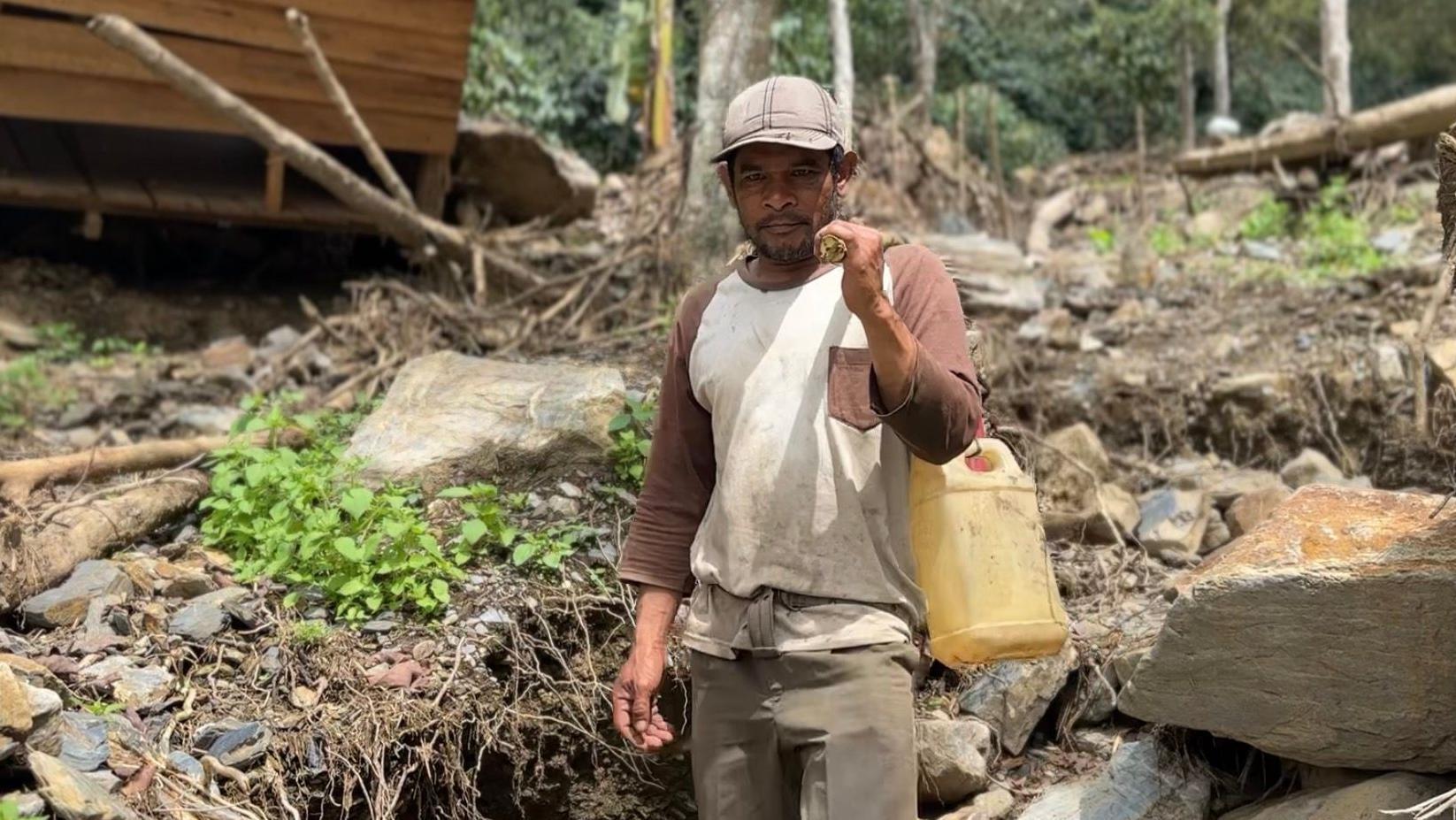

A devastating hydrometeorological disaster in Sumatra has ravaged tens of thousands of hectares of Arabica coffee plantations in Aceh’s Gayo Highlands. This calamity is poised to significantly impact the economic well-being of local farmers and could trigger a scarcity of coffee supplies in both national and international markets.
How are Gayo coffee farmers navigating survival after their primary source of livelihood was decimated by last November’s disaster?
Sumiaji, a 45-year-old farmer, traverses rugged terrain, balancing three used oil jerrycans on a wooden branch. He is collecting clean water for his daily needs from his coffee farm in Paya Reje Temi Delem Village, Kebayakan District, Central Aceh Regency.
Accompanied by three other coffee farmers, he walks home along a path littered with rocks and logs, still impassable to vehicles. The natural disaster that struck last November obliterated a significant portion of his one-hectare farm, which was cultivated with Gayo Arabica coffee, avocados, and interspersed with chili plants.
Today, only 20% of his coffee plants remain.
“There’s nothing left of my farm. The land is gone, the coffee is gone, about 500 trees. The average age of those coffee trees was five to seven years,” laments Sumiaji, a father of three whose wife suffers from a stroke.

Coffee was, in fact, his family’s main staple, the sole means to “keep the smoke rising” in his home.
“The impact is hard to describe. It was the only farm we had, coffee was our only hope, there was nothing else. And now, brother, our farm is gone due to the landslide,” says Sumiaji, who has been farming since 2004.
As a migrant from Aceh Tamiang, Sumiaji has no relatives in the area to turn to for support or to share his plight.
“It’s sad, brother, because I have no family here; I came here as a migrant in 1996,” he explains.

He recalls that his coffee farm was in its harvest season before the disaster struck. During his last harvest, he earned Rp200,000 per can (approximately 10 bamboo measures). “I usually harvested around 50 cans, bringing in about Rp7 million per harvest. Now, there’s nothing left,” he laments.
To support his family now, Sumiaji works as a hired coffee picker for other villagers, a practice locally known as ongkosen.
“Basically, ever since my farm was ruined, I’ve been doing ongkosen. Ongkosen… it’s what I do day-to-day, picking coffee on my neighbors’ farms,” he shares.
Amidst a life that has been completely upended, Sumiaji holds no grand expectations from the government.
For him, the most important thing is to keep fighting to survive.
“We don’t demand from the government; if they give, alhamdulillah (thank God), if not, what can we do? The important thing is we keep struggling,” he asserts.
Sumiaji remains determined to be a farmer, even though he is unsure where he will cultivate next.
You might be interested in:
- Is climate change making high-quality Arabica coffee harder to find in Indonesia?
- Aceh Gayo coffee farmers complain of declining harvests ‘due to climate change’
- Government accused of glorifying Umar Patek, leading to coffee business – ‘Hundreds of ex-terrorism convicts repeat their crimes’
Production Facilities Damaged and Shipments Halted

Beyond the farmers, the disaster’s impact is also profoundly felt by Hendrika Fauzi, 34, an entrepreneur who processes red coffee cherries into green beans. His business, Harvest Coffee, located in Kebayakan District, Central Aceh, distributes Arabica green beans with various aromas to Medan, Jakarta, and even Kalimantan.
His coffee production facility, which had been under construction since July 2025 (sic), is now severely damaged. Mud blankets his coffee drying areas, and floods inundated his production house.
“Our facilities, specifically the fence and drying floor, are damaged. They can’t be used today because they’re covered in mud. And of course, this will affect our production volume,” explains Hendrika.

Consequently, his production house, which previously yielded up to 50 tons of coffee per month before the disaster, now manages only one to two tons. “In monetary terms, the damage is estimated at around Rp50-70 million. We have to rebuild the damaged fence, clean up, rent excavators again, and so on. Then there’s the cost of backfill material, equipment, and so forth,” Hendrika details.
The disaster also brought his coffee sales to a standstill, as national road access in and out of Central Aceh was severed for an extended period. “First, the business couldn’t run because there was no transportation, no buying or selling, and so on. It clearly halted our operations and only just resumed this past Monday,” says Hendri.
“Our business sector losses, calculated over approximately 38 days, could reach Rp100 million. Normally, we produce and ship one to three tons of coffee per week. With no shipments, we simply stopped,” he adds.

Another cascading impact, according to Hendrika, is the fate of his five employees, four collectors, and dozens of farmers who rely on coffee for their livelihoods. He notes that about 10 of his partner farmers’ 40 hectares of coffee land are severely damaged. Hendrika tirelessly seeks solutions to overcome these challenges amidst limited electricity and communication networks.
“We remain optimistic; we still have great hope for economic recovery, but it requires support, of course, from all parties, especially perhaps from the government. We hope that the government can quickly repair access,” Hendrika states.
With restored access, he believes, coffee from farmers can be easily sold, allowing the community’s economic cycle to resume its flow.

The Gayo Highlands in Aceh, encompassing Central Aceh, Bener Meriah, and Gayo Lues, are renowned as a major producer of the famous Gayo Arabica coffee. According to data from the Central Aceh Regency Plantation Office, there are approximately 52,076 hectares of coffee plantations in this region. With around 39,475 coffee farmers, Central Aceh alone produced 36,532 tons of Gayo Arabica coffee in 2021. Meanwhile, data from the Bener Meriah Regency Agriculture and Food Office indicates that coffee plantations in Bener Meriah cover about 50,000 hectares, with another 7,000 hectares in Gayo Lues.
Before the disaster, the price of red cherry coffee, or picked red coffee berries, reached Rp250,000 per bamboo measure. However, this price plummeted during the disaster, falling to around Rp150,000 to Rp190,000 per bamboo. Prices are now slowly recovering after two sections of the national roads, Takengon-Bireuen and Takengon-North Aceh, were temporarily reopened.
Gayo Coffee Cash Flow Halted
Similar hardships are being endured by Armiyadi, a coffee exporter from Takengon, Central Aceh. Last November’s disaster brought his coffee export business to a complete halt. The causes ranged from power outages and limited cellular and internet networks to severed road access.

“For 40 days until yesterday, we conducted no transactions, no buying, no selling, and no shipments. Because at that time, there were no roads connected. For those 40 days, all operations at our company stopped, so there was no cash flow,” explains Armiyadi, director of PT Asa Coffee Gayo. In addition to covering employee salaries, planned exports were delayed for one to two months post-disaster.
His company suffered an estimated turnover loss of Rp10-50 million per day compared to normal operations, sustained over the 40 days following the disaster. “We might not call it a loss because there are victims who have lost more, in terms of lost homes, lost land, and even lost lives. Our lives are good, our land is good, our business is good, it just stopped,” he reflects, putting his situation into perspective.
Armiyadi observes a noticeable absence of government efforts to assist the affected Gayo coffee farmers and entrepreneurs. He claims that both farmers and business owners are struggling to recover independently, without state support. “For example, from an agricultural perspective, are there subsidized fertilizers available? Are there seedlings now? The farmers’ land, just one or two ‘rante’ [25×25 meter sections], could not be harvested, and everything was lost,” Armiyadi continues. “That capital might have been their own or borrowed. When the harvest is completely lost and cannot be reaped, how do farmers even begin to restart their lives? This is what we must question,” he urges.

He advocates for stimulant aid for farmers whose coffee lands are damaged and harvests have failed, to help them restart their coffee businesses. Data from the Central Statistics Agency (BPS) records Indonesia’s four largest coffee exporting regions in 2024 (sic), totaling US$1.6 billion. Lampung was the largest contributor with US$840 million, while Aceh ranked fourth with US$155 million, a portion of which comes from Gayo coffee. The top five export destinations for Indonesian coffee are the United States, Egypt, Malaysia, Belgium, and Russia.
Tens of Thousands of Hectares of Coffee Land Damaged: What is the Government Doing?

Sabrin, the Head of the Central Aceh Plantation Office, reports that approximately 12,868 hectares of coffee agricultural land have been damaged, based on preliminary data as of January 8, 2025 (sic). He specifies that the most severely affected coffee farms are located in the Kebayakan District (from Mendale to Lelabu), followed by Bintangg and Rusip Antara Districts.
“However, this data is dynamic, and we are currently collecting data by name, by address. As of today, over 4,500 hectares have been recorded by name and address,” Sabrin clarifies. Based on this, Sabrin asserts that the government has deliberated a long-term program to address agricultural matters, particularly for coffee farmers.
“For the short term, we have proposed intensification for plantations that were not directly hit by landslides but were affected by the disaster. This proposal has been submitted to the central government,” Sabrin states. For the medium term, his office has proposed providing coffee seedlings, fertilizers, and daily wages for labor (HOK) for farm work, based on specific criteria.
Regarding severely damaged land, such as Sumiaji’s case, his office plans further discussions with various levels of government. “Meanwhile, the central government has held further discussions, indicating they will replace lost plant populations for land that can still be cultivated. In addition to providing seedlings, fertilizers and dolomite may also be given, as the soil acidity tends to be high,” he explains. Sabrin confirms that the planned programs are slated for implementation this year. “We hope these programs are rolled out quickly, so the welfare of our coffee farmers can be restored,” he concludes.
Potential Coffee Scarcity in National and International Markets

The cascade of problems facing the region, according to coffee observer and businessman Uzair, 55, is likely to lead to a drastic reduction in Gayo Arabica coffee supply over the coming months. “With 13,000 hectares of coffee farms affected, it will significantly impact Gayo coffee production,” states Uzair, who also operates a coffee business in Banda Aceh.
This decline in production, Uzair adds, could potentially cause a scarcity of Gayo coffee in national and international markets. “It might not be immediately felt. But once old stocks are depleted, there will be a scarcity of Gayo coffee circulation and supply. Although national and global producers will seek other sources in the global market,” he predicts. This scarcity, he continues, will subsequently drive up Gayo coffee prices in the market.

Even before the recent disaster, Uzair (referred to as Ubaid in the original, likely a typo) notes that Gayo coffee was already facing significant threats due to climate change. “The optimal altitudes for coffee farming areas are moving higher. Originally 1,400 meters above sea level (MASL), then 1,600 MASL, and now 1,700 MASL,” he observes. Scientists forecast that optimal conditions for Arabica coffee growth will become increasingly difficult to meet due to climate change, leading to reduced productivity and even crop failures. This, in turn, lessens the volume of quality coffee available to businesses.
The environmental research institute CIFOR (Center for International Forestry Research) projects an 80% reduction in land suitable for Arabica coffee cultivation by 2050. Furthermore, scientists predict that, in a worst-case scenario, wild Arabica coffee could face extinction by 2080. Other studies suggest that at least 60% of the world’s coffee species (not limited to Robusta and Arabica) are threatened with extinction.
What Makes Gayo Coffee Unique, and What is its History?

Arabica coffee is often marketed as a premium variety from specific regions, such as Gayo Coffee, Bali Kintamani Coffee, Mandailing Coffee, and Toraja Coffee. Some Arabica varieties boast such exceptional flavors that they are classified as specialty coffees. Uzair highlights Gayo coffee’s distinctiveness compared to other coffees, noting its organic cultivation practices that largely eschew chemical inputs. “Generally, these are community farms, not large corporations, so it’s naturally grown,” he states.
This traditional approach contributes to Gayo coffee’s high quality and unique flavor profile. “Gayo coffee is rich in flavor. It has fruity, cherry, and various other notes.” According to the book Kopi dan Kehidupan Masyarakat Gayo (Coffee and the Life of the Gayo Community), published by the Banda Aceh Cultural Conservation Center in 2012, Arabica coffee was introduced to Indonesia from Malabar in 1699 by Dutch capitalists. The rapid development of coffee in Indonesia is inseparable from the forced cultivation system (Cultuurstelsel) in the 1830s, which saw nearly half of Java’s plantations converted to Arabica coffee farms. Arabica coffee was then brought by the Dutch to areas outside Java, including the Gayo Highlands, in 1904.
However, a version of local lore suggests that coffee existed in Gayo even before the Dutch colonialists, having been brought by a local resident returning from a pilgrimage to Mecca. Over time, coffee, often referred to as the ‘life and death of the Gayo people’ (hidup dan matinya urang Gayo), has become the primary source of livelihood for the Gayo community. The majority of farmers in Central Aceh and Bener Meriah Regencies cultivate coffee, employing both traditional and modern methods. In Gayo tradition and culture, all family members play a role in the coffee production process, from clearing land, planting, and tending to the plants, all the way through harvesting the coffee beans.
Journalist Iwan Bahagia in Central Aceh contributed to this article.
- Why durian makes global coffee prices more expensive?
- Floods and landslides reopen old wounds for earthquake survivors in Central Aceh
- Residents in Central Aceh still use emergency bridges one month after the disaster – Rp30,000 per crossing
- For Christmas Mass, one family in Central Aceh struggles through landslide points – How Sumatra flood-landslide survivors spent Christmas?
- Testimony of young people in Serule Village, Central Aceh, saving residents from starvation
- The story of children orphaned by the Sumatra disaster, what is the state’s responsibility?
- The struggle of pregnant women and autoimmune sufferers amidst Aceh’s floods
Summary
A devastating hydrometeorological disaster in Sumatra has severely damaged tens of thousands of hectares of Arabica coffee plantations in Aceh’s Gayo Highlands, threatening the livelihood of local farmers and potential global coffee scarcity. Farmers like Sumiaji lost almost their entire farms, forcing them to take on daily labor to survive, while entrepreneurs like Hendrika saw production drop from 50 tons to 1-2 tons monthly and suffered significant financial losses due due to facility damage and severed road access. Exporters also experienced prolonged halts in operations and cash flow, highlighting the widespread economic disruption caused by the calamity.
The disaster halted the Gayo coffee cash flow and is projected to cause a drastic reduction in supply, potentially leading to scarcity and increased prices in national and international markets once existing stocks are depleted. The Central Aceh Plantation Office reported nearly 13,000 hectares damaged and has proposed short-term (intensification) and medium-term (seedlings, fertilizers) programs to the central government for recovery, aiming for implementation this year. This challenge is compounded by existing threats from climate change, which scientists predict will severely reduce suitable Arabica coffee cultivation land and endanger species globally.