
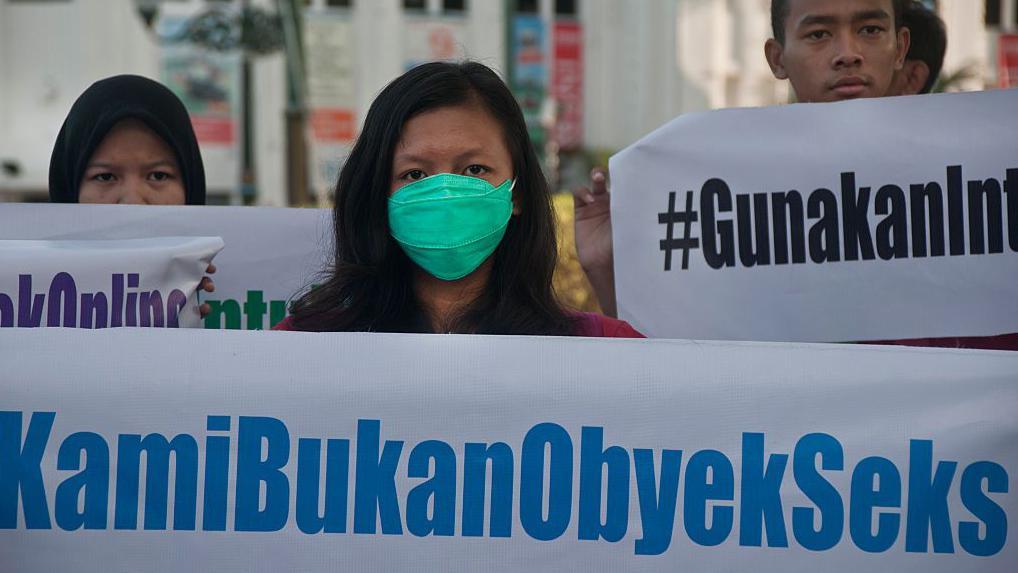

Behind the harrowing cases of sexual violence plaguing various university campuses, there lie countless untold stories of anguish. Survivors who dare to come forward and expose these crimes within academic institutions often face severe backlash, intimidation, and immense social pressure.
BBC News Indonesia interviewed two survivors, whose identities have been concealed for their safety, to shed light on their ordeals.
‘I Was Told I Was Hallucinating’
“The Task Force (for the Prevention and Handling of Sexual Violence) told me, ‘Perhaps you are hallucinating because of past trauma.'”
These words still echo in the mind of Intan, a student at Hasanuddin University (Unhas) in Makassar, South Sulawesi. Intan recounted this demoralizing response when she reported an alleged incident of sexual violence to her campus’s Sexual Violence Prevention and Handling Task Force (Satgas PPK).
- Read also:
- Allegations of sexual harassment in UI and IPB student chat groups – ‘Must be legally prosecuted for a deterrent effect and eradication of rape culture’
- ‘Erika’ song at ITB and testimonies of sexual violence survivors
- Viral allegations of sexual harassment at FH UI – Why does violence ‘thrive’ in educational institutions?
The incident occurred on September 25, 2024, during a thesis consultation in the office of a lecturer identified by the initials FS. However, the response Intan received from the Task Force shattered her resolve.
“They (the Task Force) seemed to believe that he (the reported perpetrator) couldn’t possibly commit (sexual violence) just because he had recently returned from Umrah.”
Intan stated that she, too, initially found it hard to believe her thesis supervisor would perpetrate such an act, as she had never observed any “strange” behavior from him. This is precisely why she bravely sought help.
“A friend informed me that the campus had a Sexual Violence Handling Task Force,” she explained.

Intan’s alleged sexual violence case was subsequently processed by the Unhas Satgas PPK, a procedure that lasted at least a month. She initially described the handling of her case as proceeding well during the first examination. Intan felt empowered enough to detail her experience, including suspicions that she was intentionally made the last student for consultation, despite arriving earlier.
However, during the second examination, Intan claimed that the Unhas Satgas PPK’s approach shifted dramatically. She felt cornered and blamed as the victim.
“There were words from a task force official saying I was hallucinating,” Intan elaborated. “That was truly what made me somewhat, and indeed very, disappointed.”
Intan also recalled that the Unhas Satgas PPK handling her case sent her several text messages that seemed to defend FS, the alleged perpetrator. “There was also a viral chat (conversation message) from the task force that appeared to support the perpetrator. I was quite shocked by that,” Intan stated.
Intimidation from Campus, Police, and Perpetrator’s Family
Intan’s disillusionment only deepened. After reporting FS to the Unhas Satgas PPK, she claimed to have received intimidation from multiple parties: the police, the perpetrator’s family, and the university itself.
Despite this overwhelming pressure, Intan repeatedly affirmed to herself that no one could break her spirit. She was fortunate to receive a wave of support from many students after her case became widely discussed on campus.
Some students even organized demonstrations, demanding the perpetrator’s dismissal. During these protests, Intan reported being visited by police late at night.
“(The police) came to my house, claiming they wanted me to tell the students to stop protesting. They said I was the one mobilizing the demonstrations,” Intan recounted.

Yet, the protests were purely a student-led movement against sexual violence on campus. FS, the perpetrator, also visited Intan’s parents in their village. She suspected that FS obtained her home address from the university, “Because my data is recorded there.”
Unexpectedly, the university administration itself asked Intan to drop the case. “Even Unhas asked me to stop the case, for the sake of the campus’s good name,” she claimed. It was due to these experiences that Intan refused the Unhas Satgas PPK’s offer to accompany her in reporting the case to the police. She feared that the Task Force’s inconsistent stance would backfire on her in the future.
“That’s what I couldn’t trust about the task force, because of the intimidation. As a victim, how could I trust them again?” expressed Intan, who ultimately reported FS to the South Sulawesi Regional Police herself in pursuit of justice.
When her case proceeded to the Makassar District Court, the trial was held behind closed doors. According to Intan’s lawyer, the university presented several lecturers from the Faculty of Humanities (FIB) as witnesses, allegedly in an attempt to defend the perpetrator. However, the judges rejected the presence of these witnesses, deeming them to have no direct knowledge of the incident.

The relentless pressure Intan endured ultimately led her to lose hope, especially in her own university, Unhas. She had hoped Unhas would seriously handle reports of sexual violence within the campus environment and genuinely side with the victims.
“My trust in Unhas is gone, because even in court, five lecturers from the campus defended this person (FS). What remains is disappointment,” Intan asserted. “I hope there will be no other victims. I truly hope not.”
In February 2026, the Panel of Judges at the Makassar District Court sentenced FS to 2.6 years in prison. BBC News Indonesia attempted to contact FS’s lawyer but received no response by the time this article was published.
Pressure on Student Press
Intan’s ordeal sent shockwaves through the campus community. It was exceptionally rare for a sexual violence survivor to speak out and even report to the police. The Hasanuddin University Law Faculty Student Press Institute (LPMH Unhas) prominently featured her story as their main headline.
Alisa Fitri from LPMH Unhas explained that she and her colleagues immediately planned an investigative style of reporting for the story. One key finding they uncovered was that the perpetrator, FS, allegedly planned his actions during the thesis supervision process.
“He planned it because, at that time, he turned off the CCTV in front (of the room) before entering his office,” Alisa claimed.

The student press, led by Alisa, also documented the widespread anger among Unhas students regarding the case. They organized demonstrations in front of the rectorate building, demanding the perpetrator’s dismissal. The rectorate responded to these actions, promising to send a recommendation to the Ministry of Higher Education, Science, and Technology (Kemendiktisaintek) for the perpetrator’s termination.
Following the Makassar District Court’s verdict in Intan’s case, Alisa and the Unhas Student Press once again reported on a similar issue: sexual violence within the campus environment. This time, the alleged perpetrator was claimed to have been expelled from the university in November 2024.
Their reporting was based on a Drop Out (DO) Certificate in the perpetrator’s name, which Alisa and her fellow journalists obtained in January 2025. However, Alisa noted that the perpetrator, allegedly the child of an official in South Sulawesi Regency, still moved freely within the campus environment, even participating in final semester exams in December 2024. No victims were willing to speak about this particular case.
“So we wrote the news based on the DO Certificate. There were many victims, not just one. They were from the law faculty and other faculties,” Alisa revealed.
After the report was published, Alisa claimed she received a reprimand from campus leadership. She was questioned by a leader: “Why are you reporting that?”
“I also received DMs (direct messages), inviting me to meet face-to-face after I returned to Makassar. All because of that news report,” she added. This reaction left Alisa and her friends confused, wondering if there was something wrong with reporting sexual violence cases.
In addition to these two prominent cases, the Unhas Student Press also received other reports of alleged sexual harassment. For instance, several female students confessed to receiving suggestive WhatsApp chats from an assistant lecturer in the Faculty of Law.

Again, several victims declined to be interviewed. “Perhaps out of shame, fear. Especially because he (the assistant lecturer) still had classes, and they were afraid it might affect their grades.”
From this series of sexual violence cases, Alisa concluded that Unhas still lacks a robust system to protect victims and make them feel safe. She therefore urged the Unhas Satgas PPK to enhance its competence and victim-centric perspective. “How can their competence be improved to handle sexual violence cases?” she questioned.
What is Unhas’s Response to the String of Sexual Violence Cases?
Mardiana E. Fachry, Deputy Head of the Unhas Sexual Violence Prevention and Handling Task Force, declined to revisit Intan’s case, considering it concluded in court. Nevertheless, she claimed the Task Force actively promotes sexual violence prevention both on and off campus. This is demonstrated through the distribution of anti-sexual violence stickers, discussions, and the formation of Task Force Ambassadors.
However, Mardiana acknowledged that these efforts are insufficient, as many alleged cases of sexual violence at Unhas remain unexposed. “There are so many (unexposed cases). More than those reported,” Mardiana revealed.

Since its formation in 2022 until 2025, the Unhas Satgas PPK has handled at least 26 alleged cases of sexual violence. Specifically, there was one case in 2022; seven cases in 2023; 12 cases in 2024; and six cases in 2025. Mardiana attributed the exposure of these dozens of cases to the Task Force’s socialization efforts, which emboldened victims to report.
“Most of the cases we handled involved students, both harassment between students and other forms of violence,” she explained. “Then there were cases perpetrated by lecturers against students and between education staff in teaching hospitals; all of these have been resolved. Including cases between lecturers, though these were not proven.”
Despite these figures, she noted that the Satgas PPK still faces limitations. Firstly, the Task Force only acts when there is a report from a victim. Without a complaint, they are unable to intervene. “At most, we can only investigate and then ask if they want to report or not. There can be no coercion, as it must truly be the victim’s will,” she stated, referring to the Minister of Higher Education’s regulations on the Satgas PPK.
Secondly, the Satgas PPK can only handle cases of sexual violence involving students or education staff that occur within the scope of the Tri Dharma activities, which include teaching, research, and community service. “If someone is having coffee with friends in the afternoon, and harassment occurs there, and it has no connection to Tri Dharma, then it’s not within our domain; it’s another domain,” Mardiana clarified.
In such situations, the Satgas PPK can only accompany the victim to report to the Provincial Women’s Empowerment and Child Protection Agency (DP3A) of South Sulawesi. However, if a case is proven to have occurred within their jurisdiction, the Satgas PPK has the authority to make recommendations, while the final decision on sanctions rests with the rectorate.

Meanwhile, Universitas Hasanuddin spokesperson Ishaq Rahman stated that as proof of the university’s seriousness in addressing sexual violence cases, the administration has imposed administrative sanctions, including suspensions, on three perpetrators—ranging from lecturers to professors. One such case involved sexual harassment of a student during a thesis consultation in 2024.
Based on the Satgas PPK’s examination results, the perpetrator, a professor, allegedly touched the victim’s hand, causing discomfort, which was subsequently reported as an act of harassment. “(The perpetrator) was suspended for one semester, prohibited from teaching,” Ishaq explained.
In the same year, a lecturer in the Faculty of Social and Political Sciences (FISIP) was also suspended for making jokes that bordered on harassment. “For example, if a student had a unique or funny name, it would be made into a joke. At one point, there was a female student, and he (the perpetrator) said, ‘Your name is so good. It’s perfect for my girlfriend, do you want to be my girlfriend?'”
“Her classmates laughed, but the student who was the object of the jokes felt it was harassment,” Ishaq added. Regarding the case involving lecturer FS, Unhas has prohibited him from teaching and recommended that the Ministry of Higher Education, Science, and Technology (Kemendiktisaintek) revoke his status as a Civil Servant (ASN). “We have submitted a proposal to the ministry, it has been in process since last year. If I’m not mistaken, the proposal was in November,” he claimed.
However, regarding the alleged student perpetrator, said to be the child of an official in South Sulawesi Regency, Ishaq did not mention it at all. “So far, we have never received reports where students were the perpetrators,” he stated.
Culminating in ‘Family-Style’ Resolution
In Semarang, Central Java, Noni, who is still pursuing higher education at a university, also reported experiencing sexual violence by a senior. When it happened, her mind was in disarray; she didn’t know what to do.
“If I reported it to campus, I was afraid of being blamed, because the stigma in society still blames the victim,” she confessed. In her mind, she also recognized the powerful authority dynamics between juniors and seniors, which are not easily overcome. She worried that no one would believe her story or offer support.
Furthermore, the perpetrator, she noted, was highly respected within the campus community. “Ultimately, I chose to remain silent.”

Until one day, Noni recounted, another student who had also been a victim spoke to her. That testimony, she added, became the catalyst for her to act. She decided to report the incident to the organization the perpetrator belonged to. Yet, what she received was disappointment.
“In the end, the case was resolved in a family-style manner,” she lamented. Noni emphasized that patriarchal culture still thrives in academic circles, often blaming and even stigmatizing victims as temptresses.
Now, Noni simply hopes for safe spaces for women on campus. “Yet, a safe and comfortable environment… should be created for everyone,” she concluded.
‘Victims Unprotected, Campus Caught Off Guard’
Public lawyer Siti Mazumah from the Women Crisis Center stated that the majority of sexual violence victims tend to remain silent because they “do not receive empowerment” from the Sexual Violence Prevention and Handling Task Force. The “empowerment” Siti referred to is a victim-centric approach, providing protection and accompaniment.
The problem, she noted, is that in several cases she has handled at campuses, the Task Force’s actions contradicted the victim’s wishes. “In reality, not all task forces have a good perspective,” she said.

Meanwhile, according to Echa Waode from Arus Pelangi, the mere existence of victims who fear reporting proves that campuses are “caught off guard.” “The TPKS Law (Sexual Violence Crimes Law) is in place, task forces exist, so is this effort faltering? Or is there intimidation, or pressure from the campus itself, fearing a damaged image?” Echa questioned. “This effectively perpetuates perpetrators within the education system,” Echa added in a press statement from the Indonesian Women’s Alliance (API).
Nabila Tauhida, representing API, believes that sexual violence cases in education must be a turning point for action. She called for the establishment of an independent oversight system to monitor campus accountability in preventing and handling sexual violence cases. This independent system, she stressed, should involve student organizations, victim support groups, and civil society.
Additionally, API urged the government and higher education institutions to integrate critical education on consent, power dynamics, body objectification, and gender justice as part of core curricula or compulsory general courses. “Training on victim perspectives and Law No. 12 of 2022 on Sexual Violence Crimes is also mandatory for all academic communities,” Nabila stated.
This includes pressing the government and universities to develop specific protection protocols guaranteeing the physical safety of victims, witnesses, victim companions, and vulnerable groups such as trans women, who often face structural barriers in accessing justice. “Every form of intimidation, dismissal, or academic sanction against parties who report or accompany sexual violence cases must be processed as a serious violation with strict penalties,” Nabila added.
Crucially, the alliance also urged that military practices and logic not be employed in educational environments, “because they have the potential to reinforce a culture of hierarchy, impunity, and gender-based violence.” Furthermore, they advocated for restoring the function of the PPKS Task Force to focus more specifically on sexual violence, as handling sexual violence is distinct from general violence.
What Steps is the Government Taking?
The Minister of Higher Education, Science, and Technology (Mendiktisaintek), Brian Yuliarto, affirmed his commitment to overseeing the resolution of sexual harassment cases occurring in several campuses. It is worth noting that since early April, at least four sexual violence cases have gained prominence on social media:
- A student chat group at the University of Indonesia deemed to demean women;
- A song titled ‘Erika’ sung by a group of Bandung Institute of Technology students;
- A professor at Padjajaran University allegedly committing sexual violence against his students;
- A lecturer at Budi Luhur University (UBL) reported by his students for alleged sexual harassment, who then counter-reported the victim to the Metro Jaya Regional Police.
Minister Brian emphasized that the resolution of harassment cases must not stop at mediation or apologies. “Every report must be processed according to regulations, with a principle of favoring the victim, but upholding fair and objective examination,” Brian was quoted by detikcom on Sunday (19/04).
He added that Kemendiktisaintek will continue to strengthen the evaluation of the implementation of prevention and handling of violence in higher education. Brian assured that his ministry would push for the reinforcement of campus-based Sexual Violence Prevention and Handling Task Forces (Satgas PPKPT) at every university. “Ensuring reporting channels are safe and trustworthy, and requiring higher education institutions to conduct more serious education on social ethics, power dynamics, consent, digital space safety, and victim protection,” Brian explained.
Journalists Muh. Aidil in Makassar and Kamal in Semarang contributed to this article.
- ‘I don’t want any other victims’ – Alleged sexual harassment case at Unhas, PPKS Task Force asks suspected perpetrator lecturer to be dismissed
- Allegations of sexual harassment in UI and IPB student digital chat groups – ‘Must be legally prosecuted for a deterrent effect and eradication of rape culture’
- ‘Erika’ song at ITB and testimonies of sexual violence survivors – ‘Between fear, shame, or not knowing where to report’
- Allegations of sexual harassment in universities: Minister’s regulation on prevention of sexual violence ‘prone to being undermined’
- Alleged sexual harassment case at Pancasila University, victim: ‘It’s okay if I expose my shame, as long as I get justice’
- Campus sexual harassment defendant acquitted, Nadiem Makarim meets victim
- Former church leader who admitted to sexually abusing children still free in Canada
- Fate of domestic violence and sexual violence victims when BPJS does not cover health services and forensic examination costs
- Men secretly record women for profit – BBC investigation reveals social media video phenomenon
- ‘We had sex in a hotel, but it was recorded and shared with thousands of people’
- Female victim of police rape becomes defendant instead – ‘I hope no one is in the same position as me’
- Indonesia claims to block Grok – ‘Is there still a safe digital space for women?’
- Stories of immigrant women seeking new lives – ‘We were asked to pay with our bodies’
- Every 10 minutes worldwide, a woman is murdered by her partner or family member
- Andrew loses UK ‘prince’ title due to sex scandal
- ‘Sexual violence in pesantren is not exaggerated’ – More than 40,000 santri vulnerable to sexual violence
- Young Indian women dedicated to gods but trapped as sex workers
- Andrew loses UK ‘prince’ title due to sex scandal
Summary
Survivor Intan from Unhas reported sexual violence by a lecturer but was accused of hallucinating and faced intimidation from the campus task force, police, and the university itself, which urged her to drop the case. Despite this, she pursued justice, leading to the perpetrator’s conviction, yet expressed profound disappointment in Unhas’s handling. Another victim, Noni, initially remained silent due to fear and stigma, and later saw her case resolved informally, underscoring the prevailing patriarchal culture and victim-blaming on campuses.
Unhas’s Sexual Violence Prevention and Handling Task Force (Satgas PPK) reported managing 26 cases from 2022-2025, yet acknowledged many more remain unreported due to systemic limitations and victim’s fear. Experts criticize the lack of victim empowerment and inconsistent task force actions, advocating for independent oversight, comprehensive education on consent, and stronger protection protocols. The government has pledged to reinforce campus task forces and ensure victim-centric, fair processes to address campus sexual violence.
