
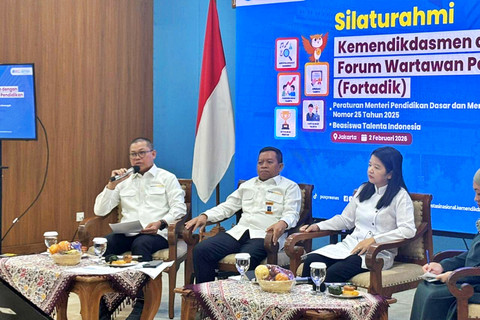
The Ministry of Primary and Secondary Education (Kemendikdasmen) is embarking on an ambitious journey to cultivate future Indonesian Nobel laureates through its new Student Talent Management policy. This visionary initiative, codified in Ministerial Regulation of Primary and Secondary Education Number 25 of 2025, aims to be a critical long-term investment in developing the nation’s brightest minds.
This strategic regulation is designed to systematically manage the innate talents, interests, and best abilities of students. It outlines a meticulously planned, structured, and sustainable framework applicable across primary and secondary education levels, thereby replacing the previous Ministerial Regulation of Education, Culture, Research, and Technology Number 71 of 2024 concerning Student Talent Management. The updated policy reflects a renewed commitment to fostering a holistic development environment for young learners.
Biyanto, Expert Staff for Regulation and Inter-Agency Relations at Kemendikdasmen, emphasized that this new talent management framework transcends traditional academic achievements. It encompasses a comprehensive approach to developing both academic and non-academic talents. Speaking at a Kemendikdasmen gathering with the Education Journalists Forum (Fortadik) in Central Jakarta on Monday, February 2nd, Biyanto passionately articulated the ministry’s aspirations.
“Beyond preparing our students for national and international academic success, we fervently hope that, through this Ministerial Regulation and the support from the ministry, as well as the participation of various stakeholders including local governments, we can ultimately produce Indonesian citizens capable of winning Nobel Prizes,” Biyanto stated. He highlighted Indonesia’s historical absence of Nobel laureates across any field, underscoring the strategic importance of nurturing talent from the foundational stages of primary and secondary education. This proactive stance is seen as a crucial step towards building a robust foundation for enduring national and global recognition.
Biyanto reiterated the profound impact anticipated from this long-term investment in talent development. “The seeds we plant today will hopefully yield extraordinary individuals in the future, not only bringing pride to their respective regions but also elevating the name of our beloved nation on the global stage,” he added. He believes the potential for world-class talent to emerge is vast, spanning both academic and non-academic domains, including arts, culture, and sports. The regulation thus serves as a vital umbrella to ensure the directed and sustainable development of Indonesian children’s potential.
The discussion also touched upon the potential for collaboration with other ministries regarding sports. Biyanto noted, “There are numerous opportunities in arts, culture, and sports. We’ve even heard that several sports branches from the Ministry of Youth and Sports will be transferred to us for guidance.” However, Maria Veronica Irene, Head of the National Achievement Center, clarified that these discussions are ongoing and no official transfer has yet occurred.
Irene elaborated that the current phase is still a transition period involving extensive deliberation. “It’s not about a complete transfer, but rather a focus on coaching because the target is the students,” she explained. “The hope is that Kemendikdasmen can collectively support these sports branches. The key is that if the target is children, Kemendikdasmen can provide significant support.” This collaborative approach ensures that the development of student talent remains at the forefront, paving the way for a generation of globally competitive Indonesians.
Summary
The Ministry of Primary and Secondary Education (Kemendikdasmen) has introduced a new Student Talent Management policy, codified in Ministerial Regulation Number 25 of 2025, aimed at cultivating future Indonesian Nobel laureates. This visionary initiative replaces previous regulations, establishing a structured framework to systematically manage students’ innate academic and non-academic talents across primary and secondary education levels.
Biyanto, Expert Staff at Kemendikdasmen, highlighted the policy’s ambition to produce world-class talent, bringing global recognition to Indonesia through success in various fields. While discussions are ongoing regarding collaboration with other ministries for sports guidance, the primary focus remains on coaching students to holistically develop their potential, as clarified by Maria Veronica Irene from the National Achievement Center.