
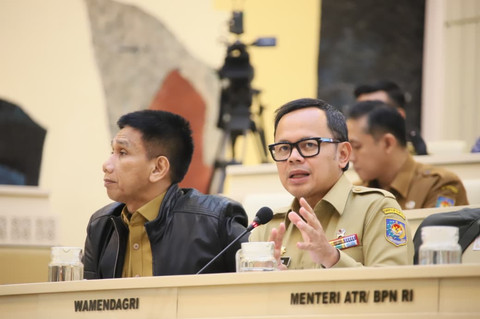

Indonesia’s Deputy Minister of Home Affairs (Wamendagri), Bima Arya, has offered a nuanced response to the Corruption Eradication Commission’s (KPK) significant proposals aimed at reforming political party governance. These proposals, designed to enhance the integrity and effectiveness of the nation’s political landscape, specifically include a mandate for presidential and vice-presidential candidates to originate from robust party cadre regeneration systems, alongside a suggestion to limit political party chairpersons’ tenures to a maximum of two terms.
Bima Arya expressed his unequivocal support for strengthening political party cadre regeneration, declaring, “For cadre regeneration, we are 100% in agreement and enthusiastic. Indeed, cadre regeneration must be reformed to produce competent leaders who possess the necessary capacity.” Speaking to reporters on Thursday (23/4), he further articulated that the ambition for future leaders to emerge from within party ranks is a profound desire shared by all political organizations. “That is the dream of all political parties—to cultivate their cadres into leaders at all levels, including the highest level, the presidency. That is every party’s aspiration,” Bima emphasized, highlighting the universal appeal of developing internal talent.
However, the Deputy Minister also provided a dose of reality, cautioning that transforming this aspiration into practice is a formidable challenge, demanding a comprehensive overhaul of the entire political ecosystem. He pointed out the intricate web of dependencies: “But in reality, that is not an easy task. It is connected to issues of financing, education, the political system, and the electoral system.” This perspective underscores the complexity of implementing such fundamental reforms.
Turning to the proposal for limiting the tenure of political party chairpersons to two terms, Bima Arya urged an extremely cautious approach. He specifically warned of potential legal ramifications, including the risk of such a policy being challenged at the Constitutional Court. The Deputy Minister highlighted global examples where influential party leaders have served beyond two terms, successfully building and sustaining resilient party systems.
Bima Arya posited that the core challenges confronting political parties might not primarily stem from the duration of a chairperson’s tenure. Instead, he argued that the more critical issues reside in the fundamental systems of accountability and integrity within these organizations. “So, I believe the problem is perhaps not in the term limit itself, but rather more about the accountability and integrity system of political parties,” Bima clarified, drawing a vital distinction. He concluded by confirming that all recommendations put forth by the KPK would be subjected to further, thorough review and consideration.
Earlier, the KPK’s comprehensive study into political party governance had unveiled four fundamental problems impeding effective and ethical operations. These critical findings included: the glaring absence of a clear political education roadmap; a lack of an integrated standard system for cadre regeneration; the non-existence of a dedicated financial reporting system for political parties; and the persistent ambiguity surrounding the designated oversight body within the Political Parties Law.
Building on these crucial observations, the KPK formulated 16 robust recommendations aimed at enhancing political party governance, with a key focus on revising the Political Parties Law (UU Parpol). Specifically, the anti-graft body advocated for “the necessity of adding to the revision of Article 29 of Law Number 2 of 2011,” as detailed in their study’s findings, published on the KPK website on Thursday (23/4).
The KPK identified four key areas within Article 29 that urgently require revision to strengthen party structures and improve leadership selection. These proposals seek to redefine party membership, establish clear candidate qualifications, and ensure leadership emerges from systematic cadre development. The suggested revisions include:
-
Amending Article 29 Paragraph (1) letter a to specify that political party members shall comprise junior, middle, and main cadres, creating a clearer progression;
-
Establishing explicit, tiered requirements for cadres aspiring to become candidates for the House of Representatives (DPR) or Regional Legislative Councils (DPRD) in Article 29 Paragraph (1a). For instance, candidates for the DPR would need to be main cadres, while provincial DPRD candidates would originate from middle cadres;
-
Adding a crucial clause that requires presidential, vice-presidential, regional head, and deputy regional head candidates to emerge from the party’s internal cadre regeneration system, thereby complementing existing democratic and open selection criteria;
-
Introducing a minimum duration of party membership as a prerequisite for an individual to be nominated by the party for public office, ensuring commitment and experience.
Beyond these detailed systemic overhauls, the KPK’s recommendations also notably reiterated the call for restricting the tenure of political party chairpersons. The study explicitly stated, “The KPK recommends: to ensure the functioning of cadre regeneration, it is necessary to regulate the leadership term of party chairpersons to a maximum of 2 periods of management.” This direct linkage between leadership term limits and the imperative of cadre development underscores the KPK’s strategic approach to fostering internal party growth.
KPK spokesperson Budi Prasetyo clarified that this extensive study is an integral part of the commission’s overarching strategy to prevent corruption, particularly within the political sector. He asserted, “Regarding that study, it is part of the KPK’s efforts, especially within the framework of prevention, in the political sector, because we indeed view the political sector as one of the sectors still vulnerable to corruption. Therefore, the KPK also intervenes through prevention approaches.” This statement emphatically highlights the anti-graft body’s proactive commitment to bolstering political integrity through comprehensive governance reform.
Summary
The Corruption Eradication Commission (KPK) has proposed significant reforms for political parties, notably mandating presidential and vice-presidential candidates to emerge from internal cadre systems and limiting party chairpersons’ tenures to two terms. Deputy Minister of Home Affairs (Wamendagri) Bima Arya strongly supported strengthening cadre regeneration, viewing it as a universal aspiration for political organizations. However, he cautioned that transforming this aspiration into reality is a complex task, citing challenges related to financing, education, and the broader political and electoral systems.
Regarding the proposed two-term limit for party chairpersons, Bima Arya advised extreme caution due to potential legal challenges, suggesting that core issues might lie in accountability and integrity rather than tenure length. The KPK’s comprehensive study, identifying governance problems such as a lack of political education and integrated cadre systems, underpins its 16 recommendations. These recommendations include revising the Political Parties Law to ensure leaders emerge from internal party development, with the two-term limit reiterated to foster cadre regeneration as part of the KPK’s strategy to prevent corruption in the political sector.
