
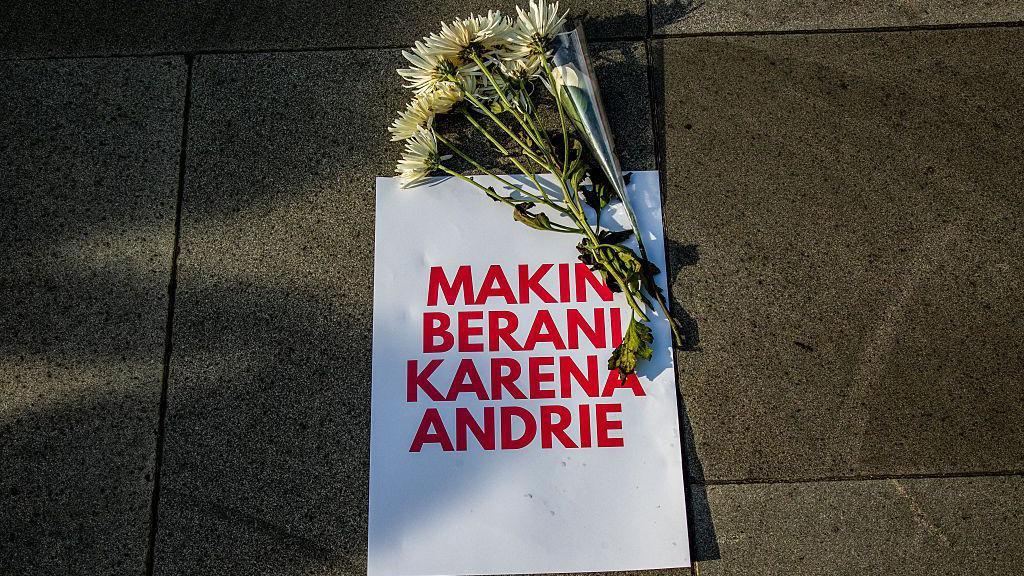
The police’s decision to transfer the investigation file for the acid attack case against KontraS activist Andrie Yunus to the Indonesian Military Police (Puspom TNI) has sparked sharp criticism, with civil society organizations labeling it a “premature step.” This move immediately raises concerns about the potential for impunity, as the military now assumes control of the case.
The handover of Andrie Yunus’s case was confirmed by the Director of General Criminal Investigation for the Jakarta Metro Police, Senior Commissioner Iman Imanuddin, during a hearing with Commission III of the House of Representatives on Tuesday, March 31. Despite the transfer, Iman assured that all previous police investigative steps were transparent and accountable. “Our process has always been based on legal facts obtained during the investigation. We have conveyed that the transfer to Puspom TNI has been completed, and up to the point of transfer, we found no civilian involvement,” he stated, emphasizing the integrity of the police’s prior work.
However, Dimas Bagus Arya, Coordinator for KontraS, expressed deep regret over the police’s choice, noting that the TNI’s handling of the attack on Andrie had been “perceived as slow.” He pointed out that since Puspom TNI announced the detention of four suspected perpetrators on March 19, 2026, “there has been no release of their faces or identities.” This lack of transparency, Dimas warned, creates a significant vulnerability for “manipulation of law enforcement.” To safeguard the investigation’s integrity, Dimas urged the government to establish an independent fact-finding team, comprising law enforcement officials, experts, and civil society representatives, to oversee and complete the inquiry into the attack on Andrie Yunus.
Adding to the chorus of criticism, Fadhil Alfathan, Director of LBH Jakarta, argued that the transfer of the investigation file from the police to the military “lacks a clear legal basis.” This concern is amplified by the findings of the Advocacy Team for Democracy (TAUD), which suggests that as many as a dozen individuals may have been involved in the assault on Andrie. Fadhil called for a “review” of the decision to transfer the file, asserting, “For us, if we rely on the legal politics post-amendment of the 1945 Constitution, our constitution, the principle of equality before the law is a fundamental principle.”
Based on BBC News Indonesia’s monitoring of numerous human rights reports and media coverage, criminal cases involving military personnel frequently conclude with less than ideal outcomes. Rahadian Suwartono, a legal scholar from the Islamic University of Indonesia (UII), further explained that once an investigation file is handed over to the military and processed through a military court, the avenue for trial in a civilian court automatically closes. This is attributed to the legal principle of *ne bis in idem*, which prohibits an individual from being prosecuted twice for the same offense. Rahadian highlighted the fundamental difference, stating, “The paradigm used in military courts differs from general courts,” making it “one of the gateways to impunity.”
‘I feel like I died twice’
Lenny Damanik’s tears flowed uncontrollably as she recounted her harrowing experience before the Constitutional Court (MK) judges in January 2026. Her presence in the courtroom was in connection with her testimony as a witness in a material review of the TNI Law. Lenny shared the tragic story of her 15-year-old son, Michael Histon Sitanggang, who died in 2024 after being assaulted by a first sergeant in Medan, North Sumatra. Michael had been observing a street brawl when security forces dispersed it. He was apprehended, beaten by the soldier, and fell two meters under a bridge. Although he returned home and received treatment at a clinic, his health deteriorated, and despite medical interventions, his life could not be saved.
In her relentless pursuit of justice, Lenny, alongside the Legal Aid Institute (LBH) Medan, reported her son’s death to various authorities, including military institutions. According to her testimony, the TNI’s investigation was sluggish, and the case only reached a military trial several months after Michael’s death. The military court ultimately sentenced the soldier responsible for Michael’s assault to a mere 10 months in prison. This verdict, Lenny felt, was profoundly unjust. “I feel like I died twice. My son’s death already killed me, but then came a verdict that was even more unjust,” Lenny expressed. “A 10-month prison sentence, for me, as a mother, is not just a number. It is a sense of justice that feels very far from conscience.” During her testimony, Lenny challenged the basis of the 10-month sentence, imploring the MK judges for a legal system that “does not differentiate between uniformed personnel and ordinary people.” She concluded, “If the law cannot deliver justice for my son, I fear it will also fail to protect other children in the future.”
Shortly after Michael’s passing, in June 2024, a similar incident unfolded in Karo Regency, North Sumatra. Journalist Rico Pasaribu and three members of his family perished in an arson attack on their home. Rico’s daughter, Eva Pasaribu, believes the fire was an act of retaliation for Rico’s reporting. Prior to the fire, Rico had extensively published news regarding alleged TNI involvement in illegal gambling. The implicated TNI members were reportedly incensed and demanded Rico remove his posts. Rico refused, leading to three civilians—who were later named suspects—setting his house ablaze. The house was gutted, and Rico died instantly.
According to civil society organizations monitoring the case, the Committee for Journalist Safety (KKJ) and LBH Medan, the arson attack on Rico’s home was not limited to the field perpetrators. Police were urged to uncover the motive and the masterminds behind the assault. Witness testimonies in court indicated that the arsonists were hired, implying orders from a superior. Based on this, Eva and her legal support team pressed Kodam I/Bukit Barisan and the Army Military Police (Puspomad) in Jakarta to investigate. According to Eva, the TNI promised that “suspects would be named soon,” but her wait yielded no results. Eva highlighted a stark disparity: “The difference in treatment between civilian perpetrators and military perpetrators was evident from the outset of the case. Civilian perpetrators were quickly arrested, detained, openly interrogated, and their trials proceeded with full public access.” Conversely, Eva continued, “the military process was closed,” characterized by “minimal information” and a lack of oversight mechanisms for families or civil society “to monitor.” This situation created “deep concern” and “legal scars as a victim,” Eva added, underscoring that the military judiciary’s lack of transparency and the TNI’s internal authority risk rendering legal proceedings against its members “unaccountable” and “prone to impunity.”
The criticism of impunity arising from military courts is not isolated. In August 2025, the Military Court 1-02 Medan sentenced two TNI members to 2 years and 6 months in prison and dismissal from service for their involvement in the murder of a 13-year-old child. One month earlier, the same court found two soldiers guilty of smuggling 1.2 tons of pangolin scales, sentencing them to 1 year in prison. A 2018 Amnesty International report, covering the period 2010 to 2018, documented 69 cases of extrajudicial killings involving 95 victims by law enforcement (TNI & Polri) in Papua. Nearly half (34) of these extrajudicial killings, Amnesty International explained, reportedly involved military personnel. Disturbingly, 82% of these cases (28) saw the perpetrators escape accountability. Amnesty International concluded that impunity for state apparatus, including the TNI, was starkly evident in Papua, with many extrajudicial killings not independently investigated. Even when probed, victims’ families, according to Amnesty International’s research, were often not informed of developments.
Network of legal immunity within the military
Rahadian Suwartono, a constitutional law lecturer at the Islamic University of Indonesia (UII), posits that the very design of military courts contributes to the space for impunity. Rahadian explains that military courts operate under a paradigm of “command discipline towards military institutions.” He clarifies that “discipline” here does not pose a problem when investigating internal military matters, such as desertion. “Well, the crime of desertion falls under military jurisdiction because it is not a public criminal offense, a general criminal offense, as civilians are not bound by the concept of loyalty in the same way the military is,” Rahadian elaborated to BBC News Indonesia.
However, when a crime like the attack on KontraS activist Andrie Yunus occurs, the priority should shift from military justice to general justice, Rahadian argues, because such acts constitute general criminal offenses, and the victims are civilians, not within the military’s internal scope. When questioned by BBC News Indonesia about the transfer of Andrie’s investigation file to the military, Rahadian expressed pessimism that “objective justice” would be achieved. “As I said earlier, the design of military courts is for institutional loyalty and discipline, so institutional interests will always be number one,” he stated. “And what might emerge is how to protect those institutional interests.” Rahadian likened bringing general criminal cases to military courts to “incorrect treatment,” stating, “It’s like taking the wrong medicine.” He added, “The public’s thirst for civilian justice is never quenched through military courts because their design is specifically to handle military disciplinary issues or military criminal offenses within the military’s own sphere of life.”
According to Rahadian, the roots of this impunity can be traced back to the New Order era. During Suharto’s dictatorship, the military, Rahadian noted, was not merely tasked with security and defense but also served as a tool for political stability. Elizabeth Drexler, a scholar from Michigan State University, elaborated on this in her intensive research, later published as *Infrastructures of Impunity: New Order Violence in Indonesia* (2024). In her book, Drexler explains that the justice perpetually denied to victims of state violence is not due to a lack of accommodating legal instruments but rather is deliberately perpetuated by an “infrastructure of impunity.” This infrastructure, according to Drexler, encompasses several crucial aspects: legal, military, bureaucratic networks, and propaganda. Drexler’s findings draw from various samples of human rights abuses, ranging from the 1965 massacres and mysterious shootings (*petrus*) to the Tanjung Priok tragedy and the May 1998 riots. For instance, when researching 1965, Drexler found that victims of violence were consistently framed as part of the “evil” Indonesian Communist Party (PKI). New Order propaganda manifested through official historical narratives and popular cultural products like films. In the May 1998 tragedy, Drexler continued, those responsible for the abduction of activists and student shootings were never brought to official trial because they were protected by a robust military bureaucratic structure.
Even after Reformasi replaced the New Order, this structure maintained its dominance, partly by forging relationships with civilian elite interests concerning the distribution or consolidation of political power. “Sometimes [elements of the impunity infrastructure] work independently, sometimes they work together. But most importantly, their effects are amplified by the others,” Drexler told BBC News Indonesia. In Indonesia, the system of impunity is inextricably linked to the authoritarianism established by Suharto, not long after he usurped Sukarno’s power. Its purpose, quoting Drexler, was to ensure “they were not punished,” while also “narrowing the space for accountability” for their actions. “But I also think that perhaps at that time they were not worried about impunity because they were so powerful, they controlled everything,” she asserted. “And at that time, everything was more controlled by the military, so much direct violence emerged.” The detrimental consequence created by this infrastructure of impunity, Drexler revealed, is a view that normalizes state crimes, asserting that the state commits them for a greater good. “So, this [impunity] system says it’s okay to stigmatize society. It’s okay if the legal system doesn’t serve everyone,” Drexler explained. “It’s okay if the state treats them as less than human and continuously blames the victims or sees them as threats, problems, and it doesn’t have to be the same victims.” The extent to which the infrastructure of impunity can be dismantled depends on several factors—public pressure and civilian institutions—a process that requires multiple, layered stages. Drexler warned that the longer the impunity system persists, the greater the likelihood of authoritarianism emerging. In short, impunity can lead to the birth of new, patterned violence involving the massive power of the state, wielded by the military.
Efforts to reduce impunity within the military have been undertaken by a civilian coalition under the umbrella of the Security Sector Reform Advocacy Team. Since 2025, they have filed a material review against the TNI Law, specifically highlighting the existence of military courts. The coalition argues that the root of impunity within the military stems from Law No. 31 of 1997 concerning Military Courts. In the TNI Law, specifically Article 74 paragraphs (1) and (2), this clause is maintained. Broadly, this article states that until new regulations regarding military courts are enacted, criminal offenses committed by TNI members will continue to be handled by military courts. “But the political process to update the Military Court Law has not been carried out,” the civil coalition noted. The implication of this situation, the civil coalition continued, is “the inclusion of all criminal offenses committed by military personnel within the absolute jurisdiction of military courts.” This occurs “without regard to whether the criminal offense committed is a military criminal offense or a general criminal offense,” the coalition added. Besides leading to a violation of the principle of equality before the law, the coalition contended that the existence of military courts “hampers law enforcement and justice in several aspects.” The petition for the material review of the TNI Law is still ongoing. In the 53-page document submitted by the civil coalition to the Constitutional Court, which includes various legal perspectives, Andrie Yunus is notably listed among the contributing advocates.
TNI: Investigation will be in accordance with legal provisions
Head of the TNI Information Center, Major General Aulia Dwi Nasrullah, confirmed that the TNI has named four military personnel as suspects in the acid attack on Andrie Yunus. The four suspects, ranging in rank from captain to second sergeant, are members of the Strategic Intelligence Agency (BAIS) TNI. Aulia stated that they have been detained since March 18, 2026, under strict supervision by the Jaya Guntur Military Police Command (Pomdam Jaya Guntur). The investigation into the acid attack is ongoing, with Puspom TNI actively gathering testimonies from several witnesses, Aulia added. He assured that all stages of the investigation would adhere to applicable legal frameworks and maintain transparency. The TNI, he claimed, is acting “firmly” against those involved in the attack on Andrie Yunus. Previously, the TNI announced that Lieutenant General Yudi Abrimantyo had resigned from his position as Head of BAIS.
Meanwhile, the National Commission on Human Rights (Komnas HAM) reported that coordination between the TNI and the National Police in investigating Andrie’s case has not proceeded smoothly. In the latest development, Komnas HAM invited high-ranking TNI officials to their office for confirmation regarding the investigation. One key question posed to Komnas HAM was whether the acid attack on Andrie Yunus constituted a “command operation.” “If this was an operation, were there superiors involved?” asked Komnas HAM Commissioner Pramono Ubaid Tanthowi. Pramono did not elaborate on the TNI’s specific response but affirmed that Puspom TNI guaranteed openness.
Society could distrust the state’s justice system
Research by Marcus Mietzner, a political science professor at Australian National University, titled *The Politics of Military Reform in Post-Suharto Indonesia: Elite Conflict, Nationalism, and Institutional Resistance* (2006), states that impunity is a “military culture” “cultivated for decades.” Mietzner suggests that as long as impunity persists, reforms within the military will not progress significantly. Rahadian Suwartono, a law lecturer at the Islamic University of Indonesia, believes that if military impunity issues are not promptly addressed, “past traumas will resurface” among the public. “Military justice has had a stigma of non-transparency since the New Order era. This stigma is entrenched. Why? Because there have been many public disappointments when judicial processes were conducted in military courts,” Rahadian explained. “That disappointment stems from the justice never received by victims of violence involving soldiers.” From trauma, public sentiment can evolve into distrust of “the state’s judicial process,” Rahadian continued.
KontraS Coordinator Dimas Bagus Arya argues that the attack, or attempted murder, against Andrie Yunus can no longer be simply interpreted as a “single act.” What happened to Andrie Yunus, Dimas emphasized, creates a domino effect of fear, threats, and repression from parties “who may never be on the same wavelength as civil society.” Therefore, Dimas urged the government not to fully entrust the investigation of Andrie’s case solely to the TNI, to ensure that impunity, or the cycle of violence, does not end in an anomaly. “So, we ask that this forum can also emphasize or produce a political decision to create an independent joint fact-finding team consisting of several experts, several law enforcement bodies, and also civil society,” Dimas stated during a hearing with Commission III of the House of Representatives late last March. “So that it can be clearly uncovered. Not only the executors in the field, but also the intellectual actors, and also the motive.”
- Acid attack case on KontraS activist, Prabowo promises to investigate ‘who ordered and paid’ and consider forming a joint fact-finding team
- Solidarity action for Andrie Yunus – ‘It’s time for us to build collective strength’
- TNI detains four military suspects in acid attack case on KontraS activist – ‘Bring perpetrators and intellectual actors to justice in civilian courts’
- ‘I am more worried when my child is on duty in Papua’ – The story of an Indonesian soldier who died in Lebanon
- Police transfer acid attack case on KontraS activist to Puspom TNI, YLBHI deems it ‘legally flawed’
- TNI’s ‘Alert Level 1’ status: responding to global conflict or quelling social unrest?
- North Sumatra Regional Police name new suspect in journalist’s house ‘arson’ in Karo
- Prada Lucky case verdict: 22 soldiers dismissed and sentenced to less than 10 years – What is the chronology of this case?
- TNI insists alleged Basarnas chief corruption be tried in military court; observer: ‘This will reinforce the notion that TNI members are first-class citizens’
- Grasberg gold mine shooting – Why could Freeport security, involving thousands of personnel and trillions of rupiah, be breached?
- Construction of military battalion headquarters rejected by residents in several regions – ‘We are still traumatized’
- More soldiers to be sent to Aceh and Papua – ‘I fear the trauma of conflict will re-emerge’
- TNI members allegedly involved in violence in Papua urged to be tried through general courts
- TNI members allegedly involved in killing a pastor in Papua, says Komnas HAM
- Revision of TNI Law: ‘The military is never democratic’ – What is the danger if TNI expands into civilian affairs?
- Suharto officially declared a national hero – Why did Prabowo designate him at the beginning of his administration?
- From Marsinah’s murder to the Tanjung Priok massacre: When Munir’s advocacy often confronted the military
- ‘Father of Development’ and human rights violator – Why is Suharto considered unworthy of being a national hero?
- Formation of new regional military commands and hundreds of battalions, to cyber authority – What is the military’s position in Prabowo’s second year?
- Deployment of military in Biak, Papua sparks pros and cons
- Draft presidential regulation on military involvement in counter-terrorism emerges; why does this provoke anxiety?
- One year of Prabowo’s government – ‘Cute grandpa’ image ends, militaristic character re-emerges
- TNI allegedly shot resident in Asmat, Papua to death – ‘Why use weapons to handle a drunk person?’
- Constitutional Court rejects formal review of TNI Law – What are the reasons and impacts?
- Military searches for figures behind petition rejecting TNI Bill, accuses civil movements of being paid
- Army recruits tens of thousands of new soldiers, what are the impacts on budget and politics?
- Students challenging TNI Law allegedly ‘intimidated’ by TNI members – Calls to parents, Babinsa visiting neighborhood heads
Summary
The police’s decision to transfer the investigation file for the acid attack case against KontraS activist Andrie Yunus to the Indonesian Military Police (Puspom TNI) has drawn sharp criticism from civil society organizations. Concerns about potential impunity are rampant, as critics highlight the military’s perceived slow and opaque handling, including the lack of transparency regarding the identities of four suspects. Many argue that the transfer lacks a clear legal basis and violates the fundamental principle of equality before the law for all citizens.
Legal scholars emphasize that military courts, designed for internal discipline, prioritize institutional interests over objective justice in general criminal cases, creating avenues for impunity. This pattern is evident in past cases involving military personnel, where victims of violence or crime often saw lenient sentences or a lack of accountability. Consequently, civil society is pushing for an independent fact-finding team and advocating for a review of the TNI Law to ensure military personnel involved in general criminal offenses are tried in civilian courts.