
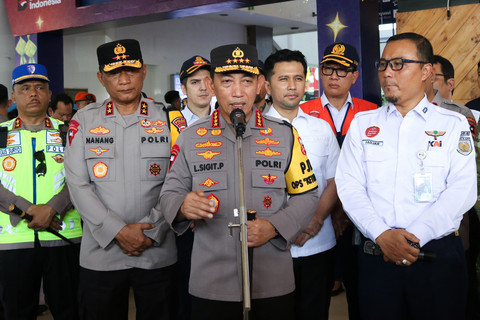
The three days leading up to Lebaran mark the critical peak of the annual homecoming exodus, known locally as “mudik,” a phenomenon expected to intensify until the eve of Eid al-Fitr. National Police Chief General Listyo Sigit has estimated that as of today, an staggering 1.2 million vehicles have departed Jakarta via the toll road network alone, highlighting the immense scale of this nationwide migration.
“The current estimate for vehicles exiting Jakarta through toll roads stands at 1,213,788,” Sigit announced after overseeing the departure of thousands of travelers participating in the ‘Mudik Gratis Polri Presisi 2026’ program at Polda Metro Jaya, Jakarta, on Wednesday (March 18).
Sigit further elaborated that this substantial figure represents a significant increase, being 20.89 percent higher than the typical daily vehicle volume. This surge underscores the extraordinary travel demand during this festive period, putting immense pressure on the country’s infrastructure.
“This marks a 20.89 percent increase compared to normal daily traffic volume, and a 2.83 percent rise even when compared to Lebaran in 2025,” Sigit stated, indicating a consistent upward trend in holiday travel.
Regarding congestion hotspots, Sigit identified the Merak Port area as experiencing the highest vehicle density, a critical transit point for those traveling between Java and Sumatra. Within the toll road system, the Cikampek Utama Toll Gate (Cikatama) was pinpointed as the most heavily congested section.
“The most congested point I can report so far was at Merak some time ago, but thankfully we have slowly managed to alleviate the situation,” Sigit confirmed, assuring the public of ongoing efforts to manage traffic flow.
He added, “Meanwhile, on the toll road network, congestion is still concentrated at the Cikatama toll gate.” These insights are crucial for travelers planning their routes during this busy period.
To support the millions undertaking this journey, the National Police have deployed a comprehensive array of facilities and services for travelers. These provisions range from strategically located security posts and essential health check services to practical amenities for observing religious duties, such as designated areas for sahur (pre-dawn meal) and iftar (breaking fast).
“We have made extensive preparations, particularly along the toll roads and at rest areas. Similarly, on arterial roads, we have established security posts, service posts, and integrated posts. These facilities allow travelers to rest, undergo health checks, and even enjoy meals for breaking fast or sahur, or refuel their vehicles,” Sigit explained, highlighting the multi-faceted support system.
In anticipation of potential vehicle breakdowns, the National Police have also organized specialized ‘motoris’ motorcycle teams. These rapid response units are specifically designed to assist travelers whose vehicles encounter mechanical issues or run out of fuel during their journey, ensuring quick assistance.
“Everything has been prepared, including the ‘motoris’ teams, so that if there’s a problem on the road, such as a traffic jam caused by a vehicle running out of fuel, the ‘motoris’ will respond swiftly,” Sigit emphasized, underscoring the commitment to uninterrupted travel.
Furthermore, robust information centers have been established to keep travelers informed. Sigit detailed the range of platforms available, stating, “To ensure the public can access information regarding the ‘mudik’ flow, we have prepared various information services. These include the NTMC (National Traffic Management Center), the Travoy (Hub) application, and also Sipolan (Sistem Informasi Polisi Online) specifically for the Central Java region.” These resources aim to provide real-time updates and guidance for a smoother journey.
Summary
As of H-3 Lebaran, an estimated 1.2 million vehicles have departed Jakarta via toll roads, marking a significant 20.89% increase compared to normal daily traffic volume. This large-scale exodus has led to high congestion, especially at Merak Port and the Cikampek Utama Toll Gate (Cikatama), identified as major bottlenecks.
To manage the surge in travelers, the National Police have deployed comprehensive facilities, including security posts, health check services, and designated areas for meals. They also organized ‘motoris’ motorcycle teams to assist with vehicle breakdowns and established information centers such as NTMC, the Travoy app, and Sipolan (for Central Java) to provide real-time updates.