
For six consecutive days, the United States and Israel have launched a barrage of airstrikes against various locations within Iran. The pressing question now reverberating through the region is whether ground troops will be deployed to invade Iran. While a ground offensive remains a possibility, it is unlikely to come from the United States.
Instead, Iranian Kurdish opposition groups, living in exile in northern Iraq, have informed the BBC of their decades-long plan to cross the border. They have, however, vehemently denied claims that their forces are already on the move.
“We have been preparing for this for 47 years, since the establishment of the Islamic Republic,” stated Hana Yazdanpana of the Kurdistan Freedom Party (PAK), which asserts it commands the largest armed force among these groups. Despite this long-standing readiness, she firmly underscored that “not a single Peshmerga has moved.” The word Peshmerga in Kurdish translates to “those who face death.”
When Could Kurdish Forces Move?
Hana Yazdanpana clarified that six opposition groups, recently forming a coalition, are engaged in both political and military coordination. “No one moves alone,” she affirmed. “We will know if our brothers decide to move.” However, she stressed there has been no troop movement this week, indicating such a step would only be possible if the United States first cleared the path.
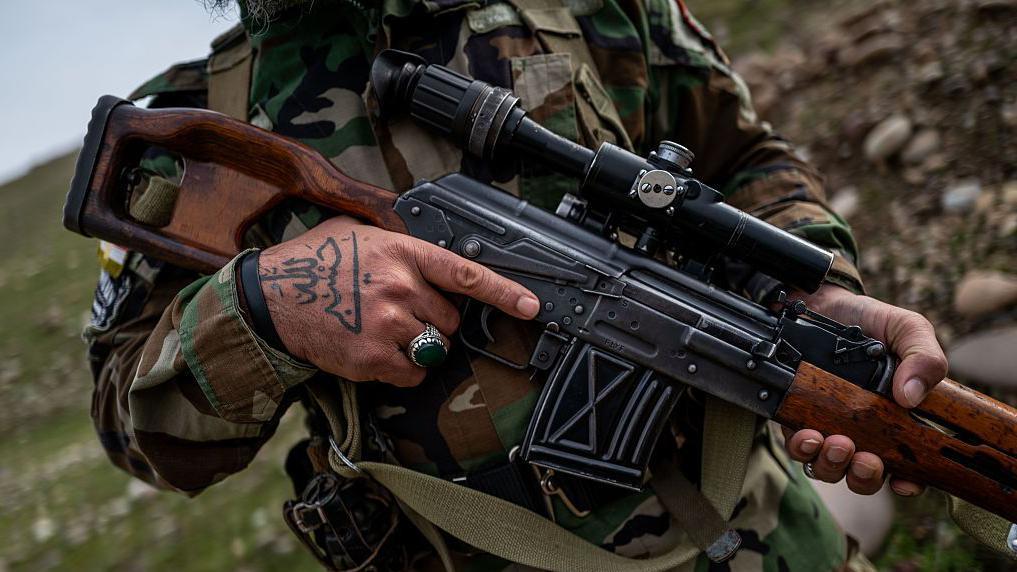
“We cannot move if the skies above us have not been cleared,” she explained. “And we need the regime’s arsenals to be destroyed. Otherwise, it would be a suicidal act. The regime is very brutal, while the most advanced weapons we possess are merely Kalashnikovs.” Yazdanpana has also implored the U.S. to enforce a no-fly zone to safeguard Kurdish forces. “We have asked for this many times,” she said. “I personally sent an email with the message, ‘we urgently need it now.'”
The White House has refuted reports suggesting U.S. President Donald Trump is considering arming Kurdish groups, many of whom were previously trained by U.S. forces to combat ISIS in Iraq. Yet, as speculation mounts regarding the movement of Iranian Kurdish forces, Iran’s military assaults against them have intensified. A BBC team witnessed the aftermath of attacks on two groups, including a ballistic missile strike that targeted the PAK headquarters, killing one fighter.
Some opposition groups have already evacuated their bases and relocated forces to evade further attacks. Engaging in battle against the Iranian government clearly carries immense risks, and it remains uncertain what Trump might offer in return. The Kurds represent the fourth-largest ethnic group in the Middle East, with their population spread across Iran, Iraq, Syria, and Turkey. They possess a long history of oppression and betrayal, encapsulated by the Kurdish proverb, “we have no friends but the mountains.”
This raises a crucial question: Can the U.S. be trusted to uphold its promises? Many Kurds in Syria, who served as Washington’s primary allies in the fight against ISIS, subsequently felt betrayed after Trump sided with the transitional government in Damascus rather than with them.
A Pragmatic View
Some Iranian Kurdish leaders have adopted a pragmatic outlook. “America and Israel did not initiate this war for our aspirations, but for their own interests,” remarked Mustafa Mauludi, vice-chairman of the Kurdish Democratic Party of Iran (KDPI). “However, they are targeting the headquarters of the Islamic Revolutionary Guard Corps (IRGC), and this will benefit us and help us to advance.”
At 67 years old, Mauludi has waited nearly his entire life to witness the downfall of the Iranian regime. Dressed in traditional Kurdish attire, he recounted a family history steeped in trauma: a cousin murdered by Iranian authorities at 13, while another remains imprisoned for 31 years on accusations of collaborating with the opposition. He noted that 60% of his family members have been arrested and mistreated due to their political activism. Mauludi has already envisioned his first moment returning to his homeland. “When I arrive at the first village,” he stated, “I will shout loudly: ‘I have fought for you, you are my people, and now I will fight even harder.'” He is confident he will be there in time to celebrate the Kurdish New Year festival, Nowruz, which falls on March 21.
Approximately 10% of Iran’s 90 million people are ethnic Kurds. Their leaders are now urgently appealing for international support for Trump and their enduring struggle. “We are the most politically organized group in Iran,” affirmed Abdullah Mohtadi, secretary-general of the Komala Party of Iranian Kurdistan. “And we will not let this opportunity [for change] be wasted.” Mohtadi expressed his disappointment with the UK’s stance, stating, “I am shocked the UK is the only country on the European continent that has not designated the IRGC as a terrorist organization.” He also criticized London’s “hesitation” in permitting the use of its military bases for U.S. attacks on Iran.
How Many Kurdish Fighters?
It remains challenging to accurately gauge the number of forces Kurdish groups could muster. “Perhaps a few thousand, including some who are already inside [Iran],” offered a local journalist of Kurdish ethnicity. “They want to be part of the change in Iran, ensuring that they have a say in shaping the future. Even though history is full of bitter lessons, they still hope,” he added. Some Iranian Kurds believe the time to act is now, with or without American assurances. “If we have even a little hope of seeing our homeland, that is enough for us,” said a woman in the city of Sulaymaniyah, near the Iranian border. “We call [Iran] the executioner Islamic regime. We hate them so much. They have killed so many people.”
This entire dynamic places Iraq in a precarious position, fearing it could be drawn into a war with its neighbor. The Iraqi government in Baghdad has unequivocally stated it will not permit any group to “infiltrate or cross the Iranian border to conduct terror acts from Iraqi territory.”
For Hana Yazdanpana of PAK, if Kurdish forces do indeed cross, it will be a moment fraught with mixed emotions. “Returning to my land will be very emotional,” she shared. “My uncles and grandparents died here [northern Iraq]. I don’t know whether to be happy or sad, because those who truly deserved to witness this day are gone.”
Additional reporting by Wietske Burema, Matthew Goddard, and Bizhar Shareef.
- Trump demands Iran ‘surrender unconditionally,’ death toll surpasses 1,300
- ‘If we are not killed, we will remain here’ – The fate of Iranians amidst US-Israel attacks
- Will Gulf states retaliate against Iranian attacks and be drawn into war?
- What is the objective of US-Israel attacking Iran?
- Ayatollah Ali Khamenei dies, who is his successor and what might happen next?
- Religious organizations in Indonesia collectively condemn US-Israel attacks on Iran
- To what extent will the US-Israel war with Iran impact Indonesia’s economic-political stability?
- US-Israel attack Iran, where are Russia and China?
- What happens if Iran closes the Strait of Hormuz, a global oil route?
Summary
Iranian Kurdish opposition groups, exiled in northern Iraq, possess a decades-long plan to invade Iran, though they deny any current troop movement despite 47 years of preparation by groups like the Kurdistan Freedom Party (PAK). Their leaders state that a ground offensive is contingent upon the United States first clearing Iranian skies and destroying the regime’s arsenals, as moving without such support would be suicidal given their limited weaponry. These coalition groups will not move alone and have repeatedly sought a U.S.-enforced no-fly zone for their protection.
Amid intensified Iranian attacks on these groups and U.S. denials of arming them, the immense risks are clear, raising concerns about U.S. reliability given past betrayals. Nevertheless, Kurdish leaders, like Mustafa Mauludi of the KDPI, view the current U.S.-Israel strikes as a beneficial opportunity that aligns with their long-held aspirations for regime change. Representing a significant portion of Iran’s Kurds, these groups are urgently appealing for international support to seize this moment and shape Iran’s future, despite Iraq’s firm stance against cross-border attacks from its territory.