
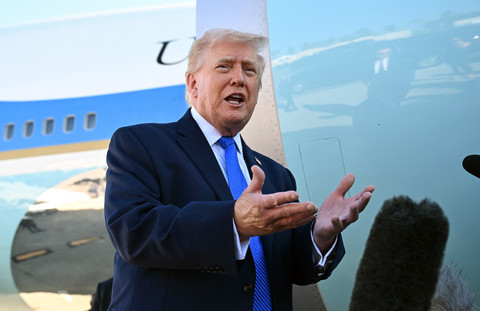

In a move that captured significant attention, former U.S. President Donald Trump made a noteworthy statement during a speech in Miami on Friday, March 27, when he referred to the Strait of Hormuz as the “Trump Strait.” The remark, delivered amidst a discussion on critical geopolitical issues, quickly became a focal point of news coverage.
Citing CNBC on Saturday, March 28, the former president initially focused on the vital strategic importance of the Strait of Hormuz in ongoing conflicts involving Iran. However, he then interjected a jocular comment, deliberately altering the name of the internationally crucial waterway. “Iran must open the Trump Strait, I mean, Hormuz,” Trump stated, drawing a reaction from the audience.
Following his unexpected renaming of the strait, Trump humorously expressed regret for what he termed a “very bad mistake.” “I’m sorry. I’m very sorry. Very bad mistake,” he declared, maintaining a lighthearted tone. He then preemptively addressed potential media interpretations, adding, “Fake news will say, ‘He didn’t say it accidentally,’ no, nothing accidental about me, not much. If anything, it would be big news.” This assertion underscored his claim that the comment was intentional, not a slip of the tongue.

This controversial statement emerged against a backdrop of escalating regional tensions and ongoing conflict in the Middle East, where the Strait of Hormuz remains an exceptionally critical flashpoint. The conflict, reportedly entering its second month, amplifies the significance of this maritime chokepoint. Serving as one of the world’s primary oil distribution routes, approximately 20 million barrels of crude oil traverse its waters daily, making it indispensable for global energy supplies.
The potential for Iran to impede or close the Strait of Hormuz carries profound implications for international trade and global energy security. Any disruption to this vital artery would have a massive impact on worldwide energy supplies, inevitably triggering dramatic spikes in oil prices and potentially destabilizing the global economy.
Notably, this was not the first instance of Trump proposing unconventional solutions for the strait’s management. Previously, he had suggested the possibility of joint control of the Strait of Hormuz alongside Iran. He envisioned the strategic area being managed by both himself and former Iranian Supreme Leader Ayatollah Ali Khamenei, as part of a comprehensive resolution to the regional conflict.
Furthermore, Trump had publicly asserted that Iran was engaged in negotiations with the United States to forge a new agreement. However, authorities in Tehran vehemently denied any direct discussions taking place, highlighting the significant diplomatic chasm between the two nations. Adding to the intrigue, U.S. media outlets had reported that Trump even entertained the idea of unilaterally seizing control of the Strait of Hormuz and subsequently renaming it, with considerations for titles such as “U.S. Strait” or even applying his own surname to the critical waterway.
Summary
During a speech in Miami on March 27, former U.S. President Donald Trump referred to the Strait of Hormuz as the “Trump Strait.” He made this noteworthy remark while discussing the strait’s vital strategic importance in ongoing conflicts involving Iran. Trump later expressed humorous regret for the comment, but then clarified that the renaming was an intentional statement rather than an accidental slip.
The Strait of Hormuz is a critical global maritime chokepoint, facilitating the passage of approximately 20 million barrels of crude oil daily, essential for worldwide energy supplies. Any potential disruption by Iran carries profound implications for international trade and global energy security, potentially causing dramatic spikes in oil prices. Trump had previously proposed unconventional solutions for the strait, including joint control with Iran, and had reportedly considered unilaterally seizing and renaming the waterway.