
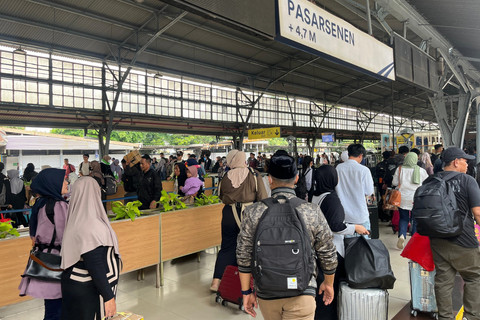
PT Kereta Api Indonesia (Persero), commonly known as KAI, has reported a significant surge in ticket sales for the upcoming Lebaran 2026 holiday season. As of March 23, 2026, at 09:00 AM WIB, KAI had successfully sold an impressive 4,028,839 tickets. This substantial figure represents 89.6 percent of the total 4,498,696 seats made available for both Long-Distance and Local train services during the peak travel period from March 11 to April 1, 2026.
Anne Purba, Vice President of Corporate Communication at KAI, highlighted the remaining availability. With nearly 90% of tickets sold, approximately 469,857 seats are still open, offering a crucial opportunity for the public, especially for those planning their return journeys. “The trend of train travel has been consistently increasing since mid-March and is now entering the return flow phase. People are opting for trains because of their enhanced comfort and reliable schedules,” Anne stated in a written release on Monday, March 23.
Delving into the specifics, sales for Long-Distance train tickets have reached 3,507,988, accounting for a remarkable 98.2 percent of the 3,571,760 available seats. This leaves a limited 63,772 seats for those specific routes. In contrast, Local train services have seen 520,851 tickets sold, making up 56.2 percent of their 926,936 total seats, with a more generous 406,085 tickets still available. Anne explained that the booking mechanism for most Local train tickets, which typically opens just seven days before departure (H-7), means sales are generally expected to continue climbing closer to the travel dates.
Throughout the initial phase of the Lebaran transport period, from March 11 to March 22, 2026, KAI efficiently served a vast number of passengers across Java and Sumatra. A total of 2,131,656 customers traveled on Long-Distance trains, complemented by 387,852 passengers utilizing Local train services, bringing the combined total to 2,519,508 satisfied customers during this busy period.
The daily passenger volume and occupancy rates for Long-Distance trains between March 11 and March 22, 2026, vividly illustrate a continuous upward trend. The peak was recorded on March 22, 2026, with an astonishing 242,773 passengers, representing an impressive 150.7 percent of the available seating capacity. The detailed daily breakdown is as follows:
- March 11: 101,617 passengers from 159,404 seat capacity (63.7 percent)
- March 12: 126,208 passengers from 159,404 seat capacity (79.2 percent)
- March 13: 165,675 passengers from 163,432 seat capacity (101.4 percent)
- March 14: 185,873 passengers from 163,432 seat capacity (113.7 percent)
- March 15: 180,836 passengers from 163,432 seat capacity (110.6 percent)
- March 16: 173,753 passengers from 163,432 seat capacity (106.3 percent)
- March 17: 191,413 passengers from 163,432 seat capacity (117.1 percent)
- March 18: 205,842 passengers from 163,432 seat capacity (125.9 percent)
- March 19: 196,324 passengers from 163,432 seat capacity (120.1 percent)
- March 20: 167,659 passengers from 160,252 seat capacity (104.6 percent)
- March 21: 193,583 passengers from 161,100 seat capacity (120.2 percent)
- March 22: 242,773 passengers from 161,100 seat capacity (150.7 percent)
222 Thousand Long-Distance Train Passengers Ready for Departure
KAI further noted that as of Monday, March 23, a significant 222,948 Long-Distance train passengers were scheduled to depart, with a provisional occupancy rate reaching 139.1 percent. Anne clarified that this figure still has the potential to increase as ticket sales are ongoing. She elaborated that occupancy levels exceeding 100 percent are made possible by the dynamic travel patterns within a single train series. “On a single Long-Distance train journey, one seat can be utilized by more than one passenger for different route segments. This scheme allows for a greater number of customers to be served compared to the total number of seats available on a continuous cross-journey route,” Anne explained.
Among the train services experiencing exceptionally high demand during the Lebaran 2026 transport period are KA Airlangga, KA Joglosemarkerto, KA Sri Tanjung, KA Bengawan, KA Kahuripan, KA Rajabasa, and KA Jayakarta. Despite the high demand, Anne assured the public that opportunities to secure tickets for the return journey are still available. She suggested exploring various options, including alternative routes, different departure schedules, or considering connecting train services. Additionally, being flexible with travel dates can significantly increase the chances of obtaining desired tickets.
“With the remaining capacity, KAI encourages the public to promptly plan their return trips efficiently to ensure a more comfortable, smooth, and enjoyable journey aboard our trains,” Anne concluded, urging travelers to make their arrangements without delay.