
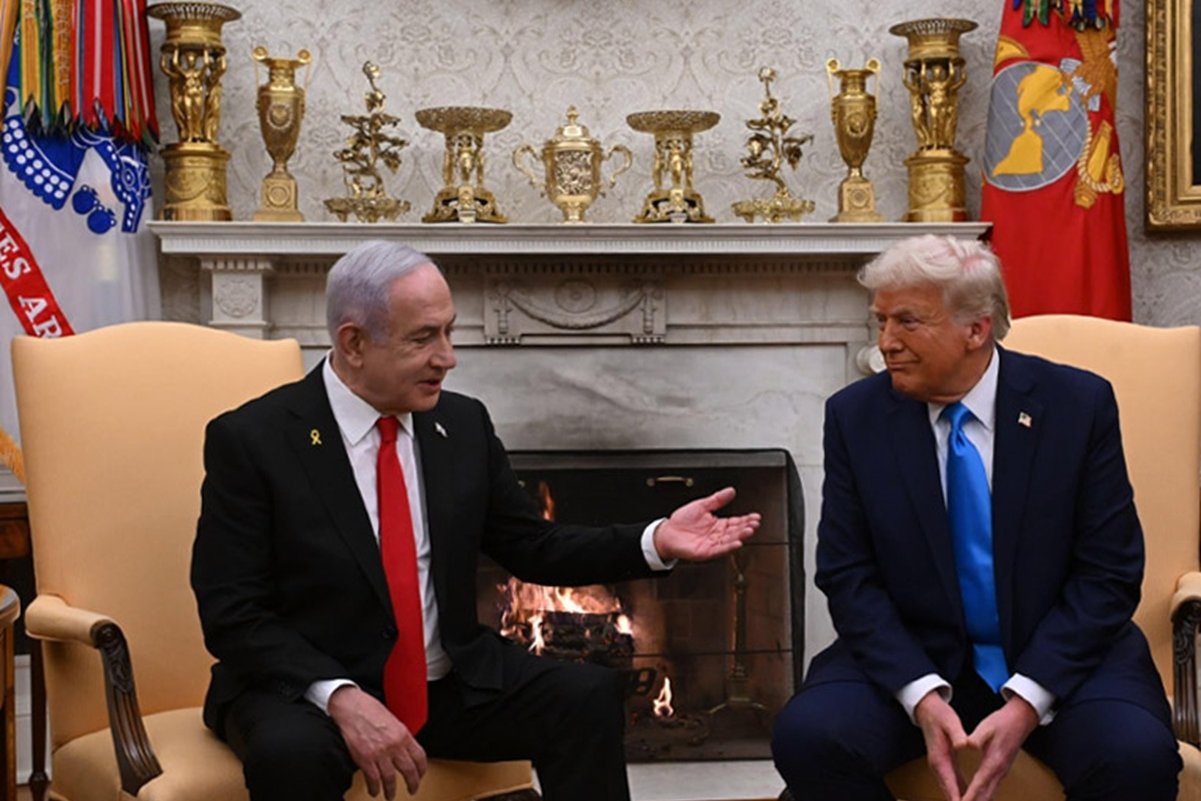

Israeli Prime Minister Benjamin Netanyahu announced yesterday, Wednesday, February 11, that his country has officially joined the Gaza Peace Council (BoP), a significant step in the ongoing efforts to stabilize the volatile region.
The pivotal declaration was made by Netanyahu himself on his official social media account, X. The post featured a compelling photograph depicting the Prime Minister alongside U.S. Secretary of State Marco Rubio, prominently displaying Israel’s accession document to the BoP. “In my meeting with President Trump at the White House, I signed Israel’s accession as a member of BoP,” Netanyahu’s X account stated, a quote widely reported on Thursday, February 12.
According to Reuters, the United Nations Security Council authorized the BoP to establish an international force tasked with stabilizing conditions in Gaza in November 2025. This crucial decision followed a formal ceasefire between Israel and Hamas, which was officially enacted in October 2025. Initially, the BoP was conceived to oversee the temporary governance of Gaza during this ceasefire period, but its mandate was subsequently broadened by President Trump to address a wider array of global conflicts.
Looking ahead, President Trump has scheduled the inaugural meeting of the Gaza Peace Council in Washington, D.C., next week, on Thursday, February 19. The primary focus of this high-level gathering will be the critical reconstruction efforts in Gaza, following three months of sustained ceasefire. Notably, Indonesian President Prabowo Subianto is slated to attend this important summit. Post-reconstruction, Trump’s strategic vision includes disarming Hamas and facilitating the withdrawal of Israeli armed forces from Gaza, while the BoP simultaneously deploys peacekeeping forces across the 42-square-kilometer territory.
However, the formation of the Gaza Peace Council has not been met without reservations. The Central Leadership (PP) of Muhammadiyah, a prominent Indonesian Islamic organization, has expressed concerns that the BoP could inadvertently complicate efforts toward lasting Palestinian peace if it does not firmly uphold principles of justice and adhere strictly to international law.
Muhammadiyah specifically pinpointed the legal foundation of the BoP as problematic, citing inconsistencies between its charter and United Nations Security Council Resolution No. 2803. This divergence, Muhammadiyah argues, has the potential to spawn new legal challenges. Furthermore, the organization warned that the BoP’s operational framework might create avenues for the violation of state sovereignty and international legal norms.
In a press release issued on Saturday, February 7, the PP Muhammadiyah underscored its core apprehension: “Muhammadiyah believes that the BoP Charter does not contain a roadmap towards Palestinian independence. This raises concerns that BoP will not address the root of the problem, namely the end of Israel’s occupation of Palestine.” This critical perspective highlights the imperative for any peace initiative to tackle the fundamental issues driving the enduring conflict.