
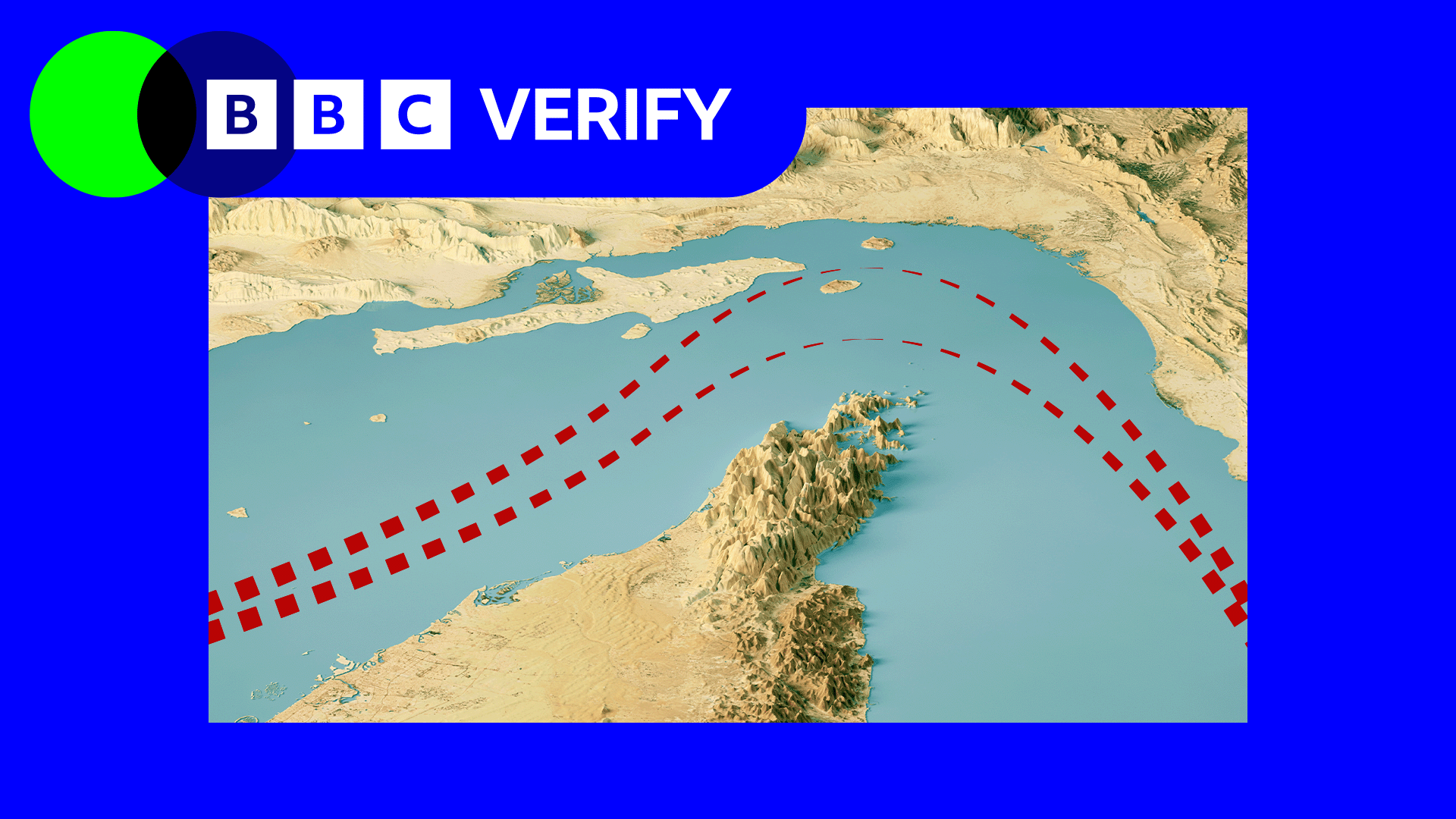

Vessels navigating the Gulf waters have received a chilling warning from the Iranian Navy: any ship attempting to traverse the strategically vital Strait of Hormuz without explicit permission “will be targeted and destroyed.” This stark declaration was confirmed to BBC Verify by shipping brokerage firm SSY, casting a long shadow over a recently announced ceasefire. The United States and Iran had reportedly agreed to a two-week truce, with the critical condition that Iran would reopen maritime traffic through the strait. Iranian Foreign Minister Abbas Araghchi declared that “for a two-week period, safe shipping lanes through the Strait of Hormuz will be possible.” Yet, the reality on the ground—or rather, on the water—paints a different picture, as few vessels have dared to transit this crucial waterway since the agreement.
The Strait of Hormuz became a focal point in the recent US-Israel conflict with Iran after Tehran implemented a blockade of the narrow passage, which measures only about 33 kilometers at its most constricted point. The ensuing five weeks of tension sent shockwaves across the global economy. Crude oil prices soared dramatically, primarily because approximately one-fifth of the world’s oil and liquefied natural gas (LNG) shipments depend on this narrow maritime corridor. Furthermore, vessels carrying essential chemicals required for processing products like microchips, pharmaceuticals, and fertilizers also rely heavily on the strait for global distribution, highlighting its irreplaceable role in global supply chains.
While news of the ceasefire did prompt a decline in oil prices, shipping analysts are sounding a note of caution, emphasizing that maritime traffic in the Strait of Hormuz remains severely restricted. Lars Jensen of Vespucci Maritime articulated the industry’s trepidation to the BBC, stating, “Most shipping companies want to get the details and assurances about what is actually required to cross, and those details are not yet available.” This lack of clarity continues to deter many from risking passage.
Indeed, a detailed analysis by BBC Verify, utilizing vessel tracking data from MarineTraffic, revealed a stark picture of limited activity. From Tuesday night (April 7) to Wednesday (April 8) at 8:00 PM WIB, only three cargo ships—the NJ Earth, Daytona Beach, and Hai Long 1—had successfully transited the Strait of Hormuz since the ceasefire announcement. This number is dramatically low when compared to the average of 138 vessels per day that navigated the strait before the conflict began on February 28. The BBC remains uncertain whether these three crossings were a direct result of the ceasefire or if they were pre-planned voyages. Ana Subasic from shipping analysis firm Kpler noted, “It’s too early to conclude if this reflects a wider ceasefire-driven reopening or pre-approved exceptions.” Jensen echoed this sentiment, adding, “Nothing has really changed.” He further suggested that it would take considerable time before ship crews feel confident enough to safely navigate the Strait of Hormuz again.
The current situation is characterized by profound uncertainty, making it “a very dangerous time” for ship owners, as emphasized by Richard Meade, editor-in-chief of Lloyd’s List. He underscored that Iran fundamentally retains control of the strait, meaning ship owners would likely still need permission from the IRGC (Islamic Revolutionary Guard Corps), though the exact mechanism for this remains obscure. Adding to the concerns, BBC Verify’s analysis of the routes taken by the three aforementioned ships showed they opted for a northern path through the strait, hugging the Iranian coastline and entering its territorial waters. Prior to the conflict, vessels typically favored a more southerly route through the central part of the waterway.
Amidst this precarious environment, Meade anticipates that fully loaded tankers would be among the first to attempt transit if vessels return to the Strait of Hormuz. “There are nearly 800 ships that have been stuck there for several weeks. Most are now fully loaded, so the priority is to get them out,” he explained. The limited two-week duration of the ceasefire also introduces another layer of uncertainty for shipping companies, according to Niels Rasmussen, a shipping analyst from BIMCO. “I doubt there will be a large influx of ships into the Gulf… because they don’t want to risk getting trapped after that two-week period ends,” he elaborated. Compounding these worries, Thomas Kazakos, Secretary-General of the International Chamber of Shipping, highlighted the potential threat of sea mines. “We need to ensure there is clear confirmation that safety of navigation for ships and seafarers has been agreed,” he told BBC Verify.
Beyond these immediate concerns, ships are likely to face potential demands for payment to Iran for safe passage through the Strait of Hormuz, with reports suggesting a toll system might be part of the ceasefire agreement. Jensen elaborated on this, stating, “Iran’s negotiating position seems to be that ships need to pay a toll to cross the strait, and shipping companies will also be hesitant to pay that toll.” Several nations, including India, Malaysia, and the Philippines, have already appealed to Iran to allow their vessels to transit. However, making such payments could create significant complications for both countries and shipping companies. Jensen warned that such actions “might actually violate some of the US sanctions against Iran, which will create other implications for shipping companies.”
Years ago, the US implemented a comprehensive economic sanctions regime against the Iranian government, certain individuals, and entities. James Turner, a shipping lawyer from Quadrant Chambers, clarified to BBC Verify that any party engaging in payment transactions with individuals, companies, or organizations on this sanctions list could face criminal prosecution. Therefore, paying a toll to sanctioned individuals or entities would be classified as a violation unless the US explicitly grants an exception, further complicating any potential reopening of the Strait of Hormuz.
Despite the current low volume of maritime traffic, financial markets responded positively to the ceasefire announcement. Brent crude oil prices dropped by approximately 13% to US$94.80 per barrel, while US-traded oil fell by more than 15% to US$95.75. However, Meade cautioned against excessive optimism, stating, “Oil prices responded because it’s a positive directional move, but I don’t think that suggests we’re immediately going to see 20% of global energy flowing back through that route at normal rates.” The path to a full resumption of normal shipping operations through this critical waterway remains fraught with significant challenges and uncertainties.
Additional reporting by Tamara Kovacevic

- What happened during the 1970s oil crisis, and are we heading for a worse situation?
- Subsidized fuel prices will not increase throughout 2026, state budget predicted to only withstand ‘for weeks’
- Iran allows Malaysian, Thai, and five other countries’ ships to cross the Strait of Hormuz, what about Indonesian ships?
- ‘All vehicles must be electric’ – Two major obstacles to realizing President Prabowo’s idea