
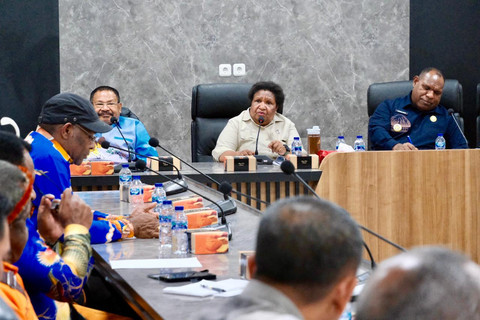

Deputy Minister of Home Affairs, Ribka Haluk, has emphatically affirmed the central government’s full and unwavering commitment to ensuring the comprehensive and measurable resolution of the Wamena conflict. A paramount focus remains on fostering robust community recovery until conditions in the region are genuinely conducive. This crucial declaration was made by Ribka during a high-level Security Situation Development Coordination Meeting. The meeting, held in the Jayawijaya Regent’s Meeting Room in Wamena, Papua Pegunungan, on Saturday (May 16, 2026), convened key stakeholders including the Governor of Papua Pegunungan, various regents, representatives from the TNI-Polri (Indonesian Armed Forces and National Police), the Papuan People’s Assembly (MRP), Traditional Community Institutions (LMA), as well as religious and community leaders.
Addressing the attendees, Ribka conveyed profound gratitude on behalf of the Minister of Home Affairs and the Central Government. “I, on behalf of the Minister of Home Affairs, representing the central government, extend the highest appreciation and thanks to the people of Wamena and all development components who have undertaken significant rescue efforts,” she stated, commending the immediate and compassionate actions taken by local residents.
She specifically lauded the Wamena community for their rapid response in assisting affected citizens and their instrumental role in maintaining a stable situation amidst the conflict. Ribka highlighted their exemplary efforts, noting, “First, to the people of Wamena who, at the time of the incident, immediately mobilized quickly and took commendable actions to help each other and calm the situation among themselves.”
In her directive, Ribka instructed provincial and regency governments to promptly initiate comprehensive assistance, detailed data collection, and robust coordination across the eight regencies within Papua Pegunungan. This meticulous data gathering is vital for accurately assessing the needs for both intervention and support for all affected citizens. She underscored that these findings would form the cornerstone of government decision-making for subsequent aid, whether channeled through regency budgets (APBD), provincial budgets, or direct central government support.
“Together, we all share responsibility,” Ribka emphasized. “This data collection will serve as the fundamental basis for calculating the government’s capacity to effectively assist affected citizens.” The objective is to ensure that all relief efforts are targeted, efficient, and responsive to the actual requirements on the ground.

Further reinforcing the path forward, Ribka affirmed that all key stakeholders – including community leaders, traditional leaders, religious leaders, local government officials, and security forces – have collectively agreed to definitively halt the Wamena conflict and redirect all energies toward the critical process of community recovery. “We have declared that conflicts are no longer an issue. Our current focus is on resolving governmental challenges and the comprehensive recovery of affected communities,” she asserted, signaling a decisive shift in regional priorities.
She also provided an assurance of sustained Central Government support, pledging continuous accompaniment throughout the recovery process until complete stability is achieved. “I will be here,” Ribka stated, underscoring her personal commitment. “I have been assigned by the Minister to continue coordinating with the government until conditions fully recover.” This ongoing presence aims to ensure seamless cooperation and effective implementation of recovery initiatives.
Beyond immediate emergency response, the Ministry of Home Affairs (Kemendagri) is also set to facilitate the development of a Special Regional Regulation (Perdasus) concerning conflict management. This crucial legal framework will apply to the eight regencies in Papua Pegunungan, providing a clear and measurable legal basis for future interventions and ensuring consistent, effective conflict resolution strategies.
Following the coordination meeting, Deputy Minister Ribka, accompanied by the Governor of Papua Pegunungan and other local government officials, personally visited sites impacted by the conflict. They inspected burned homes, hospitals, and evacuation centers, meticulously ensuring that the basic needs of the affected population were being met. The government is also meticulously planning the phased return of displaced persons once the security situation is officially declared conducive and safe for resettlement.
“The fundamental goal is for the community to return to a normal way of life, enabling people to resume their daily activities without hindrance,” Ribka concluded. “Economic, educational, and health activities must all function smoothly, ensuring a holistic restoration of well-being for all residents.”
Summary
Deputy Minister of Home Affairs, Ribka Haluk, affirmed the central government’s full commitment to resolving the Wamena conflict and fostering comprehensive community recovery in Papua Pegunungan. During a coordination meeting in Wamena, she lauded the local community’s rapid response and instructed provincial and regency governments to collect meticulous data. This data will serve as the crucial basis for channeling targeted assistance from central and local budgets to all affected citizens.
Ribka further pledged sustained central government support throughout the recovery process until complete stability is achieved in the region. The Ministry of Home Affairs will also facilitate a Special Regional Regulation (Perdasus) for conflict management across the eight regencies. The ultimate goal is to restore normal life, ensuring smooth economic, educational, and health activities for all residents.
