
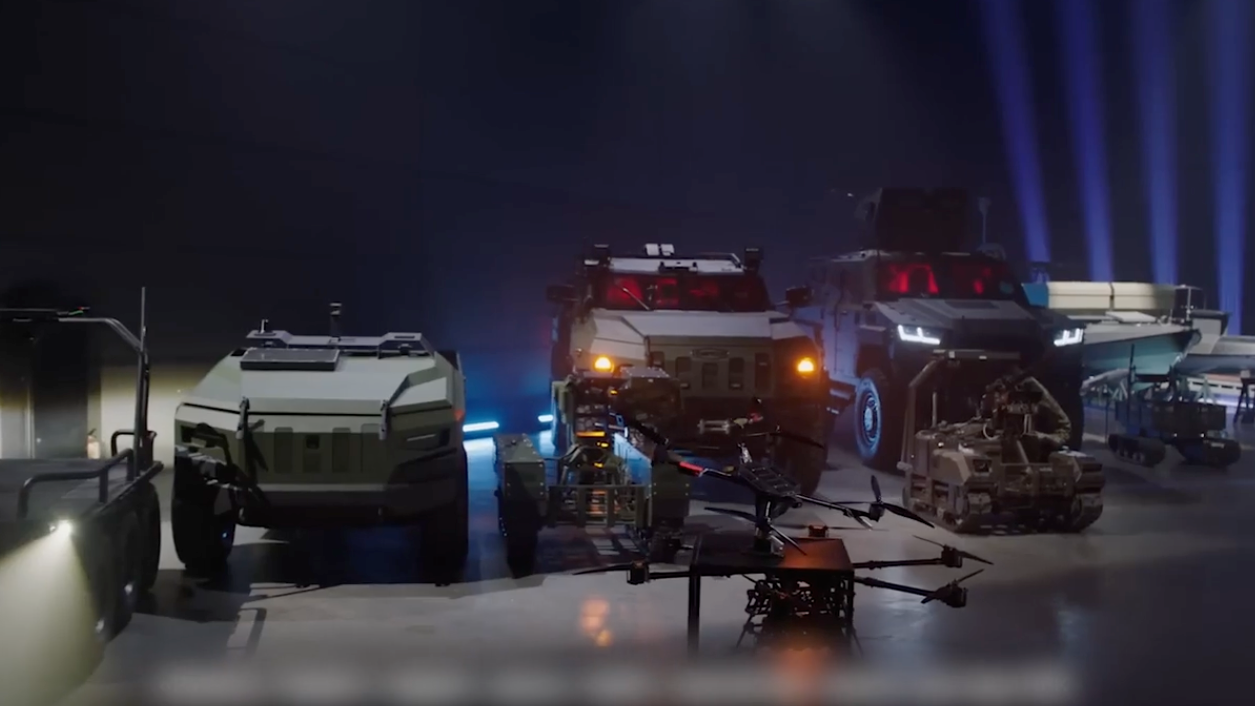

The battlefields of Ukraine could soon feature more robot soldiers than human troops. This startling claim comes from a Ukrainian-UK military startup at the forefront of defense innovation.
The BBC recently visited UFORCE, a Ukrainian manufacturing firm, at their London offices. The company’s name is conspicuously absent from the exterior of their building, and their offices are designed with a high degree of secrecy. This measure, according to UFORCE, is a deliberate strategy to shield them from potential Russian sabotage.
A keen interest has emerged in UFORCE due to their reported unprecedented involvement in Ukrainian military operations. It’s claimed that the Ukrainian military has reclaimed Russian-occupied territory solely by deploying UFORCE-manufactured robots and advanced drones.
These extraordinary claims were echoed by Ukrainian President Volodymyr Zelensky in a video released last April, which showcased Ukraine’s latest robotic weaponry and its impact on the modern battlefield.
Both Ukraine and Russia have extensively utilized unmanned aerial and ground systems throughout their ongoing conflict, demonstrating the critical role of robotic warfare.
Analysts concur that this war has dramatically accelerated the development of cutting-edge military technology, pushing the boundaries of what’s possible in combat.
This escalating situation has ignited a fierce debate about the future of military conflict and its profound implications for soldiers, both robotic and human, raising critical questions about autonomy and ethics.
150,000 Combat Missions
President Zelensky has actively publicized what he asserts was the first-ever robot battle in the annals of warfare. However, the Ukrainian military has declined to provide specific details regarding this unprecedented operation.
A UFORCE representative also refrained from commenting on the particular robot battle depicted in Zelensky’s video. The company would only confirm that UFORCE’s aerial, ground, and naval drones are currently deployed in combat operations across the war zones.
“While I cannot delve into the specifics of that operation or UFORCE’s exact involvement, we have successfully executed over 150,000 combat missions since the full-scale Russian invasion in 2022,” stated Rhiannon Padley, UFORCE’s Director of Strategic Partnerships in the UK, highlighting the company’s significant operational footprint.
Clearly, advanced robotic weapon systems represent a burgeoning and highly lucrative industry within the defense sector.
The company itself has experienced rapid growth, recently achieving “unicorn” status, valued at over US$1 billion (approximately IDR 17.5 trillion), underscoring the vast investment flowing into robotic defense solutions.
Padley anticipates that the phenomenon of robot-on-robot combat will become increasingly common. She even predicts that unmanned weaponry will eventually surpass the number of human soldiers on the battlefield, heralding a new era of warfare.
Russia, too, has deployed robots engineered to deliver explosives to Ukrainian positions, further emphasizing the global shift towards automated combat. Analysts universally agree that these technological advancements are poised to fundamentally reshape the future of warfare tactics and strategies.
“Ukraine, in my view, is truly the primary teacher for the future of national defense and weaponry,” remarked Melanie Sisson, a senior research fellow at the Brookings Institution, reflecting on the lessons learned from the conflict.
“This conflict presents an impressive case study in how necessity drives innovation, particularly in defense technology,” she added, emphasizing the rapid evolution of military capabilities.
UFORCE is part of a burgeoning group of defense companies known as Neo-Prime, which is now actively challenging established industry giants such as BAE Systems, Boeing, and Lockheed Martin with their innovative robotic solutions.
Another prominent player is Anduril, a US defense technology firm that announced in February the successful maiden flight of its pilotless fighter jet, marking another significant leap in autonomous combat aircraft development.

While most drones are still remotely operated by humans, companies like Anduril are increasingly integrating artificial intelligence (AI) into their weapon systems, paving the way for more autonomous capabilities.
UFORCE’s ground drones employ software engineered to assist with targeting, enhancing precision and efficiency. Meanwhile, Anduril states that some of its systems can autonomously complete the final phase of an attack, signifying a major step towards fully autonomous combat robots.
The United States government has openly urged its military to aggressively adopt artificial intelligence, recognizing its transformative potential for modern warfare.
In January 2026, US Secretary of Defense Pete Hegseth stated that the nation needs to become an “AI-first fighting force,” underscoring the strategic imperative of integrating AI into military operations.
China is also rapidly escalating its use of AI-powered military systems, according to a US Department of Defense assessment published in 2025, indicating a global race in AI military development.
According to several analysts, a future where robots directly confront each other on the battlefield may be increasingly difficult to avoid, given the accelerating pace of technological advancement.
“Ukrainian and Russian drones are already fighting each other,” noted Jacob Parakilas from RAND Europe, a prominent military think tank, highlighting the current reality of drone warfare.
“Seeing that extend to ground and maritime warfare seems highly probable,” he added, predicting the expansion of robotic conflict into new domains.

However, human rights advocacy groups warn that greater autonomy in weapon systems raises serious concerns regarding accountability, particularly when decisions of life and death are involved.
“Militaries are adopting AI to accelerate processes like target identification. Yet, delegating life-and-death decisions to machines poses profound ethical and human rights risks,” cautioned Patrick Wilcken of Amnesty International, calling for careful consideration of autonomous weapons.
Weapon manufacturers, however, argue that maintaining “humans in the decision chain” addresses these concerns, asserting that the ultimate decision to use force remains with military personnel, ensuring human oversight.
“Humans require rest and food, and in combat conditions, those needs are not always met,” explained Rich Drake, head of Anduril Industries in the UK, pointing out the practical advantages of autonomous systems.
“Computation allows us to reduce errors along what we call the kill chain,” he added, suggesting that AI can lead to more precise and potentially safer military operations.
- Thousands of Drones Used in Ukraine War: Why Are They So Important?
- How Ukraine Launched ‘Spiderweb’ Drone Attack Operations on Russian Airbases
- Russia to Showcase Robot Tanks at World War II Victory Parade
- Indonesian Police Launch Robot Police and Robot Dogs: What’s Their Purpose?
- Moments of a Child’s Death in Yahukimo Due to a ‘Drone-Carried Grenade’: ‘He Was a Student, Not a TPNPB Member’
- Drone Attack Videos Circulate on Social Media – Did it Really Happen in Papua and Who Was Responsible?
Summary
The conflict in Ukraine has significantly accelerated the development of robotic warfare
