
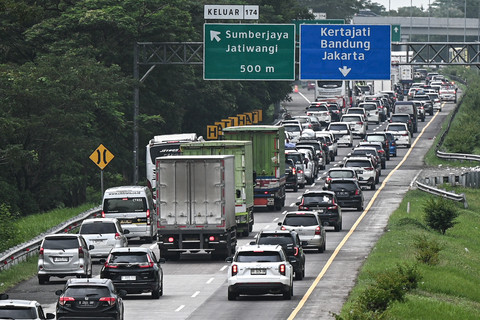

The Korlantas Polri (National Police Traffic Corps) is actively preparing to extend the existing one-way traffic scheme on the Trans-Java Toll Road in anticipation of a potential surge during the second wave of Lebaran return traffic. Currently, the critical one-way system remains operational from Kilometer (Km) 263 down to Km 70, with officials ready to lengthen its application should vehicle volumes escalate during the projected peak of the second wave.
Irjen Pol Agus Suryonugroho, the Head of Korlantas Polri, affirmed that the first and second stages of the one-way system are being rigorously maintained. His teams are continuously monitoring the evolving flow of vehicles, with particular attention directed towards traffic originating from the Central Java region.
Speaking from Km 48 of the Jakarta-Cikampek Toll Road on Saturday, March 28, Agus elaborated on the strategic decision: “We are also making preparations for tomorrow morning. The first and second stages of the one-way system will not be revoked tonight; we are continuing them to prepare for any potential surge in traffic from Central Java that might occur in the early hours or this morning.” This proactive stance underscores the police’s commitment to managing the heavy influx of travelers.
Agus further detailed the potential expansion points for the one-way scheme. An extension could commence from Km 275 in Batang or Km 390 in Kendal. Should traffic conditions intensify and congestion significantly increase, the scheme is designed to be further broadened, potentially reaching as far as Km 414 at the Kalikangkung Toll Gate in Semarang, a key strategic point for eastward traffic.
“We kindly ask for your prayers as there is a possibility that we will extend the third stage of the one-way tomorrow. This could potentially involve a National One Way for the second phase of return traffic at Kilometer 414,” he stated, highlighting the extensive planning involved.
Alternatively, he added, if the anticipated surge in vehicle numbers is not as high, the third stage of the one-way might be implemented more selectively, perhaps starting from Batang or Kendal. Decisions on these critical adjustments will be informed by real-time traffic counting data observed throughout the night and into tomorrow morning, specifically tracking the volume of vehicles entering Jakarta.
Despite these extensive preparations, Agus noted that the expected peak of the second wave of Lebaran return traffic has yet to occur. As of now, vehicle volume on the roads remains relatively moderate, especially following the conclusion of the first wave’s peak on March 24, which saw significant traffic movement.
“The peak is anticipated tomorrow. Tonight’s traffic volume is not exceedingly high, and our primary focus tonight is on enforcing the Joint Decree (SKB) regarding vehicle restrictions. Acting under the direct orders of the National Police Chief, we are urging three-axle logistics entrepreneurs to temporarily refrain from operating their vehicles,” he concluded, emphasizing the comprehensive approach to ensuring safe and orderly travel during this busy period.
Summary
Korlantas Polri is preparing to extend the one-way traffic scheme on the Trans-Java Toll Road for the second wave of Lebaran return traffic. The current one-way system, operational from Km 263 to Km 70, will be lengthened if vehicle volumes surge. Head of Korlantas Polri, Irjen Pol Agus Suryonugroho, confirmed they are maintaining existing one-way stages and closely monitoring traffic from Central Java to manage the anticipated influx of travelers.
The one-way scheme could be extended from Km 275 (Batang) or Km 390 (Kendal), potentially reaching Km 414 at Kalikangkung Toll Gate (Semarang) if congestion intensifies. Decisions on these adjustments will rely on real-time traffic data, specifically tracking vehicles entering Jakarta. Although the peak of the second wave is anticipated tomorrow, current traffic volume remains moderate, and Korlantas is also enforcing restrictions for three-axle logistics vehicles.