
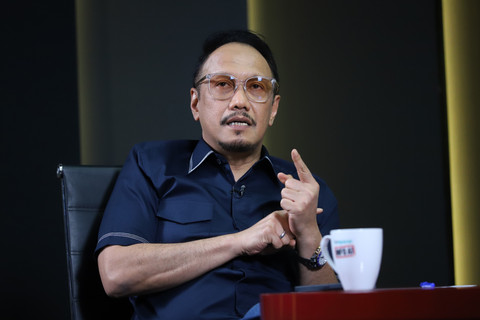
Prominent creative industry practitioner Irfan Asy’ari Sudirman Wahid, widely known as Gus Ipang, has weighed in on the compelling case of Amsal Christy Sitepu. Sitepu, a videographer from Karo Regency, was previously charged with allegedly inflating the budget for creating profile videos for 20 villages.
However, justice has prevailed for Sitepu, who was recently declared innocent and acquitted by the panel of judges at the Medan District Court on Wednesday (April 1).
Gus Ipang asserts that this case extends far beyond the fate of one individual; it serves as a critical alarm bell for the nation. He emphasizes that what is truly at stake is not merely Amsal Sitepu’s future, but the very approach to an industry that employs tens of thousands, contributes approximately 8 percent to the national GDP, thrives on Indonesia’s demographic bonus, and is deeply rooted in the rich cultural heritage that defines the nation’s identity.
Underscoring its significance, Gus Ipang quoted data from the National Statistics Agency (BPS) in a statement on his personal Instagram account on Wednesday (April 1): “BPS projects the creative economy workforce to reach 27.40 million people by 2025, constituting 18.70% of the total national workforce. Even in 2024, the figure already stands at 26.48 million people. This is not a peripheral sector; it is the nation’s backbone.”
According to Gus Ipang, the Amsal case transcends mere financial figures. It fundamentally challenges how society perceives and values creativity. He cautions, “If we mishandle this industry, what we suppress is not just the price, but the very future of the industry itself.”
Furthermore, Gus Ipang highlighted that Amsal’s ordeal is not solely a legal matter; it delves into how employers appreciate creativity. He laments the pervasive tendency to undervalue creative output, stating, “If everything is forced to be cheap, if every idea is considered worthless, if every process is homogenized, what we lose is more than just cost.”
He urged for introspection, citing the absurdity of the situation: “The case of Amsal Sitepu from Karo, North Sumatra, should make us pause. A creative professional was prosecuted and faced a two-year prison sentence simply over a discrepancy of Rp 5.9 million.” Gus Ipang noted that prosecutors deemed this amount unreasonable for tasks encompassing creative ideas, mixing, editing, and dubbing. “This implies that all of Amsal’s thought processes, efforts, and accumulated experience were considered to have zero value. This is no longer just about the law; it’s about how employers truly appreciate creativity,” he passionately added.
From his perspective, the case is not just unjust, but deeply worrying and even hurtful.
Reflecting on the intrinsic worth of creative concepts, Gus Ipang posed a crucial question: “Does an idea hold value, or is it merely seen as a cost to be minimized? For someone like me, who has dedicated almost 40 years to this industry, this is not just unfair; it’s alarming and, frankly, painful.” He further noted that the challenges facing creative professionals are far from over, as they are simultaneously being assailed from another direction: by artificial intelligence (AI).
He elaborated on the disruptive influence of AI, which makes everything appear “fast, easy, and cheap.” Instant script generation and automated visual creation exemplify how AI is transforming creative processes, presenting both opportunities and significant threats.
Given the undeniable and multifaceted threats confronting the creative industry, Gus Ipang stressed the urgent need for systemic reform.
“Thankfully, Amsal is free,” he acknowledged, before posing a poignant question to the wider industry: “But is the Creative Industry truly free? Does Amsal’s acquittal automatically confer value upon ideas in the eyes of many employers? Because the threats to the Creative Industry are real, ranging from systemic issues that demand extensive overhaul to rapidly advancing technology.” He concluded with a stark warning: “If we misinterpret this situation, what we stand to lose is not just professions, but our very way of thinking.”
Summary
Prominent creative industry practitioner Gus Ipang commented on the acquittal of videographer Amsal Sitepu, who was previously charged with budget inflation for village profile videos. Gus Ipang highlighted that this case serves as a critical alarm for the nation, underscoring the pervasive issue of undervaluing creative output and the industry’s future. He stressed the creative industry’s vital role as a national backbone, employing millions and significantly contributing to the GDP, arguing that the prosecution’s approach disregarded the inherent value of creative ideas and effort.
Gus Ipang emphasized that the Amsal case reveals systemic problems in how creativity is appreciated by employers, extending beyond legal or financial figures. He further noted that the industry faces additional, significant threats from rapidly advancing artificial intelligence, which drives expectations for “fast, easy, and cheap” content. Therefore, Gus Ipang urged for urgent systemic reform to address both the undervaluation of creative work and the disruptive challenges posed by technology, asserting that the industry’s future remains vulnerable despite Amsal’s acquittal.