
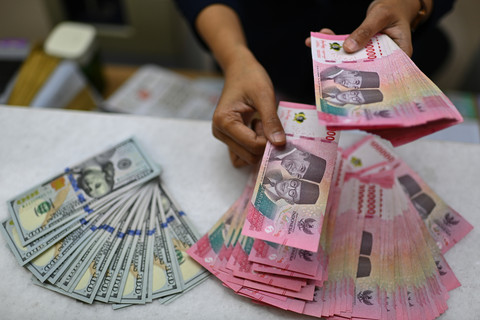
The Indonesian rupiah continues to face significant depreciation against the United States (US) dollar, recently touching Rp 17,905 per US dollar on Thursday afternoon (May 28). This figure starkly contrasts with the government’s 2026 State Budget (APBN) basic assumption, which pegs the rupiah’s exchange rate at approximately Rp 16,500 per US dollar.
Initially, Yusuf Rendy Manilet, an economist at the Center of Reform on Economics (CORE), had projected that the rupiah might approach the APBN’s assumed level by the end of the year. However, recent market volatility has led to a much deeper weakening of the currency than anticipated, severely limiting its recovery potential. “The current pressure is far more profound than our initial forecasts, consequently narrowing the scope for recovery,” Yusuf told kumparan on Thursday (May 28).
Several factors, according to Yusuf, could help the rupiah regain strength. Foremost among these is the US Federal Reserve’s (The Fed) interest rate policy. He explained that the US dollar has maintained its strength primarily because the US central bank continues to uphold high interest rates. Should clearer signals of interest rate cuts emerge in the second half of this year, the pressure on emerging market currencies, including the rupiah, could begin to subside.
Another critical factor is the movement of global oil prices. Yusuf noted that the recent rupiah depreciation has been exacerbated by rising oil prices, fueled by geopolitical tensions in the Middle East. When oil prices climb, Indonesia’s energy import requirements increase, subsequently boosting demand for the US dollar. “If geopolitical tensions ease and oil prices decline, the pressure on the rupiah could also lessen,” Yusuf added.
Furthermore, Yusuf highlighted that a renewed inflow of foreign capital into the domestic bond market is crucial. While the government has observed foreign funds beginning to return, the flow is not yet robust. Concurrently, Bank Indonesia (BI) and the government are reportedly implementing measured interventions through the bond market, managing export foreign exchange proceeds, and undertaking various other stabilization measures to prevent an overly sharp depreciation of the rupiah.
Despite these efforts, Yusuf believes that the likelihood of the rupiah returning below Rp 17,000 per US dollar currently remains challenging. He stressed that the most significant pressure stems from external factors largely beyond the government’s control. “The market still anticipates that the Fed will maintain high interest rates for an extended period. As long as the interest rate differential between Indonesia and the US is not sufficiently attractive, global investors will prefer to allocate their funds to US dollar-denominated assets,” Yusuf elaborated. He also pointed to seasonal factors in the second half of the year, such as dividend payments and the repatriation of foreign company profits, which tend to increase domestic dollar demand, adding further pressure on the rupiah.
Domestically, structural challenges also persist. Yusuf noted that when consumption and investment increase, imports typically grow faster than exports. This situation can widen the current account deficit and elevate the demand for foreign currency. “Consequently, Bank Indonesia’s room to lower interest rates becomes limited. If interest rates are cut too quickly amid exchange rate pressures, the risk of foreign capital outflow could actually intensify,” he explained. He also underscored the importance of market confidence in the government’s fiscal policy. According to Yusuf, as long as budget discipline is maintained and the State Budget deficit is confidently kept below 3 percent of the Gross Domestic Product (GDP), pressure on the rupiah typically remains more controlled. “Conversely, if doubts arise regarding fiscal management or the consistency of economic policies, the market could react negatively, triggering capital outflows. In such a scenario, government communication becomes paramount,” Yusuf asserted.
On the other hand, Myrdal Gunarto, an IRRD Economist at Bank Tabungan Negara (BTN), projects that if the rupiah continues to face severe pressure this year, its exchange rate could settle around Rp 17,602 per US dollar. “The persistent high oil prices appear to make investors reluctant to keep their investment assets for long in emerging markets that are net oil importers,” Myrdal explained to kumparan.
Nonetheless, Myrdal believes the rupiah still has a chance to strengthen back to the Rp 16,500 to Rp 16,900 range, aligning with the APBN’s assumption, provided certain conditions are met. A primary requirement is an abundant supply of domestic foreign exchange, particularly through the inflow of non-oil and gas natural resource export proceeds into domestic foreign currency liquidity. He suggested that 100 percent of non-oil and gas natural resource export earnings should ideally be converted into rupiah domestically. “It would be even better if the export proceeds from other goods, like manufactured products or other non-manufacturing commodities, also contribute,” Myrdal added.
He continued by stating that another crucial condition is for Indonesia’s exports to consistently record substantial surpluses. Myrdal emphasized that a strong trade surplus must be reinforced by solid domestic socio-political stability. Under such conditions, foreign direct investment (FDI) is likely to flow into Indonesia in significant amounts. “If the inflow is substantial, for instance, more than USD 4 billion net FDI per quarter, it could enable the rupiah to strengthen back to those levels,” Myrdal elaborated.
Beyond trade and investment, Myrdal also believes the tourism sector can significantly contribute to rupiah appreciation. He suggested that the government and relevant institutions should bolster the promotion of Indonesian tourism, highlighting the nation’s safe socio-political environment to attract more foreign tourists and encourage their spending within the country. “This is what will allow the rupiah to strengthen to the Rp 16,500 to Rp 16,900 level. But these are the prerequisites,” Myrdal concluded.
Summary
The rupiah exchange rate is experiencing significant depreciation, hitting Rp
